Long before Giuseppe Garibaldi became the celebrated “Hero of Two Worlds” and the sword of Italian unification, he was a fugitive — a young revolutionary condemned in absentia to death by the Kingdom of Sardinia, forced to flee across an ocean to a continent where wars of liberation were already reshaping the map.
What followed were nearly 14 years of adventure, hardship, and battle in South America and the United States that forged him into the legendary commander he would become.
Flight to the New World
In 1834, Garibaldi’s involvement in a failed Mazzinian uprising in Piedmont sealed his fate in Italy. He escaped to South America, arriving in Brazil in 1836 at the age of 28. Rather than living quietly in exile, he threw himself almost immediately into the turbulent politics of the continent.
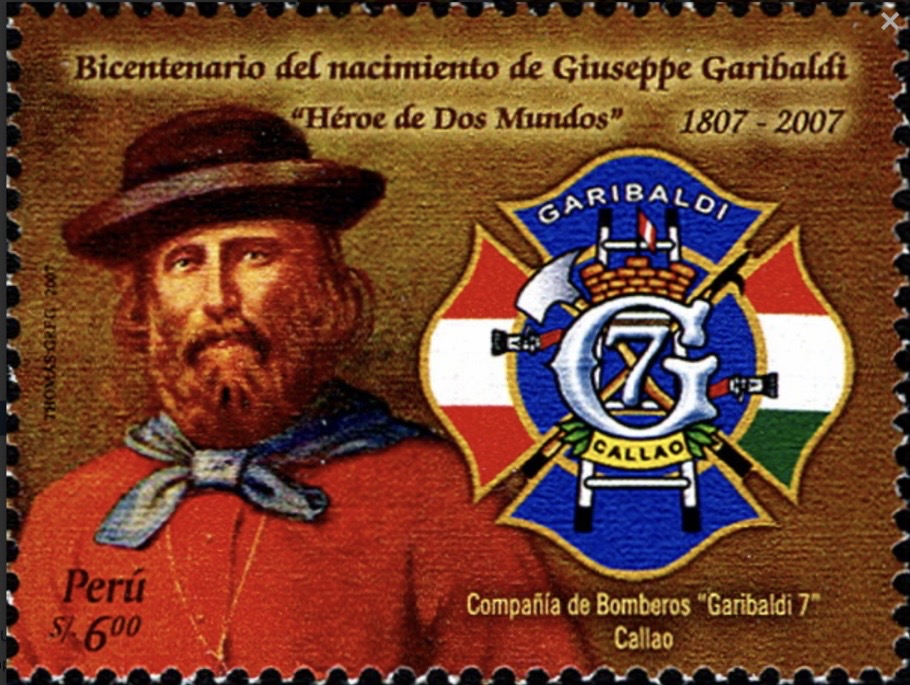
This Peruvian stamp from 2007 honors both Garibaldi and the volunteer firefighter company in the city of Callao. It originally was composed of Italian immigrants.
The Rio Grande do Sul region of southern Brazil was in open revolt against the imperial government in Rio de Janeiro — a rebellion known as the Ragamuffin War, or Guerra dos Farrapos. Garibaldi joined the rebel cause, commanding a small fleet on the lagoons and estuaries of the south.
It was rough, improvised warfare — raiding supply lines, evading imperial naval forces, keeping a rebellion alive against considerable odds. He was captured at least once, tortured, and escaped. These years taught him the guerrilla instincts and audacious improvisation that would later stun Europe.
Uruguay and the Defence of Montevideo
In 1841, Garibaldi made his way to Montevideo, Uruguay, where finally married Ana Maria de Jesus Ribeiro — the fearless Anita, who had already ridden and fought alongside him in Brazil. Uruguay was soon embroiled in its own conflict, the long and brutal Guerra Grande, pitting Montevideo against the forces of the Argentine dictator Juan Manuel de Rosas and his Uruguayan ally Manuel Oribe.
Garibaldi organized and commanded the Italian Legion, a volunteer force of Italian exiles who fought in defense of Montevideo. It was here that the famous red shirts first appeared — a practical choice born of necessity, as the only available fabric in bulk happened to be red wool intended for the slaughterhouses of Argentina.
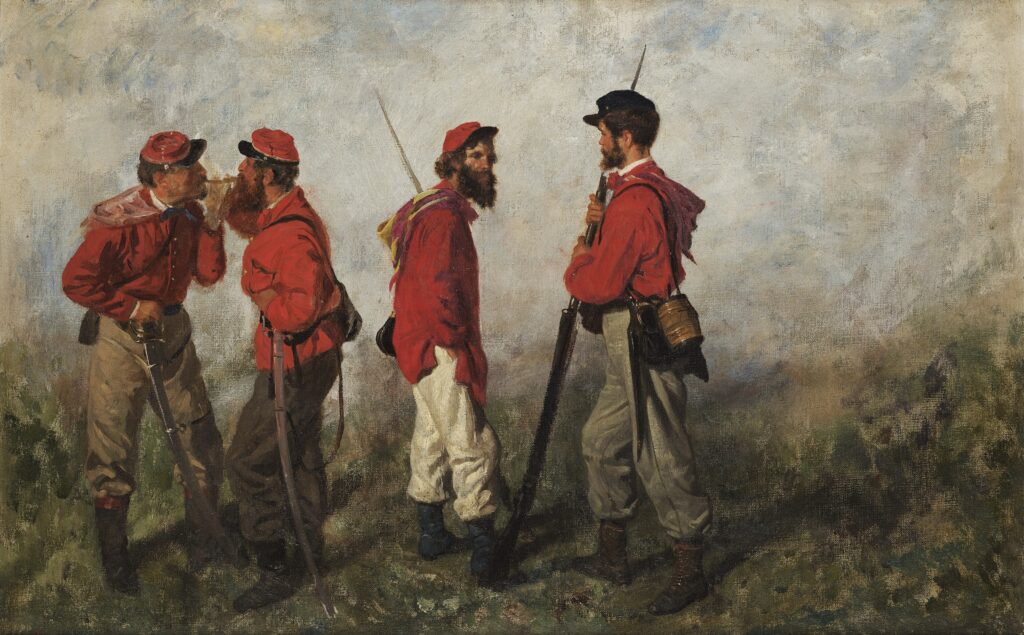
Filippo Palizzi – Un gruppo di garibaldini (1860)
The image would follow Garibaldi to Italy and into history. The Italian Legion fought with remarkable tenacity, and Garibaldi’s defence of Montevideo earned him an international reputation. Newspapers in Europe, particularly in France and Britain, began reporting his exploits. The liberal and revolutionary circles of the Old World took notice of the Italian commander holding a city against a tyrant.
Brief Time in New York
In 1850, after the devastating collapse of the Roman Republic — which Garibaldi had returned to Italy to defend — he was once again an exile. He made his way back to the Americas, this time to New York City, where he stayed for a time on Staten Island, working in a candle factory owned by a fellow Italian.
It was a humbling interlude for a man who had commanded armies, but Garibaldi bore it with characteristic stoicism. He later captained merchant vessels trading along the Pacific and Atlantic coasts before finally returning to Italy in 1854.
The Americas as Crucible
Garibaldi’s years in the Americas were not a detour from his destiny — they were its foundation. In the lagoons of Brazil, the streets of Montevideo, and the wharves of New York, he learned to lead men who had nothing to lose, to improvise under fire, and to inspire loyalty through personal example rather than rank or privilege.
When he landed in Sicily in 1860 with his Thousand red-shirted volunteers and began the campaign that would unify Italy, he was drawing on every hard lesson the New World had taught him.
The Americas did not merely shelter a revolutionary in exile. They made him.
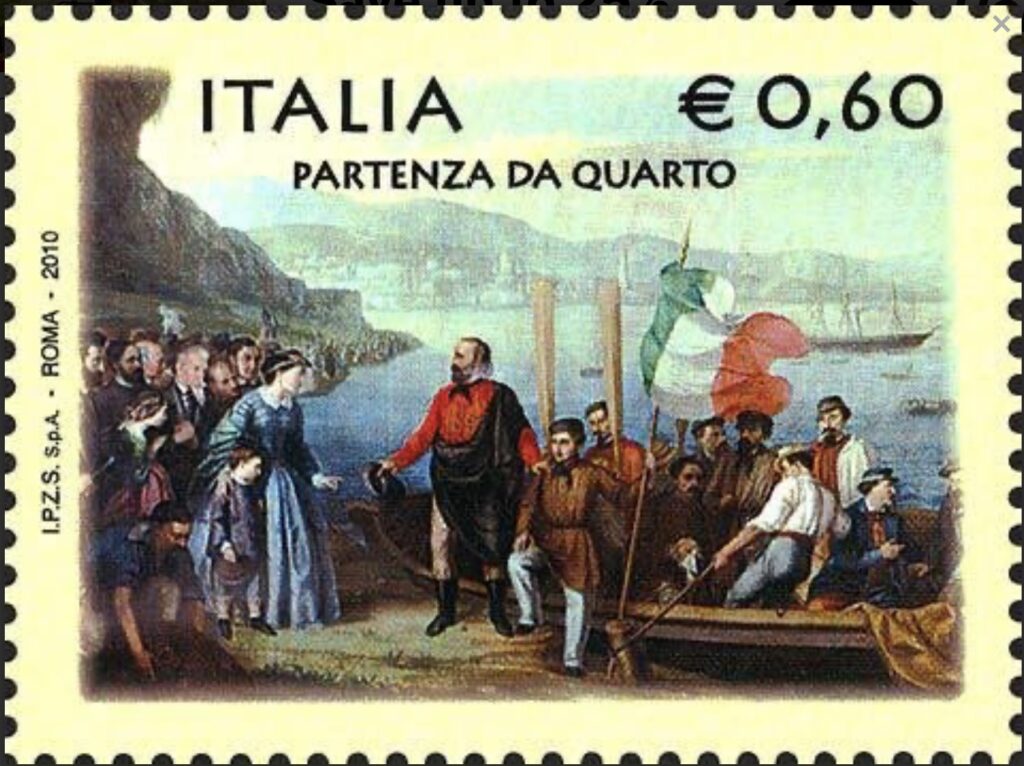
Garibaldi departing from Quarto Rock, near Genoa, on his way to do battle in Sicily. This stamp was issued by Italian in 2010. A monochrome stamp featuring the rock was issued in 1932, the 50th anniversary of his death, and was overprinted for many of the colonies.