The war of 1898 lasted only a few months, but it forged the United States into a global naval power — and made legends, and feuds, out of the men who fought it.
In the spring of 1898, the United States went to war with Spain over Cuba and, as it turned out, much of the remaining Spanish empire. The conflict was brief — just four months from declaration to armistice — but its naval chapters were dramatic, decisive, and, in one celebrated case, bitterly contested for years afterward.
Three admirals dominated the naval story: George Dewey, who struck the first blow half a world away in the Philippines; William T. Sampson, the meticulous commander who organized the blockade of Cuba; and Winfield Scott Schley, the fighting commodore who was physically present when the Spanish Caribbean fleet was destroyed.
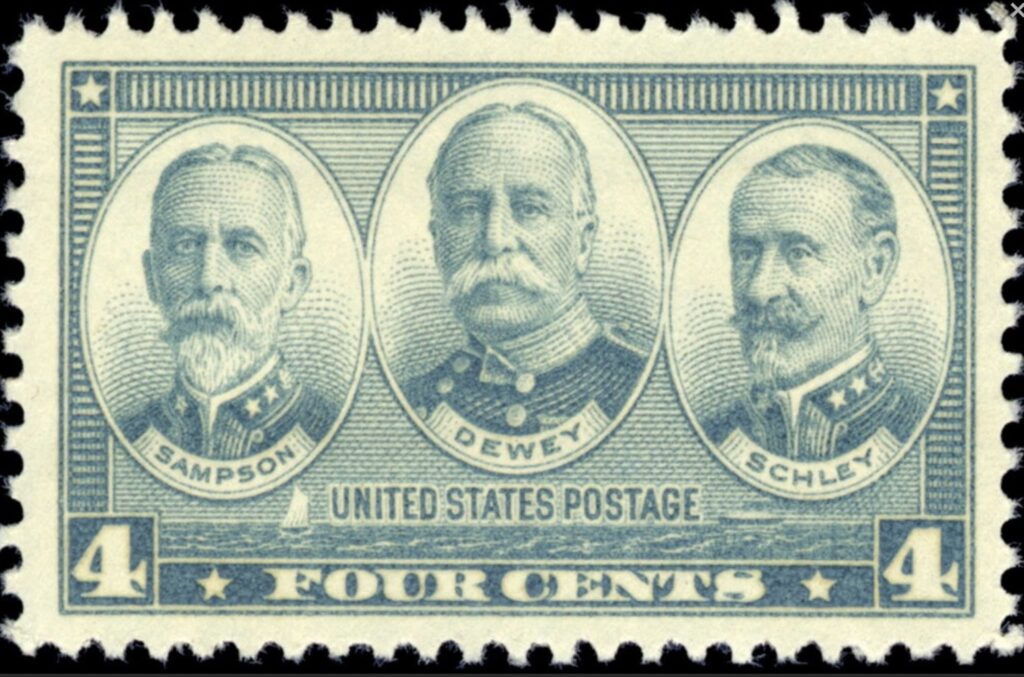
This is the fourth of five stamps the Post Office issued in 1937 honoring admirals in the U.S. Navy. Earlier, it had issued five stamps featuring historic Army leaders.
Together, their careers reveal both the glory and the complicated human politics of command in wartime.
George Dewey: “You May Fire When You Are Ready, Gridley”
Of the three, George Dewey stands apart. His victory was the swiftest, most complete, and least controversial — a textbook strike that made him the most celebrated naval hero in America since the Civil War.
Dewey was born in Montpelier, Vermont, in 1837 and graduated from the U.S. Naval Academy in 1858. He served with distinction in the Union Navy during the Civil War, fighting at the Battle of New Orleans and at Port Hudson, Louisiana.
By 1896 he had risen to the rank of commodore, and in 1897 — at his own request — he was assigned command of the Asiatic Squadron, then based in Hong Kong. The appointment, pushed through in part by the energetic Assistant Secretary of the Navy Theodore Roosevelt, would prove fateful.
As war loomed in early 1898, Dewey prepared methodically. He drilled his crews, stripped his ships of unnecessary woodwork that could feed fires, and secured intelligence from the U.S. consul in Manila about the state of Spanish defenses in the Philippines.
On April 24, with war officially declared, he received orders from Secretary of the Navy John D. Long: “proceed to the Philippine Islands; commence operations at once against the Spanish fleet; capture vessels or destroy.”
Dewey obeyed with startling speed. On the night of April 30, he led his squadron — the cruisers Olympia, Baltimore, Raleigh, Boston, the gunboats Concord and Petrel — through the darkness into Manila Bay, slipping past coastal batteries and ineffective mines.
At dawn on May 1, 1898, with the Spanish Pacific Squadron under Admiral Patricio Montojo anchored near Cavite, Dewey turned to the captain of his flagship and gave his famous order: “You may fire when you are ready, Gridley.”
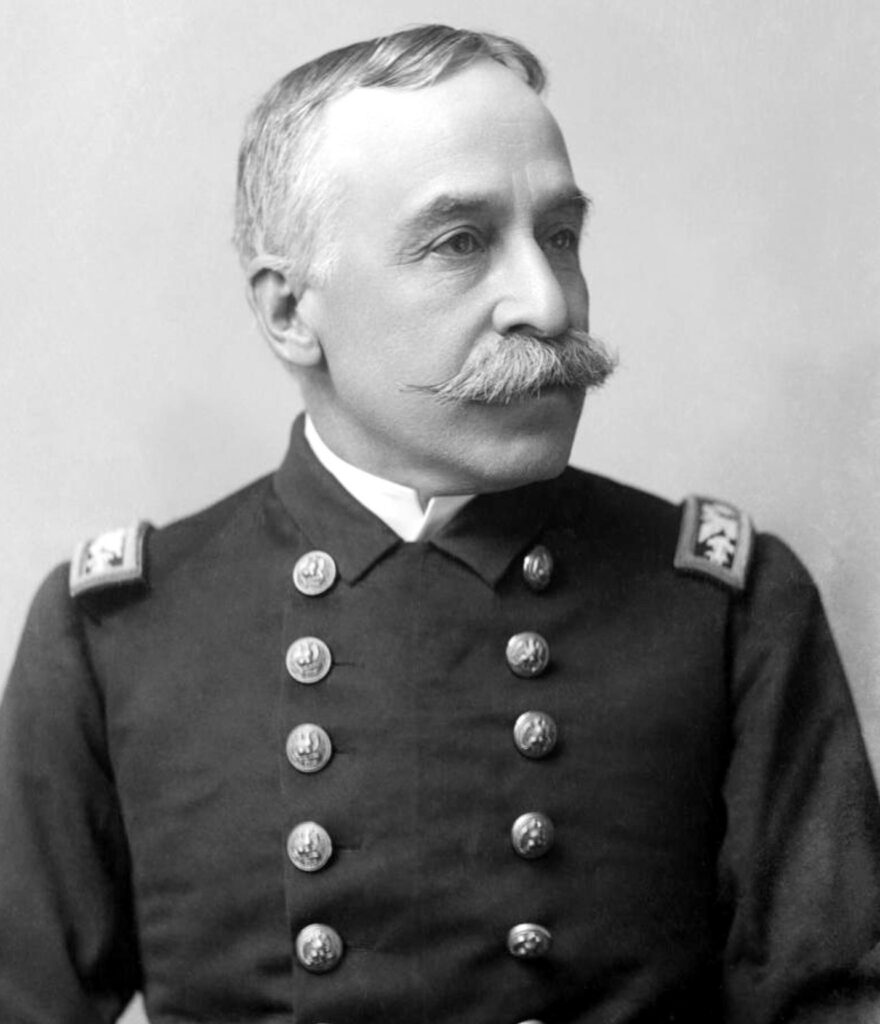
The battle lasted barely six hours. The American squadron made repeated east-to-west passes along the Spanish line, and by mid-morning the Spanish fleet was shattered — every vessel sunk or destroyed, with Spanish casualties estimated at more than 370 killed and wounded.
On the American side, not a single man was killed in combat. It was, as the Naval History and Heritage Command would later note, one of the most one-sided naval victories in history.
The country erupted in celebration. Dewey was promoted to rear admiral immediately, then to full admiral the following year, and eventually Congress created for him the unique rank of Admiral of the Navy — a title held by no one before or since.
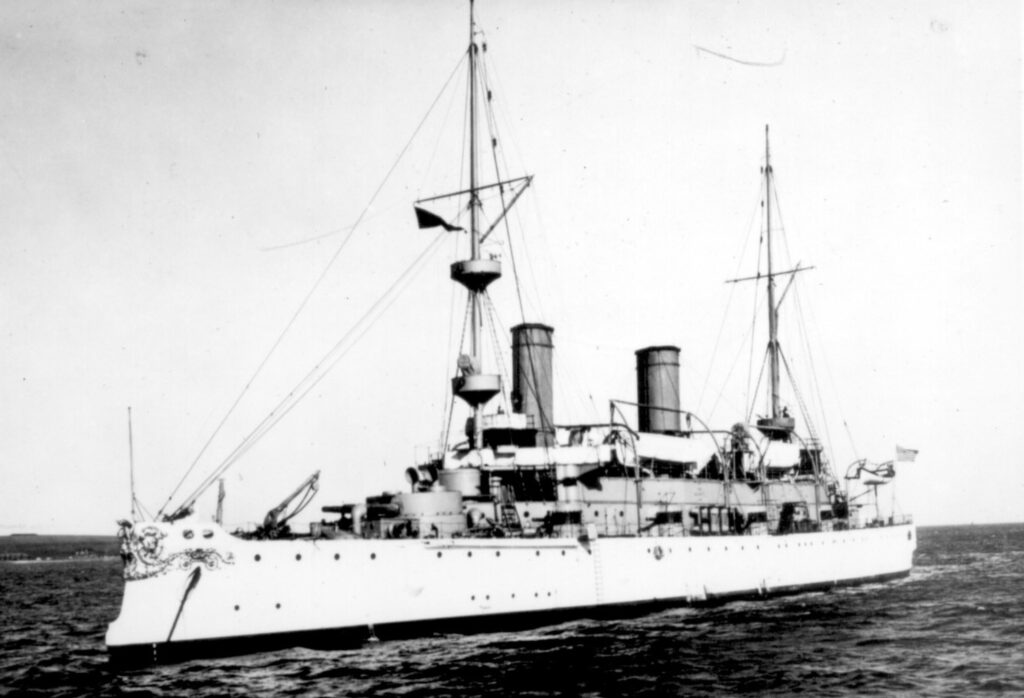
USS Olympia, Admiral George Dewey’s flagship at the Battle of Manila Bay. Today, she is a museum in Philadelphia, where she was decommissioned in 1922. She is the sole floating survivor of the U.S. Navy’s Spanish–American War fleet.
He was so popular that he briefly entertained a run for the presidency in 1900. Until his death in January 1917, he served as president of the General Board of the Navy, helping guide the service’s expansion into a world-class force.
William T. Sampson: The Strategist Who Was Absent at the Climax
If Dewey’s story is one of unclouded triumph, William T. Sampson‘s is more complicated — a tale of careful, indispensable preparation overshadowed by a single moment of bad timing.
Sampson was known throughout the Navy as a technical expert, particularly in gunnery and ship design. He had helped modernize the fleet and was appointed commander of the North Atlantic Squadron at the outset of the Spanish-American War.
His task was arguably harder than Dewey’s: bottling up the Spanish Caribbean fleet under Admiral Pascual Cervera y Topete, who had sailed from the Cape Verde Islands and eventually slipped into the harbor at Santiago de Cuba, Cuba, on May 19, 1898.
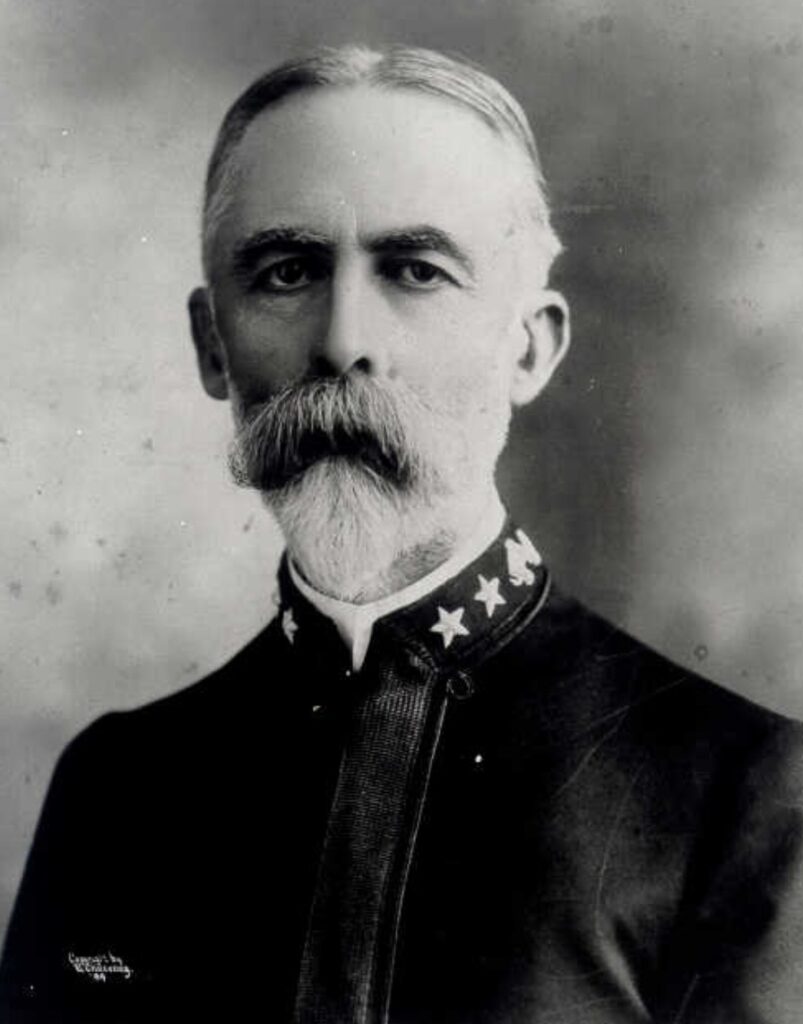
Sampson organized an effective round-the-clock blockade of Santiago Bay that lasted over a month, positioning his ships in a crescent across the harbor entrance. He drew up detailed battle plans, coordinated with the U.S. Army as it besieged Santiago from the landward side, and kept the pressure on Cervera until the Spanish admiral had no choice but to sortie and fight.
The problem was that when the moment came — July 3, 1898 — Sampson wasn’t there.
That morning, he had departed aboard his flagship New York for a meeting with Army General William Shafter several miles away. He had not named an interim commander. At 9:35 a.m., Cervera’s fleet came boiling out of Santiago harbor, guns blazing, and the battle was joined without him.
Sampson turned back at once, but by the time New York arrived, it was essentially over. His ship managed to fire only a few shots at a rapidly disintegrating enemy.
Sampson’s subsequent telegram to the Navy Department announced the victory but made no mention of his subordinates. The omission, combined with his physical absence from the fighting, proved devastating to his legacy and ignited one of the most bitter controversies in American naval history.
Winfield Scott Schley: The Hero the Public Chose
Commodore Winfield Scott Schley was the man on the spot. Born near Frederick, Maryland, in 1839 and a graduate of the Naval Academy in 1860, he was already something of a national figure before the war: in 1884 he had led a daring rescue of the survivors of the Greely Arctic Expedition, earning widespread admiration.
In 1898 he commanded the “Flying Squadron,” a fast force initially tasked with defending the Atlantic coast. When Cervera’s fleet was located at Santiago, Schley joined the blockade.
His pre-battle conduct was not without criticism — he delayed getting into position off Santiago for several days, a hesitation the subsequent Court of Inquiry would censure — but when the fight came, he was in the thick of it.
On July 3, with Sampson absent, Schley was the ranking officer present. His flagship, USS Brooklyn, was heavily engaged throughout the battle. Spanish losses were total: all six of Cervera’s ships were sunk or run aground. The public, hungry for a hero and following sensationalist newspaper coverage, largely gave Schley the credit. The Baltimore American declared him “the real hero” of the war.
The controversy raged for years. Sampson’s telegram, Schley’s delayed approach to Santiago, competing promotions on the Navy List — all became fodder for an ugly national argument.
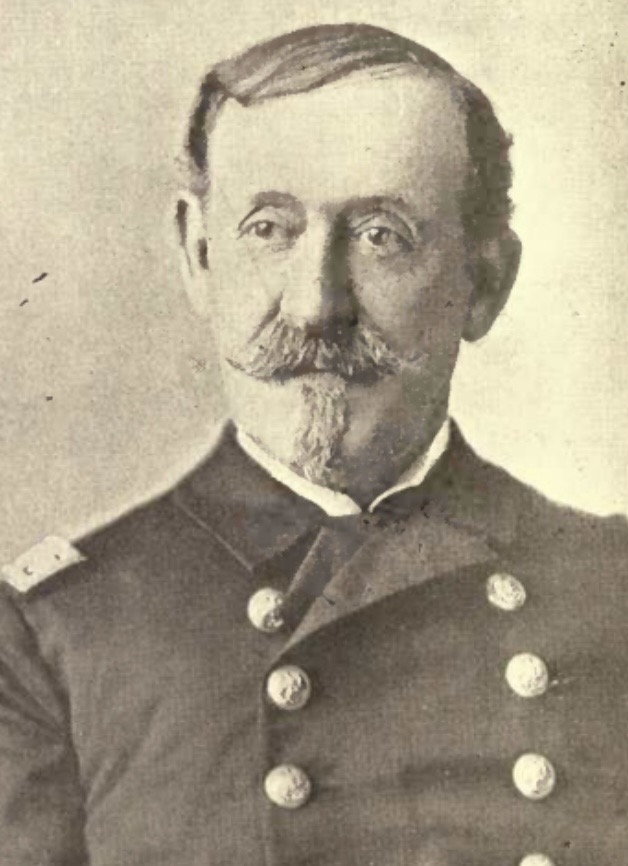
In 1901 Schley himself requested a Court of Inquiry. The majority report was mixed: it praised his conduct during the battle but criticized his earlier decisions. Then Admiral George Dewey, who presided over the court, filed a minority opinion supporting Schley and crediting him with the victory.
President Theodore Roosevelt ultimately stepped in, declaring Santiago a “captains’ battle” in which Sampson technically commanded but neither admiral could claim exclusive credit.
Legacy
The three admirals of 1898 together transformed the United States into a recognized naval power. Dewey’s devastating strike at Manila Bay ended four centuries of Spanish rule in the Philippines and announced American power in the Pacific.
Sampson’s careful blockade and strategic planning bottled up Spain’s last effective fleet in the Caribbean. Schley’s ships carried out the execution that sealed the war’s outcome.
Dewey alone emerged with an unblemished reputation. Sampson died in 1902, his health broken, without ever fully resolving the controversy. Schley retired in 1901 and died in 1911, still celebrated by his supporters.
Together, their stories capture the full spectrum of military life: brilliant execution, meticulous planning, disputed glory, and the unpredictable role of timing in making or breaking a man’s place in history.