For 15 months, Western pilots flew round the clock to feed a blockaded city — and stared down the Soviet Union without firing a shot.
On the night of June 23, 1948, Soviet forces cut every road, rail, and canal link to West Berlin. The move was calculated: nearly two million civilians, deep inside Soviet-controlled East Germany, would be strangled into submission. Joseph Stalin believed the Western powers — the United States, Britain, and France — would have no choice but to abandon the city or surrender it on his terms.
He was wrong.
What followed was one of the most audacious logistical feats in modern history: a continuous aerial supply operation that lasted 462 days, defeated the blockade without a single armed confrontation, and announced to the world that the Western democracies would not be bullied out of their commitments.
A city held hostage
Berlin in 1948 was a divided city sitting in the middle of a divided country. Germany had been split into four occupation zones after World War II, and Berlin itself — though located 110 miles inside the Soviet zone — was similarly carved up among the four Allied powers. The arrangement had always been uneasy, and tensions had been building for months over disagreements about German currency reform and the shape of postwar Europe.
When the Soviets imposed the blockade, West Berlin had roughly 36 days of food and 45 days of coal in reserve. City residents still bore fresh memories of the war’s destruction; now they faced a new kind of siege. Many expected the West to fold.
Operation Vittles takes flight
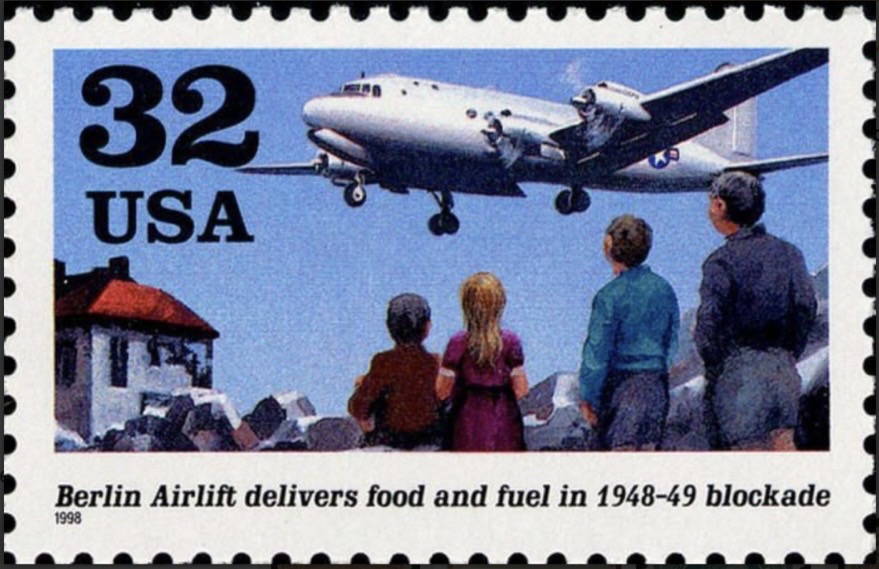
American and British planners moved quickly. Within days of the blockade, transport aircraft — primarily C-47 Skytrains and later the heavier C-54 Skymasters — began flying supplies into the city’s Tempelhof Airport. The British organized their own parallel effort, Operation Plainfare, and a new airport at Tegel was constructed in just 90 days to handle the increasing volume.
At its peak the operation was landing a fully loaded aircraft in Berlin every 90 seconds. Pilots flew in strict corridors to avoid provoking Soviet fighters, navigating fog, ice, and mechanical fatigue. Ground crews worked through the night to turn planes around in under 30 minutes. The operation became a masterclass in industrial-scale coordination, and it kept growing — delivering not just food and fuel but also machinery, medicine, and the newsprint Berliners needed to keep their free press alive.
There were moments of dark levity too. American pilot Gail Halvorsen noticed children watching through a fence at Tempelhof and began dropping small parachutes of candy from his plane. The gesture went viral before the word existed — “Uncle Wiggly Wings” and “The Candy Bomber” became international news, and dozens of American pilots joined in, dropping sweets to thousands of Berlin children.
The blockade breaks
By spring 1949 it was clear the blockade had failed. Far from demoralizing West Berliners, it had forged a fierce loyalty to the Western cause. Stalin found himself in the awkward position of having blockaded a city that was being supplied more reliably by air than it had been by road. On May 12, 1949 — without ceremony or negotiation — Soviet forces quietly lifted all restrictions.
The airlift continued for several months afterward, building up reserves in case of another attempt. It finally concluded in September 1949, having delivered over 2.3 million tons of supplies across more than 277,000 flights. The human cost was real: 101 people, including 40 British and 31 American crew members, died in accidents during the operation.
Why it still matters
The Berlin Airlift was the first major confrontation of the Cold War, and it set crucial precedents. It demonstrated that the West could sustain a collective commitment under pressure. It showed that Soviet aggression could be countered with patience and ingenuity rather than force. And it made West Berlin a symbol — a living argument, right on the front line, that liberal democracy was worth defending.
The operation also had lasting geopolitical consequences. It accelerated the formation of NATO in April 1949 and hardened the division of Germany into two states. The Federal Republic of Germany was formally established just weeks after the blockade ended, with West Berlin as its most visible outpost behind the Iron Curtain.
Decades later, when the Berlin Wall finally fell in November 1989, the people who poured through its checkpoints were the grandchildren of the children who had once gathered at Tempelhof to catch falling candy from the sky. The wall fell peacefully, too — perhaps because the precedent had been set long before that freedom, in Berlin, was worth an extraordinary effort.