By any measure, the life of Ana Maria de Jesus Ribeiro — known to history as Anita Garibaldi — reads like something conjured from the pages of a 19th-century adventure novel.
Born in 1821 in the Brazilian state of Santa Catarina, she would go on to become one of the most remarkable revolutionary figures of her era: a skilled horsewoman, a fighter in multiple wars of independence, and the inseparable companion of the legendary Italian nationalist Giuseppe Garibaldi.
That her name is not as universally known as his speaks more to history’s long habit of sidelining women than to any deficit in her achievements.
A Meeting That Changed Everything
Anita first encountered Giuseppe Garibaldi in 1839 in the port town of Laguna, Brazil, where he had come to fight in support of the Farroupilha (or Ragamuffin) Revolution — a separatist uprising in the south of the country. She was eighteen, unhappily married to a cobbler named Manuel Duarte de Aguiar.
Giuseppe, already a seasoned revolutionary, is said to have spotted her through his telescope from the deck of his ship and declared, simply, “You must be mine.” The story may be embellished, but what followed was entirely real.
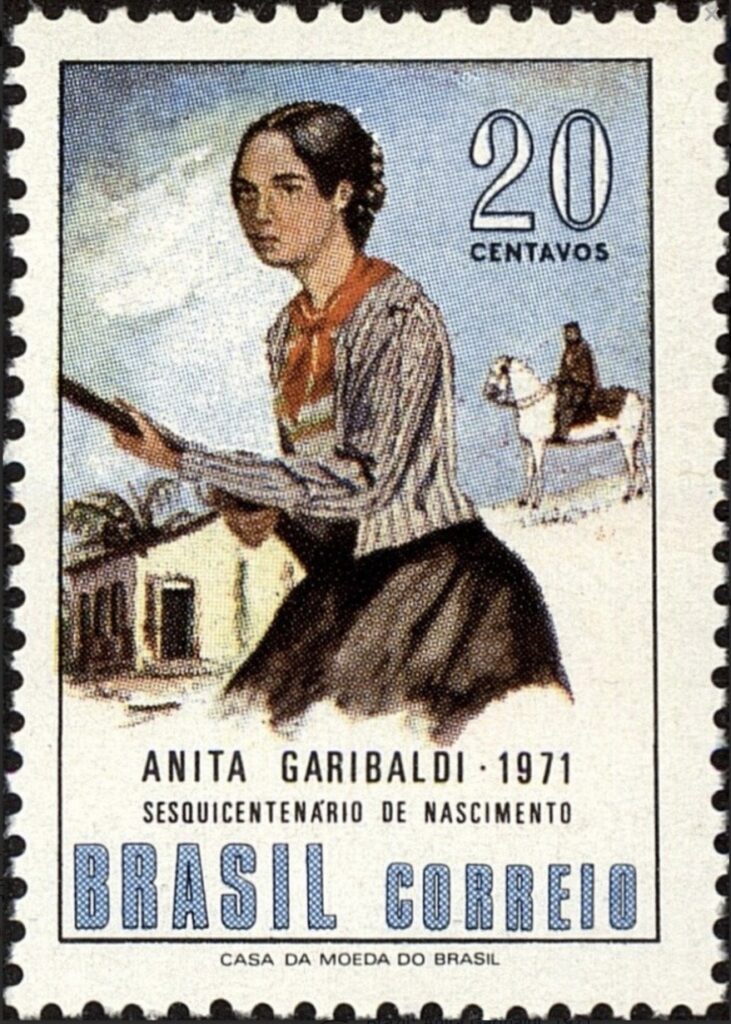
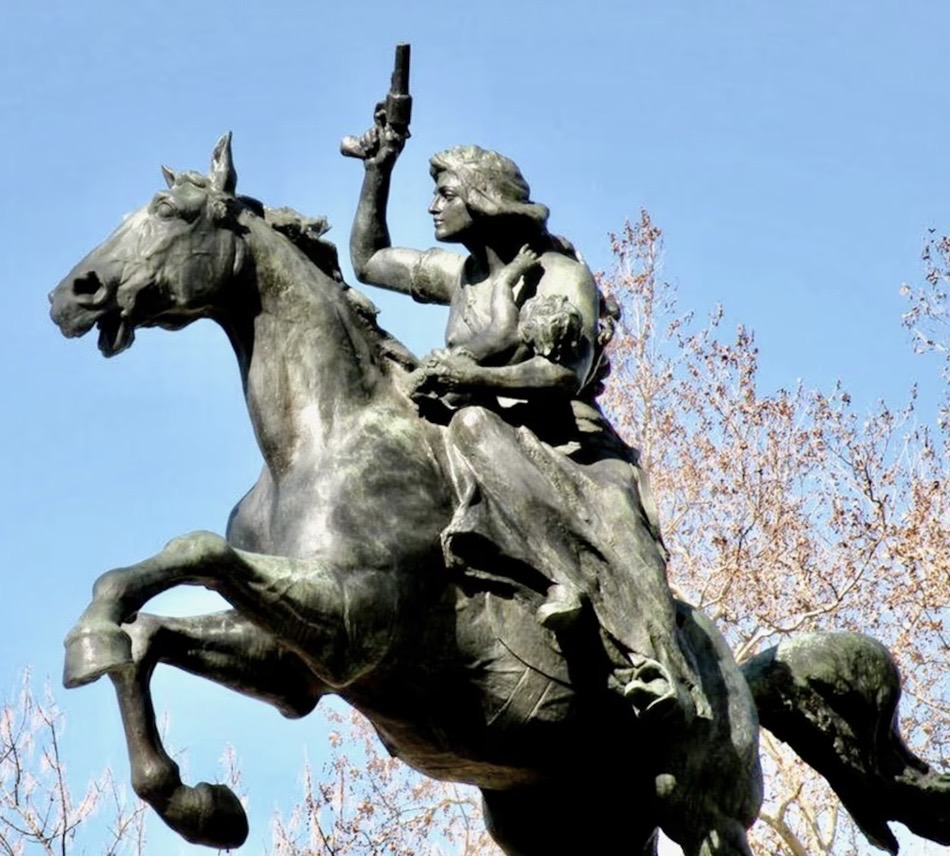
Anita Garibaldi is honored in both the Old World and the New for her willingness to fight alongside her husband.
Statues of her abound, on horseback and often with a baby in one arm and a gun in the other hand, like this one in Rome.
Anita left her husband and joined Garibaldi’s cause without hesitation. She did not merely follow him — she fought beside him. Within months of their meeting, she was riding into battle, rifle in hand.
At the Battle of Curitibanos in 1839, she was captured by imperial forces, witnessed the execution of fellow rebels, and managed to escape on horseback while pregnant. It was the kind of act that would define her reputation: fearless, resourceful, and utterly committed.
Life in the Saddle
The years that followed were ones of constant movement and hardship. Anita and Giuseppe had four children together, though she endured the chaos of revolutionary life throughout — nursing infants in makeshift camps, crossing treacherous terrain, and continuing to participate in the fighting wherever she could. She was reportedly an exceptional horsewoman, more at home on the battlefield than in the domestic sphere her era prescribed for women.
In 1841, after the collapse of the Farroupilha Revolution, the couple made their way to Montevideo, Uruguay, where Garibaldi continued his revolutionary activities and Anita raised their growing family. She married him in 1842, following news that her first husband had died. They lived modestly but purposefully, always at the edges of conflict, always preparing for the next campaign.
Return to Europe — and the Final Campaign
In 1848, the revolutionary tide sweeping across Europe drew Giuseppe back to Italy. Anita joined him, leaving their children in the care of his mother in Nice. The two fought side by side in the campaigns of the Risorgimento — the movement for Italian unification — and Anita became a celebrated figure among the insurgents.
When Rome fell to French forces in 1849 and the couple was forced into a desperate retreat across the peninsula, it was a heavily pregnant and gravely ill Anita who rode alongside her husband through swamps and enemy lines.
She died on August 4, 1849, near Comacchio, in northern Italy, almost certainly from typhoid fever — possibly aggravated by malaria and exhaustion. She was twenty-eight years old. Giuseppe, heartbroken, was forced to flee and leave her body behind. She was found by local farmers and buried in a shallow grave before eventually receiving a proper memorial.
A Legacy Worth Remembering
Today, Anita Garibaldi is celebrated as a national heroine in both Brazil and Italy. Statues of her — characteristically depicted on horseback, baby in one arm, rifle in the other — stand in Rio de Janeiro and Rome. Her story has inspired novels, films, and countless retellings, though she remains far less famous internationally than she deserves.
What makes Anita Garibaldi so compelling is not simply that she was brave — history has many brave figures — but that she chose her life with such clarity. She walked away from convention, from safety, from the limited future her world offered women, and rode toward something larger.
She fought not for glory but for conviction, and she did so on equal terms with the men around her, in an age that rarely allowed women any terms at all.
In an era of extraordinary revolutionaries, Anita Garibaldi stands out — not as a footnote to her husband’s story, but as a protagonist in her own right.
1 thought on “Anita Garibaldi: The Woman Who Rode Into History”