Origins and Background
The Mexican-American War was one of the most consequential — and controversial — conflicts in American history. To understand it, you have to go back a decade before the first shot was fired, to the turbulent politics of Texas.
In 1836, American settlers in the Mexican province of Texas revolted and declared independence, establishing the short-lived Republic of Texas. Mexico never recognized Texan independence and considered the territory its own. For nearly a decade, Texas existed in a kind of political limbo — independent in name, but diplomatically uncertain. Then, in 1845, the United States formally annexed Texas as its 28th state, a move Mexico regarded as an outright act of aggression.
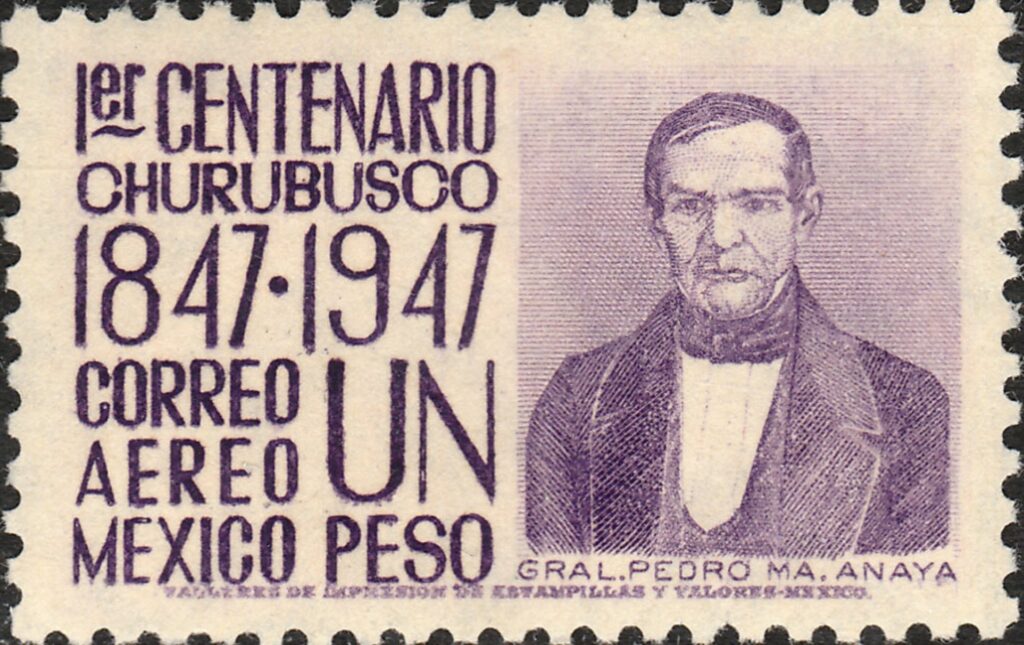
A conflict completely ignored by U.S. postage stamps, this war has been recalled several times by Mexico, including and extensive series in 1947, the centennial of the fighting. Pedro Maria de Anaya served twice, both times briefly, as president of Mexico, and distinguished himself during the battle of Churubusco.
The dispute didn’t end there. The two nations also disagreed sharply about where Texas actually ended. The United States insisted the southern boundary was the Rio Grande. Mexico maintained it was the Nueces River, roughly 150 miles to the north — a strip of land that, while modest in size, would become the spark that ignited the war.
“American Blood on American Soil”
President James K. Polk, a Tennessee Democrat and fierce champion of westward expansion, was determined to provoke a confrontation. In early 1846, he ordered General Zachary Taylor to march U.S. troops into the disputed zone between the two rivers — territory that Mexico considered its own. Mexican forces crossed the Rio Grande and attacked a U.S. patrol, killing or wounding sixteen soldiers.
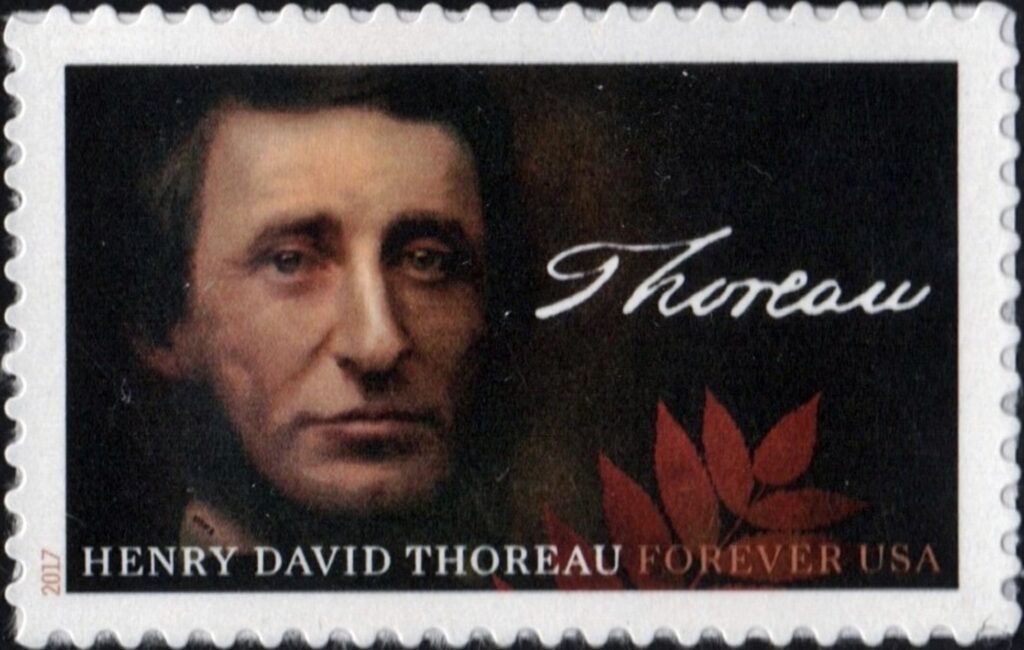
Many in the United States were opposed to the Mexican War, including Henry David Thoreau. It was one of the reasons he wrote “Civil Disobedience,” which continues to shape world politics.
Polk seized on the incident immediately. Appearing before Congress in May 1846, he declared that Mexico had “shed American blood upon American soil” and that a state of war existed. Congress voted to declare war within days. The vote was not unanimous, however. Critics, including a young Illinois congressman named Abraham Lincoln, questioned the premise of Polk’s message, demanding to know the exact “spot” where blood had been shed and whether it was truly American territory. The war had powerful opponents from the start, including the writer Henry David Thoreau, whose famous essay Civil Disobedience grew directly out of his refusal to pay taxes in protest of the conflict.
The Campaign
Despite the political controversy at home, the U.S. military performed with striking efficiency. The war unfolded across three major theaters.
In the north, General Zachary Taylor won a series of victories at Palo Alto, Resaca de la Palma, and Monterrey, establishing himself as a national hero. His easygoing manner and battlefield courage earned him the nickname “Old Rough and Ready,” and his wartime fame would eventually carry him to the presidency in 1848.
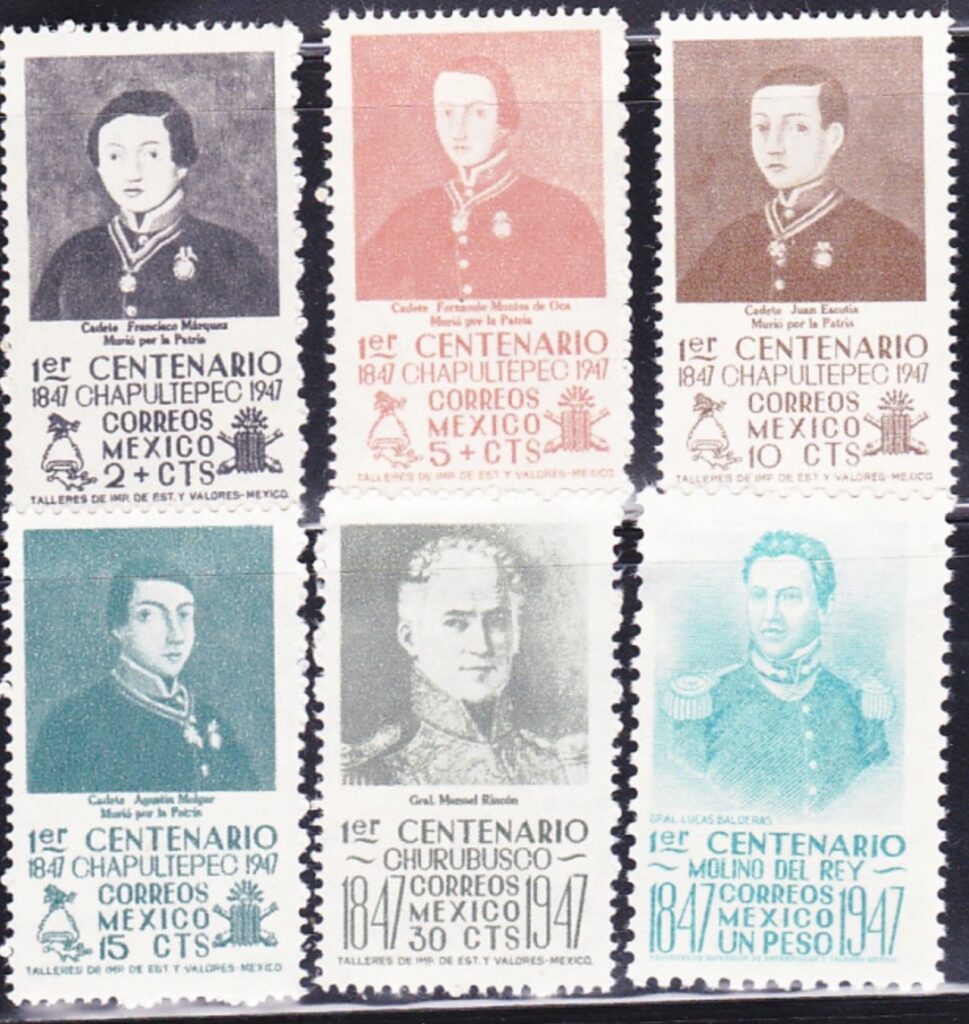
Four of these stamps portray cadets at Mexico’s military academy, at Chapultepec, who draped themselves in the flag and flung themselves at the attackers below. Chapultepec is immortalized in the Marine Corps hymn as “the halls of Montezuma.”
Meanwhile, General Stephen Kearny led a smaller force westward, seizing the lightly defended New Mexico Territory and pushing on to California, where American settlers had already launched the short-lived “Bear Flag Revolt.” California fell to U.S. forces with relatively little resistance.
The decisive blow came in the south. General Winfield Scott landed at Veracruz in March 1847, conducting the first large-scale amphibious assault in U.S. history. His army then marched inland along the same route Hernán Cortés had taken three centuries earlier.
After a series of hard-fought battles — including Cerro Gordo, Churubusco, and Molino del Rey — Scott’s forces reached the gates of Mexico City. The final engagement came at Chapultepec, a fortified hilltop castle that served as Mexico’s military academy. Young Mexican cadets, some still teenagers, fought to the last in its defense. They are remembered in Mexico today as the Niños Héroes — the Boy Heroes. On September 14, 1847, American troops raised the flag over Mexico City’s central plaza.
The Treaty of Guadalupe Hidalgo
With its capital occupied and its army shattered, Mexico had little choice but to negotiate. The Treaty of Guadalupe Hidalgo, signed in February 1848, formally ended the war. Its terms were enormous. Mexico ceded roughly half of its total territory to the United States — what would become California, Nevada, Utah, Arizona, New Mexico, and parts of Colorado and Wyoming.
In exchange, the U.S. paid Mexico $15 million and agreed to assume $3.25 million in claims American citizens held against the Mexican government. The Rio Grande was confirmed as the southern boundary of Texas.
Legacy
The war was a military triumph for the United States but a moral and political earthquake. The vast new territories immediately reignited the nation’s already-burning debate over slavery — should these lands be free or slave?
The question would consume American politics for the next thirteen years, feeding directly into the sectional crisis that led to the Civil War. Many officers who fought in Mexico — Ulysses S. Grant, Robert E. Lee, Stonewall Jackson, George McClellan — would face each other on opposite sides just over a decade later.
Ulysses Grant, who served as a junior officer in Mexico, later called it “one of the most unjust wars ever waged by a stronger nation against a weaker one.” History has largely agreed with that assessment, even as it acknowledges the war’s transformative impact on the shape of the modern United States.
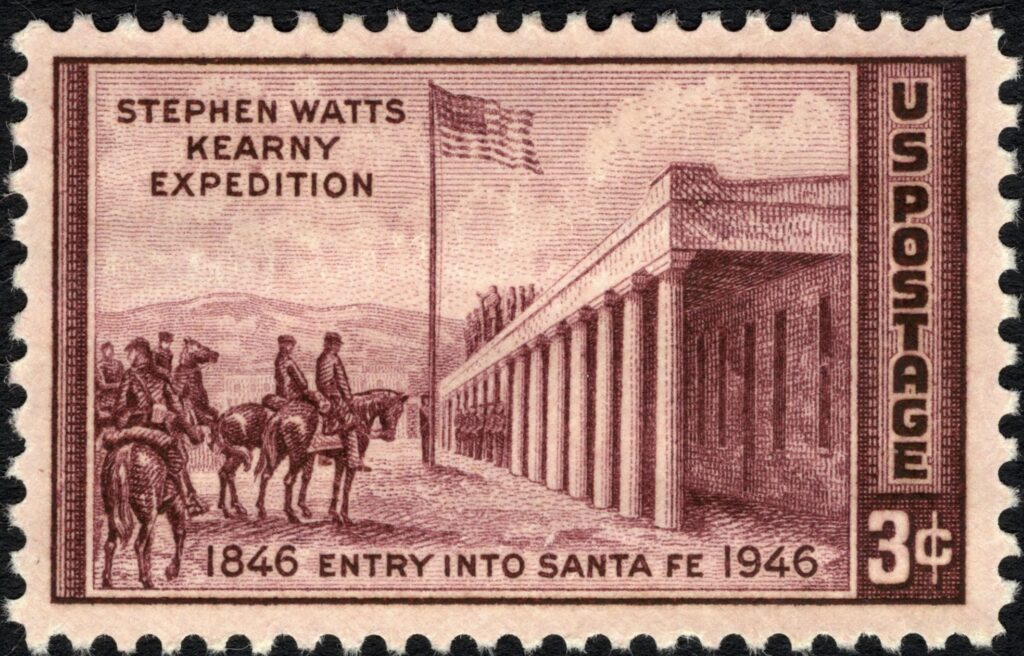
This is the only U. S. stamp that comes to commemorating the Mexican War. Santa Fe, New Mexico, which was a part of Mexico in 1846, would not have had the stars-and-stripes flying until after General Kearney had captured the area.
1 thought on “The Mexican-American War (1846–1848)”