In the long story of American territorial expansion, the Gadsden Purchase occupies a curious place — modest in size compared to the Louisiana Purchase or the Mexican Cession, yet consequential enough to reshape the southwestern United States and inflame one of the bitterest political debates of the nineteenth century.
To understand it fully, we need to examine who was involved, what was actually acquired, when and where it happened, and why anyone wanted it in the first place.
Who
The central figure on the American side was James Gadsden, a South Carolina railroad promoter and politician whose name would become permanently attached to the deal. Gadsden was appointed U.S. Minister to Mexico in 1853 by President Franklin Pierce, largely because of his enthusiasm for a southern transcontinental railroad route — a project that had powerful backing from Pierce’s Secretary of War, Jefferson Davis, the future president of the Confederacy.
Gadsden was not a diplomat by training or temperament; he was a man of business and ambition, and he approached the negotiations with Mexico with the bluntness of someone who had a specific objective in mind and wanted it accomplished quickly.
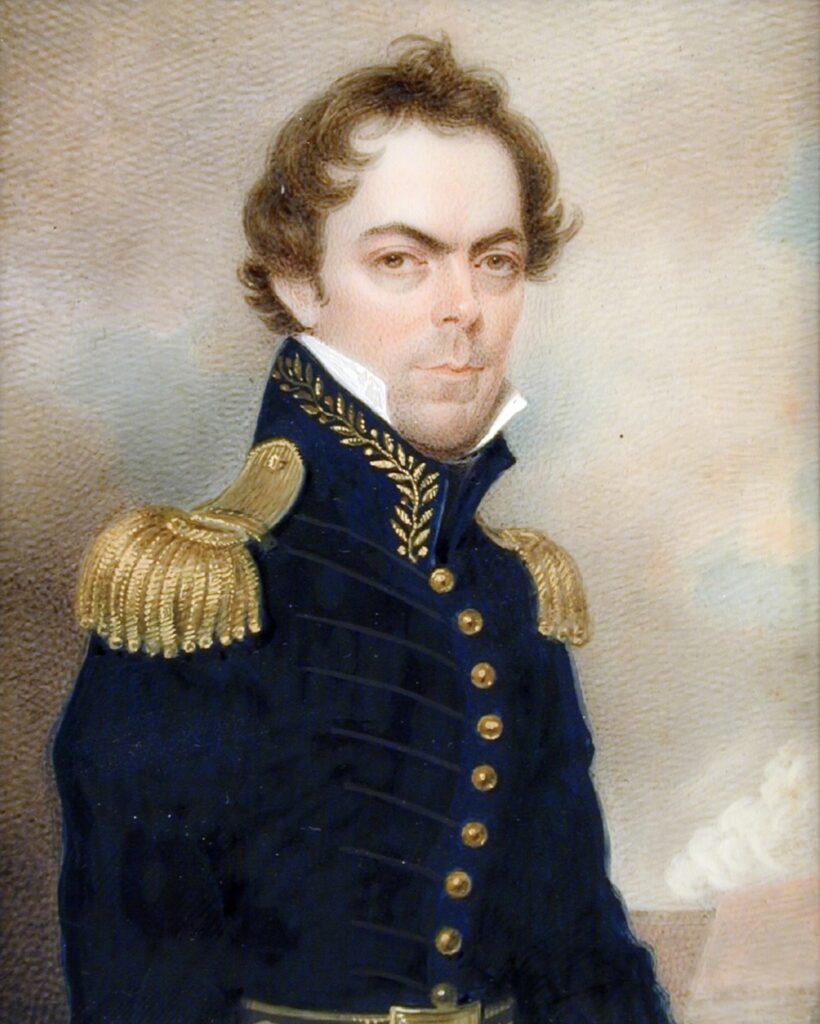
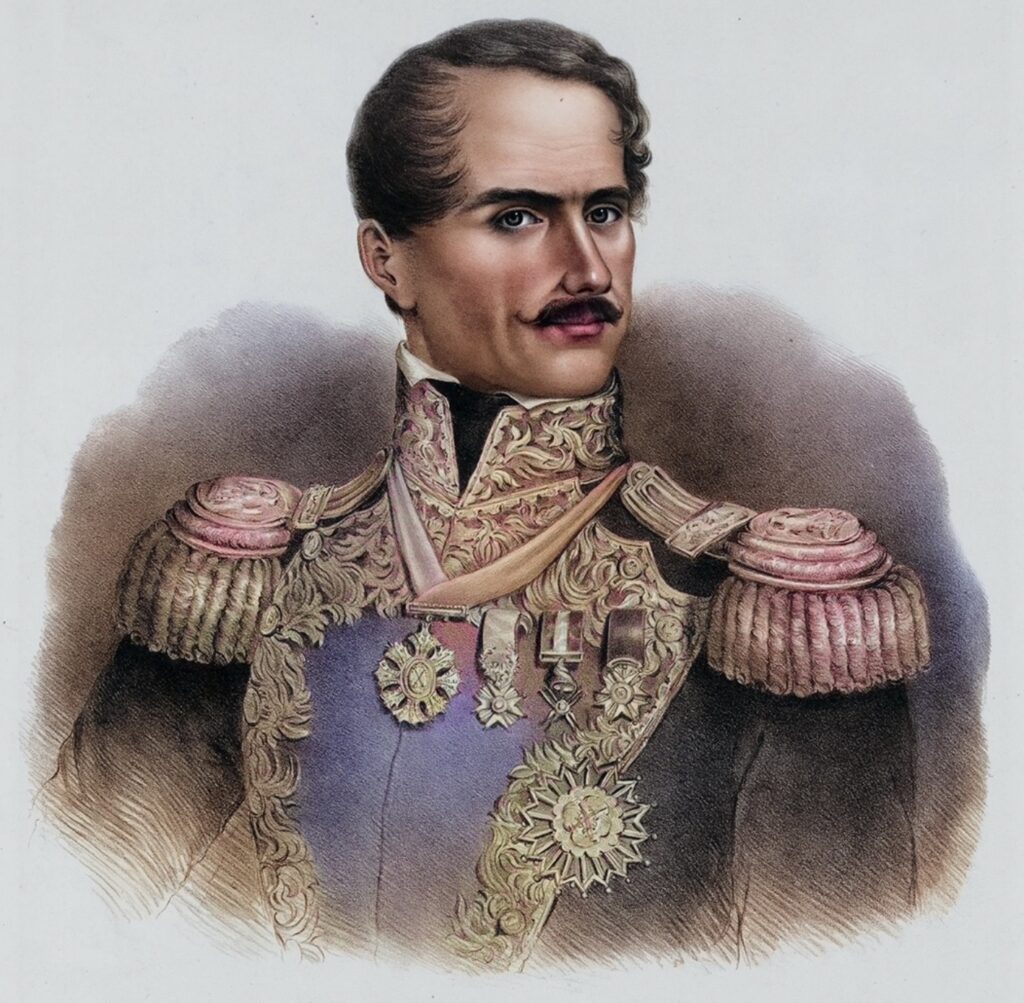
James Gadsden, left, and Antonio López de Santa Anna were the negotiators in the sale of the Gadsden Purchase to the United States.
On the Mexican side, the counterpart was President Antonio López de Santa Anna, one of the most mercurial figures in Mexican history. Santa Anna had led Mexico through decades of turmoil, including the Texas Revolution (Remember the Alamo!) and the Mexican-American War, and by 1853 he had returned to power yet again — for the 11th and final time.
His government was financially desperate, and that desperation made him willing to entertain an offer that many Mexicans found humiliating.
President Pierce himself deserves mention. A New Hampshire Democrat with strong sympathies toward the slaveholding South, Pierce was deeply invested in the idea of a southern railroad route, which he and his allies believed would bind the southern states more tightly to the Union and open new economic possibilities for the region.
What
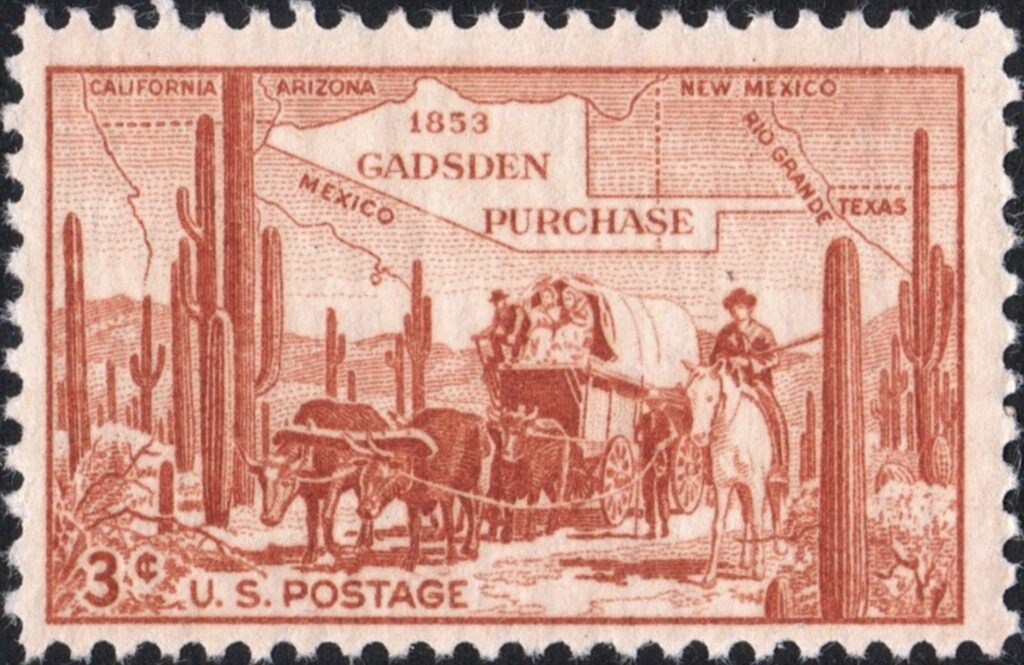
The Gadsden Purchase transferred approximately 29,670 square miles of territory from Mexico to the United States. This land comprises what is today the southern portions of Arizona and New Mexico — a strip of terrain running roughly from the Rio Grande in the east to the Colorado River in the west, and bordered to the south by Mexico.
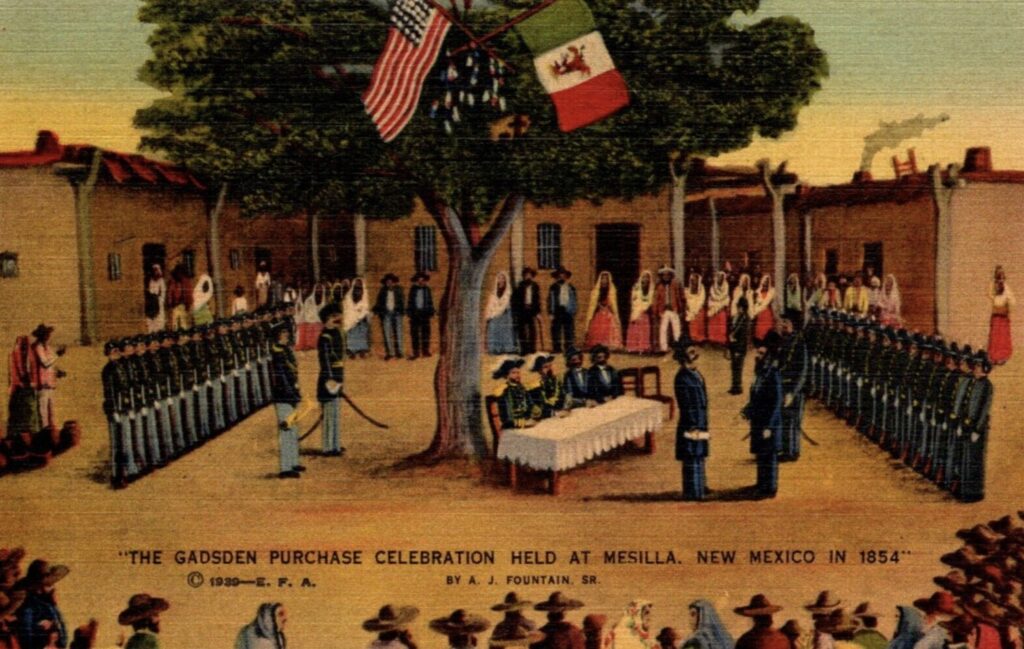
Mesilla, New Mexico was a hub of culture, transportation and trade in the Gadsden Purchase region at the time.
The United States paid $10 million for this territory (a sum later reduced from an initial proposal of $15 million during Senate ratification debates).
The land itself was largely arid desert and scrubland — the Sonoran Desert dominates much of it — though it included strategically valuable river valleys and mountain passes. Among the most significant geographic features were the Mesilla Valley along the Rio Grande and a relatively flat corridor through the southernmost reaches of present-day Arizona, near what is now the city of Tucson.
Towns like Tucson, Bisbee, Douglas and Yuma, Arizona, and Las Cruces, New Mexico, sit on Gadsden Purchase land today. The purchase also resolved longstanding boundary ambiguities left over from the Treaty of Guadalupe Hidalgo (1848), which had ended the Mexican-American War but left certain border areas poorly defined.
When
The timeline of the Gadsden Purchase unfolds across roughly two years. Gadsden arrived in Mexico City in the summer of 1853 and began negotiations with Santa Anna’s government. The two sides signed the treaty on December 30, 1853.
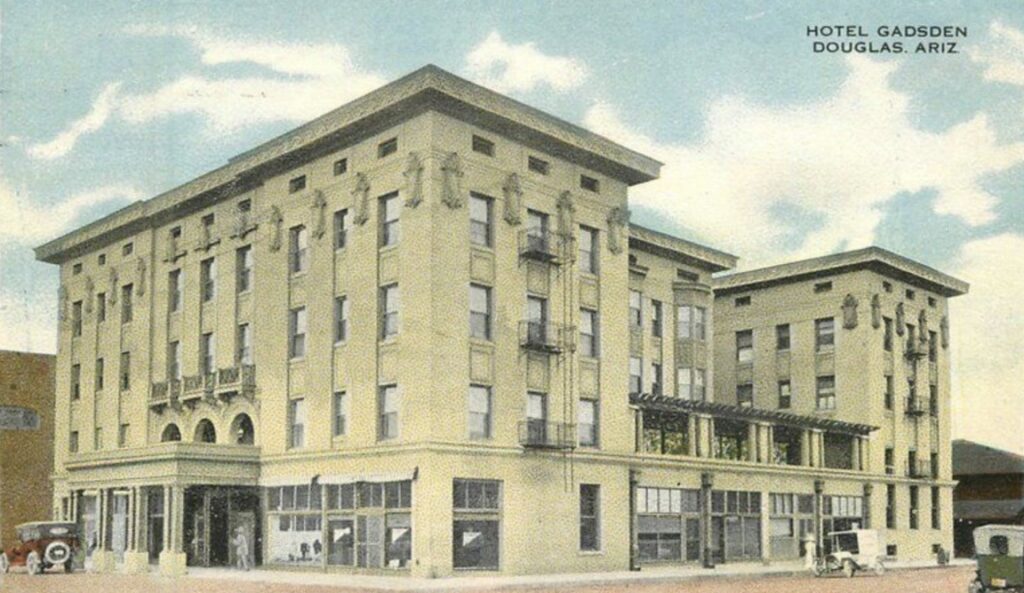
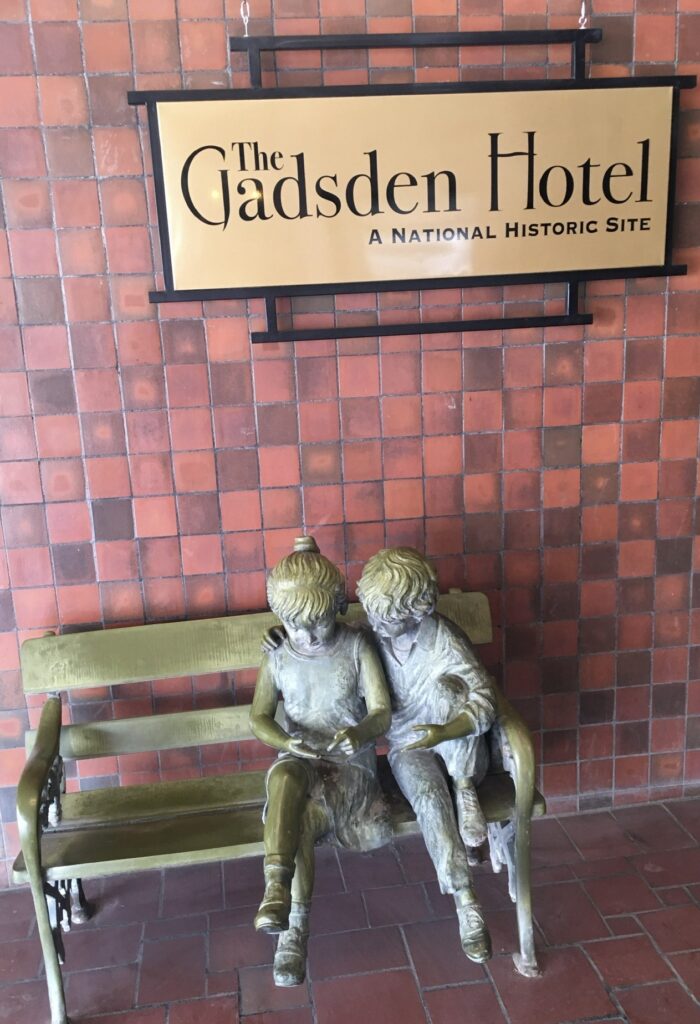
The only remembrance of the Gadsden Purchase today is the Gadsden Hotel in Douglas, Arizona. It was built in the 19-teens (above) and burned and was rebuilt in the 1920s.
To the right is a photo I took a few years ago of the entryway to the current hotel. As the sign indicates, it’s on the National Historic Register.
From there, the agreement traveled back to Washington, where it ran into fierce political opposition. The U.S. Senate debated and amended the treaty at length — stripping out provisions that would have given the United States transit rights across Mexico’s Tehuantepec isthmus — before finally ratifying a modified version on April 25, 1854. Pierce signed the revised treaty into law on June 29, 1854, and the formal transfer of the territory was completed later that year.
Where
Geographically, the purchase fills in the southern anchor of the American Southwest. Before the deal, the U.S.-Mexico border in the region followed a line that cut awkwardly through terrain made famous by the Gila River — a route that railroad surveyors had already determined was unsuitable for a low-elevation rail line.
The Gadsden Purchase moved that border southward, incorporating a band of territory that offered a more practical path through the mountains for an all-weather railroad running from the Mississippi Valley to the Pacific Coast.
The region was not uninhabited. Indigenous peoples including the Tohono O’odham had lived across this landscape for centuries, and a small Mexican population resided in towns like Tucson, which at the time of the transfer was a walled presidio settlement of a few hundred people.
These residents were given the option, as in the earlier Treaty of Guadalupe Hidalgo, to become American citizens or relocate to Mexico.
Why
The driving motivation behind the Gadsden Purchase was the transcontinental railroad — specifically, the ambition to build a southern route connecting New Orleans or Memphis to Los Angeles. Jefferson Davis had commissioned surveys of potential railroad corridors across the West, and the results strongly favored a southern path through the 32nd parallel.
The problem was that the most practical terrain for such a route lay just south of the existing border, in Mexican territory. The purchase was, in its simplest form, a real estate transaction driven by railroad economics.
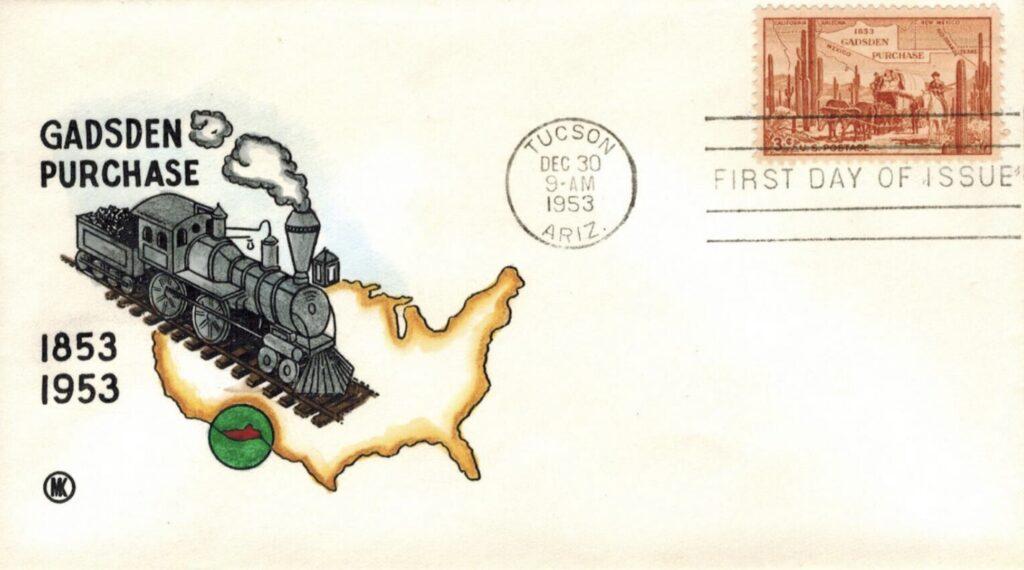
This first-day cover gets it right — the Gadsden Purchase was all about a transcontinental rail route. (This cover was hand-painted by Ross Noble. Philatelic sites often mention his work by names.)
But the railroad was never just a railroad. In the heated politics of the 1850s, it was a weapon in the sectional struggle over slavery’s expansion. Northern politicians understood that a southern railroad would anchor the southwestern territories to the slave states’ economic orbit, potentially opening new land to slavery.
This helps explain why the purchase provoked such intense opposition in the Senate, where antislavery legislators attacked it as yet another scheme by the “Slave Power” to extend its reach.
The Kansas-Nebraska Act, passed the same year and far more explosive in its consequences, drew attention away from the Gadsden Purchase — but both measures emerged from the same crucible of sectional tension.
The promised southern railroad, ironically, was never built before the Civil War. The conflict that finally erupted in 1861 redirected both capital and political will toward other ends, and when the first transcontinental railroad was completed in 1869, it ran along a northern route through Nebraska and Nevada.
The southern route Gadsden purchased the land for did not become a reality until the Southern Pacific Railroad completed its transcontinental line through Tucson and Yuma in 1881 — nearly three decades after the purchase that was designed to make it possible.
Legacy
The Gadsden Purchase drew the final map of the contiguous United States. No subsequent territorial acquisition would add land to the lower forty-eight states.
In that sense, it represents both an ending — the close of continental expansion — and a reflection of everything that expansion had come to mean: ambition, railroad fever, sectional rivalry, Indigenous displacement, and the relentless drive to bind a continent together, even as the nation was pulling itself apart.