By the time Thomas Gainsborough first displayed his now-iconic painting at London’s Royal Academy in 1770, the art world knew it was looking at something remarkable.
Originally titled A Portrait of a Young Gentleman, the full-length oil painting depicted a boy in a shimmering blue satin suit — knee breeches, a slashed doublet, and a lace collar — posed against a dusky landscape with a plumed hat in hand.
The brilliant blue palette caused an immediate stir in an era dominated by the warm, Florentine-influenced tones favored by the Academy’s founder, Sir Joshua Reynolds. Gainsborough wasn’t painting in spite of that convention; he was answering it. By 1798, people had taken to calling the work simply “The Blue Boy,” and the name has never left it.
A Tribute to Van Dyck
The costume the boy wears wasn’t contemporary dress — it was already roughly 130 years out of fashion by 1770. Gainsborough borrowed it from the era of Anthony van Dyck, the 17th-century Flemish painter whose grand, glamorous portraits of the European aristocracy had reshaped British art.
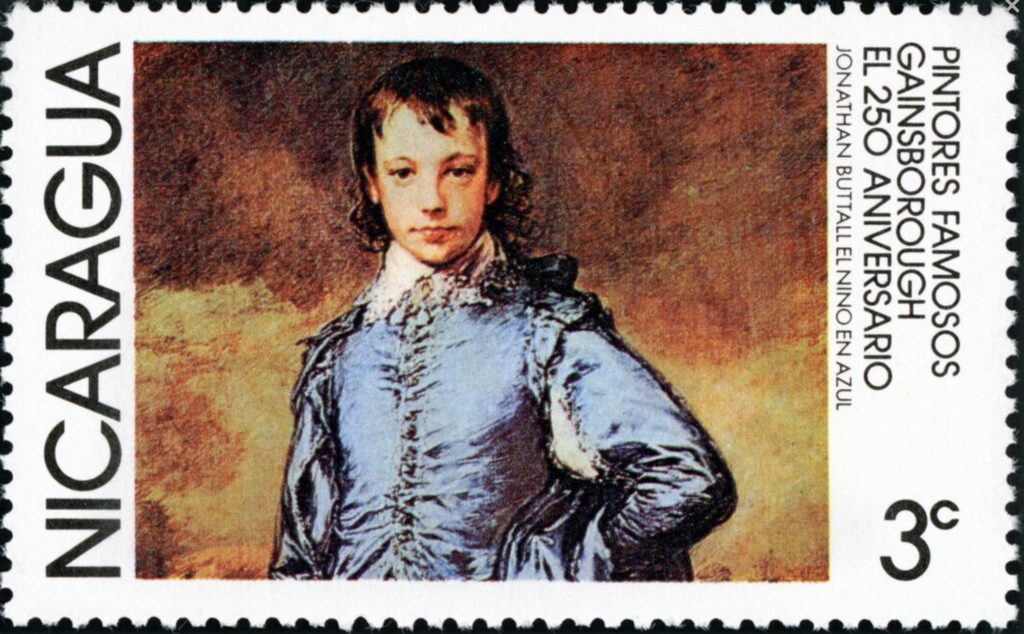
This 1978 issue from Nicaragua, one of 10 classic painting that appeared on that nation’s stamps that year, including two others by Gainsborough, says the subject is Jonathan Buttall. See the text below for more on that identification. Panama had put The Blue Boy on a stamp back in 1967. Many other nations have honored this artist. Great Britain hasn’t found a place is their oeuvre for him yet.
The Blue Boy was Gainsborough’s first attempt at depicting full Van Dyck dress, an explicit homage to the master he admired above all others. At the Royal Academy, the allusion was unmistakable and deliberate, positioning Gainsborough as a worthy heir to that courtly tradition.
Who exactly is the boy in the painting? That question remains genuinely open.
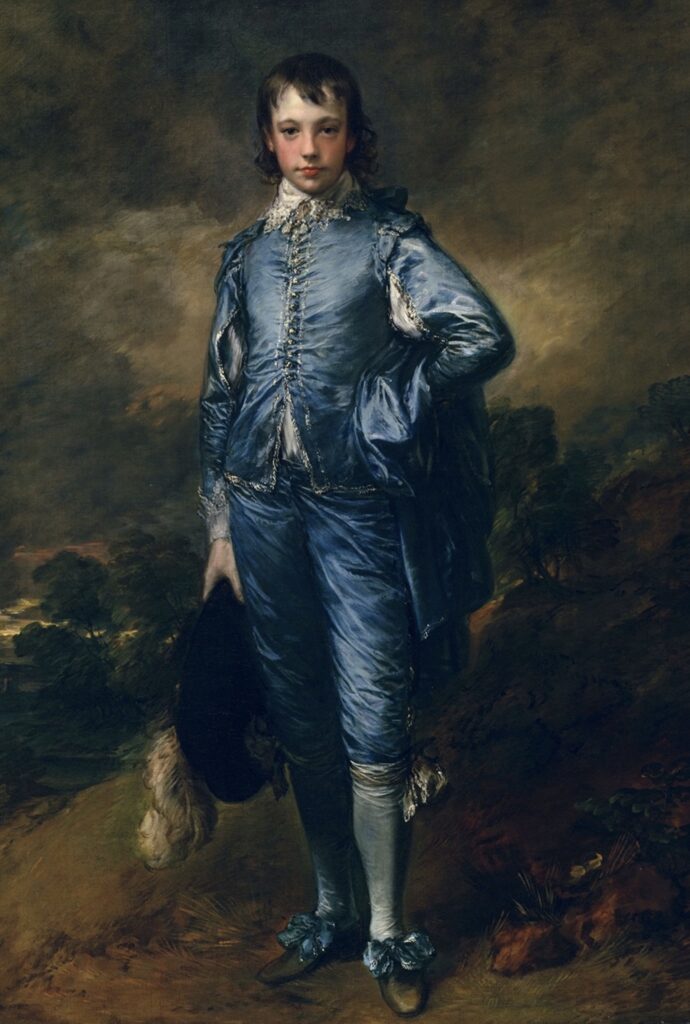
Because the stamp shows only a truncated image of the painting, I’ve posted the entire image here.
I visited the Huntington for the first time in the 1980s, and returned several more times, always stopping to see this magnificent portraiit.
What make’s it even more delectible is that it share the room with Thomas Lawrence’s Pinkie. It’s a perfect contrast, or perhaps complement, of colors.
For generations, the painting was believed to depict Jonathan Buttall, a friend of the Gainsborough family and the work’s first recorded owner. But no portraits of Buttall are known to exist for comparison, and the blue costume appears in several other works by Gainsborough — including portraits of his nephews.
In 2013, scholar Susan Sloman proposed that the sitter is more likely Gainsborough Dupont, the painter’s nephew and studio assistant. A portrait of Dupont painted a few years later shows a young man in a strikingly similar blue Van Dyck suit. The mystery endures.
The Sale That Shocked the Art World
The painting changed hands several times after Buttall went bankrupt in 1796, eventually entering the collection of the Earl Grosvenor around 1809 and remaining with his descendants for over a century. The Grosvenor family lent it generously to major exhibitions across Britain, cementing its status as one of the nation’s most beloved artworks.
(A Grosvenor descendant was created Duke of Westminster by Queen Victoria in 1874.)
Then, in 1921, the financially strained second Duke of Westminster sold it to Henry E. Huntington, a California railroad and real estate magnate with an appetite for great art. The price — $728,000 — was, at that moment, the highest sum ever paid for a painting anywhere in the world. The deal was brokered by the controversial art dealer Joseph Duveen, who had made a career of steering European masterpieces toward the newly wealthy American elite.
Before the painting left for California in 1922, it went on display at the National Gallery in London for three farewell weeks. Some 90,000 people came to see it off. The Gallery’s director at the time, Charles Holmes, inscribed “au revoir” on the back of the canvas, hoping it might one day return.
Home at the Huntington
Today, The Blue Boy hangs in the Thornton Portrait Gallery at the Huntington Library, Art Museum, and Botanical Gardens in San Marino, California, just outside Los Angeles — where it has been for over a century. Between 2018 and 2020, the Huntington undertook “Project Blue Boy,” the painting’s first major technical examination and conservation treatment, performed in public view.
Using digital X-radiography, infrared reflectography, and ultraviolet fluorescence, conservators uncovered hidden layers beneath the surface: an abandoned portrait of a man on the reused canvas, and a small white dog that Gainsborough had painted out and transformed into a pile of rocks.
The removed layers of old varnish and overpaint revealed the full dazzling virtuosity of Gainsborough’s brushwork — the shimmering blue of the costume rendered in ultramarine, smalt, Prussian blue, and possibly azurite, applied in intricate, layered strokes.
In 2022, Charles Holmes’s “au revoir” was finally answered. The Huntington lent The Blue Boy to the National Gallery in London for a four-month exhibition, exactly 100 years after it had last left. Crowds came again. Then it came home — permanently — to California.
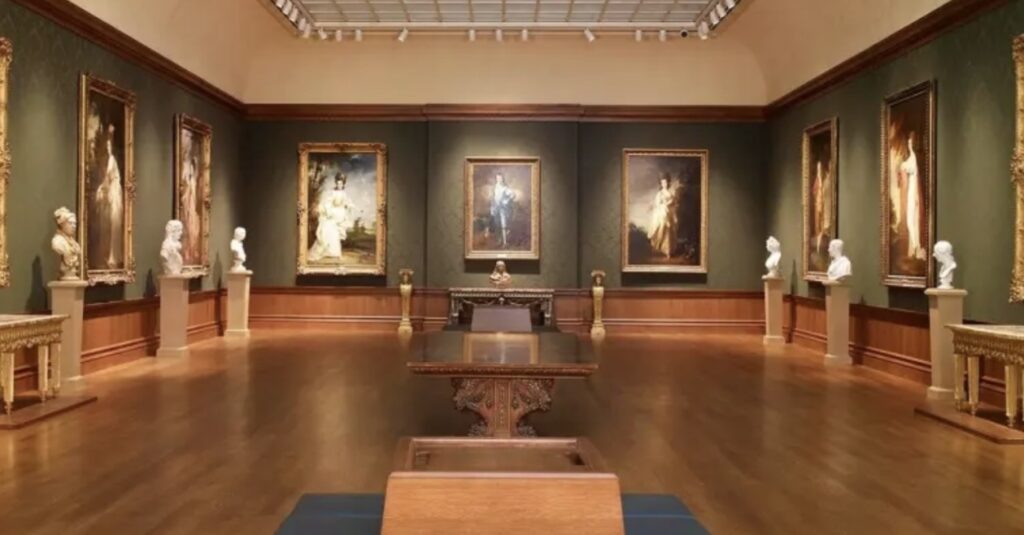
The Blue Boy is on permanent view in the Thornton Portrait Gallery at the Huntington Library, Art Museum, and Botanical Gardens, 1151 Oxford Road, San Marino, CA. huntington.org