On November 30, 1939, the Soviet Union launched a massive invasion of Finland, expecting a swift and easy conquest. What followed instead was one of the most remarkable military episodes of the twentieth century — a 105-day conflict in which a small Nordic nation armed with skis, stubbornness, and intimate knowledge of its frozen terrain held the Red Army to a standstill that stunned the entire world.
The Road to War
The roots of the conflict lay in the Molotov-Ribbentrop Pact, the secret non-aggression agreement signed between Nazi Germany and the Soviet Union in August 1939, which assigned Finland to the Soviet sphere of influence. Stalin, eyeing Finland’s proximity to Leningrad — just 32 kilometers from the border — demanded territorial concessions for security reasons.
Finland refused to cede land it considered sovereign territory. Diplomacy collapsed, and the Red Army rolled across the border.
Stalin expected the campaign to last two weeks at most. His generals boasted they would need only their dress uniforms, not their winter gear. They were catastrophically wrong.
David Versus Goliath
The numbers were staggering in their imbalance. The Soviet Union deployed over 450,000 troops in the initial assault, supported by thousands of tanks and aircraft. Finland mobilized roughly 300,000 soldiers, many of them reservists, with limited artillery, almost no tanks, and an air force that could be counted in the dozens. By any conventional military calculation, the outcome should have been swift and decisive.
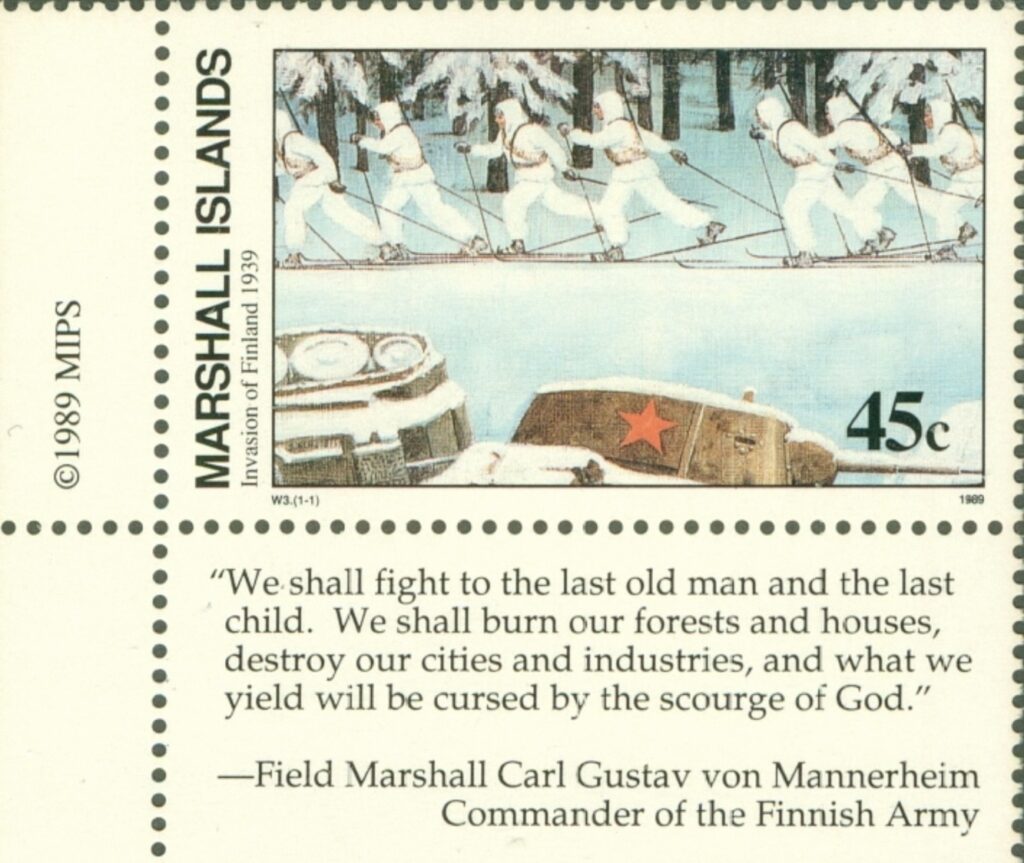
But conventional calculations did not account for the Finnish soldier — the jääkäri — fighting in his own backyard. Finland’s terrain was the army’s greatest ally: dense forests, frozen lakes, and brutal cold that regularly dropped to minus 40 degrees Celsius. Finnish troops moved on skis, dressed in white camouflage, vanishing into the treeline before Soviet columns even knew they had arrived.
The tactics developed out of necessity became legendary. Small, fast-moving ski units used motti tactics — encircling and isolating Soviet columns along forest roads, cutting supply lines, and dismembering large formations into pockets of freezing, disoriented men.
Soviet troops, trained for open-terrain warfare and grossly unprepared for the Arctic winter, froze in place — literally. Tens of thousands died from cold, hunger, and ambush rather than Finnish bullets.
The Mannerheim Line
Finland’s greatest fixed defensive achievement was the Karelian fortification network, popularly known as the Mannerheim Line, named after Field Marshal Carl Gustaf Emil Mannerheim, the stoic commander-in-chief who became the war’s defining figure. While the line was far less elaborate than Soviet propaganda later claimed, it anchored Finnish resistance on the Karelian Isthmus through weeks of fierce Soviet assault.
The image of Mannerheim — aristocratic, unflappable, orchestrating Finland’s defense with limited resources and maximum resolve — became a symbol of national identity that Finland has never forgotten.
The Inevitable End
By February 1940, the Soviets had regrouped, replaced failing commanders, and launched a renewed offensive with overwhelming force and better coordination. The Finnish line, however heroically held, could not withstand the sheer volume indefinitely. Ammunition and reserves ran low. Appeals to Britain and France for meaningful intervention came too late and too little.
On March 13, 1940, Finland signed the Moscow Peace Treaty, ceding roughly 11% of its territory, including Karelia. It was a painful peace — but Finland remained free and independent.
Legacy
The Winter War cost Finland around 25,000 dead. Soviet losses remain contested, but credible estimates range from 125,000 to over 160,000 killed, with total casualties far higher. The disproportion spoke volumes.
Beyond the statistics, the war forged something lasting: a Finnish concept called sisu — a word roughly translated as grit, resilience, and indomitable will. It became the soul of a nation that refused to disappear. (There is a 2022 action-thriller movie, aptly named Sisu, about this concept.)
The Winter War did not make Finland a victor in the conventional sense. But it made Finland a legend.