Few military decorations carry the weight and recognition of the Purple Heart. Awarded to American service members wounded or killed in action, it stands as the oldest military award still in use in the United States today — and its story stretches back not to a modern war, but to George Washington himself.
A Revolutionary Idea
In the summer of 1782, with the Revolutionary War winding down, Washington faced a problem. The Continental Congress had barred him from granting promotions or commissions as a way to reward merit among his soldiers. Yet Washington, deeply aware of the sacrifices made by his enlisted men, wanted a way to honor exceptional service — especially among the common soldiers who, at that point in history, were almost never recognized for valor.
Most military honors of the era were reserved for officers, aristocrats, and commanders who had won decisive battles.
On August 7, 1782, from his headquarters in Newburgh, New York, Washington’s general orders established the Badge of Military Merit, permitting any soldier who performed a “singularly meritorious action” to wear “the figure of a heart in purple cloth or silk edged with narrow lace or binding” on his uniform.
Why Purple?
The badge’s defining feature — its purple color — traces directly back to Washington’s original specifications. The order called explicitly for purple cloth or silk, and that color choice has never changed, even through the medal’s later redesigns. While Washington didn’t leave behind a detailed explanation of why he chose purple specifically, the color had long been associated with honor, nobility, and distinction in Western tradition — fitting for an award meant to elevate ordinary soldiers to a status of special recognition.
Despite its historic origins, the Badge of Military Merit was awarded sparingly. Only three verified recipients are known: Sergeant Elijah Churchill, Sergeant William Brown, and Sergeant Daniel Bissel. The records of additional recipients, kept in what was called the “Book of Merit,” were lost — possibly destroyed in a fire that consumed the War Department in 1800. After this initial flourish, the award fell into obscurity for nearly 150 years.
Washington Returns, Officially This Time
Interest in reviving the badge resurfaced after World War I, as the U.S. military searched for ways to formally recognize merit and sacrifice the way other nations already did. At the time, the only American award soldiers and officers could earn was the Medal of Honor, prompting calls for additional honors. Army Chief of Staff Charles Summerall pushed for a revival in the late 1920s, but the effort stalled in Congress.
It was General Douglas MacArthur who finally saw the project through. In January 1931, MacArthur confidentially reopened work on a new medal design, enlisting Elizabeth Will, an Army heraldic specialist, to create the design. The Commission of Fine Arts then solicited models from three sculptors, ultimately selecting the design from John R. Sinnock of the Philadelphia Mint in May 1931.
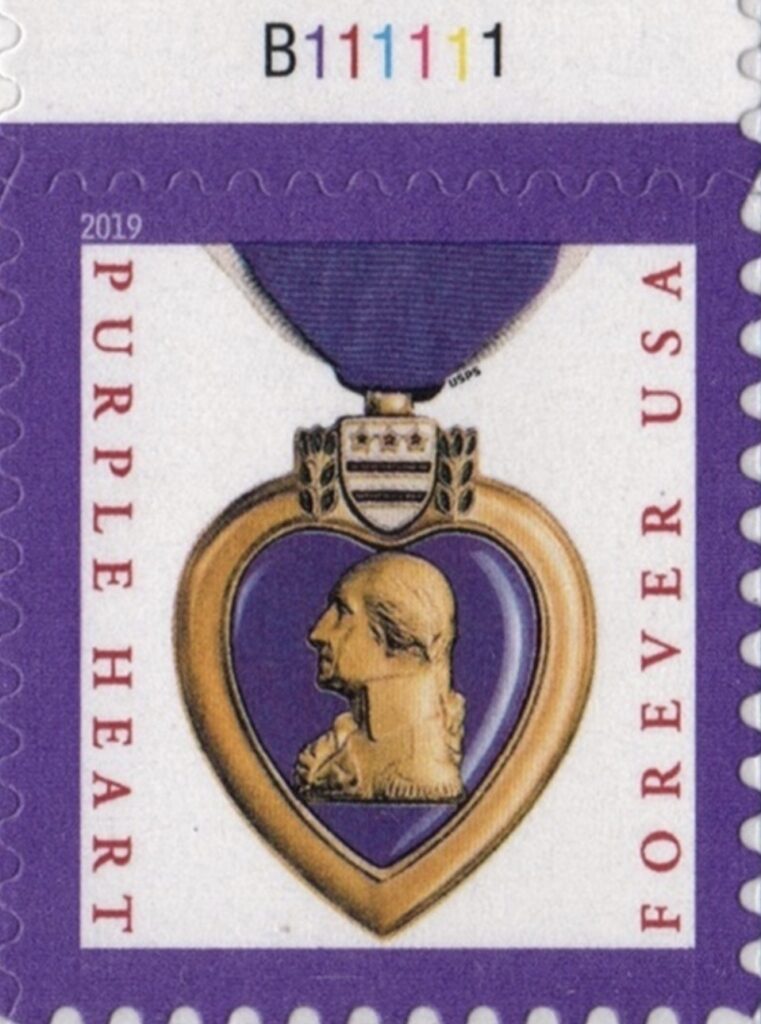
This is where George Washington’s face entered the picture. Since the medal was being revived specifically to honor Washington’s legacy, timed to the 200th anniversary of his birth, the new design featured a bust and profile of Washington, and the medal was officially issued on his bicentennial.
The final medal is a purple-and-gold heart-shaped brass medal bearing Washington’s profile, with the Washington family coat of arms — a white shield with two red bars and three red stars — above the heart, flanked by green leaves. The reverse reads “FOR MILITARY MERIT.”
On February 22, 1932, General Order No. 3 officially revived the Purple Heart “out of respect to his memory and military achievements.” Fittingly, MacArthur himself received the very first Purple Heart Medal under the new system.
Originally, the revived Purple Heart still followed Washington’s intent — honoring meritorious service broadly, not specifically injury. That changed during World War II. With the creation of the Legion of Merit in 1942 to recognize non-combat merit, the Purple Heart’s merit-based criteria became redundant and were dropped, narrowing the award specifically to those wounded or killed in action.
That same year, the award expanded beyond the Army for the first time, becoming available to the Navy, Marine Corps, and Coast Guard as well.
Interesting Facts and Modern Use
A few details stand out from the medal’s long history. During World War II alone, the U.S. manufactured 1,506,000 Purple Heart medals — a number so large in anticipation of casualties from a planned invasion of Japan that, even decades later, accounting for losses, roughly 500,000 remained unused, more than the total American military casualties of the next 70 years combined, including Korea and Vietnam.
John F. Kennedy remains the only U.S. president to have received a Purple Heart, awarded for wounds suffered in 1943. The medal’s eligibility criteria have also evolved with the times: posthumous awards were authorized in 1942, civilians serving under military authority became eligible in 1962, and acts of terrorism were added as qualifying circumstances in 1984.
Today, the Purple Heart remains unique among American military honors. Unlike most medals, it isn’t awarded based on a superior’s discretion or approval — any service member who sheds blood in the nation’s defense is entitled to receive it. Nearly two and a half centuries after Washington first sketched out the idea at Newburgh, his vision of honoring the common soldier endures in nearly every American conflict since.
If you want to read more about the Purple Heart, visit the National Purple Heart Hall of Honor, this page on The National WWII Museum site, this page at the U.S. Army Center of Military History, or this page at the U.S. Department of War.