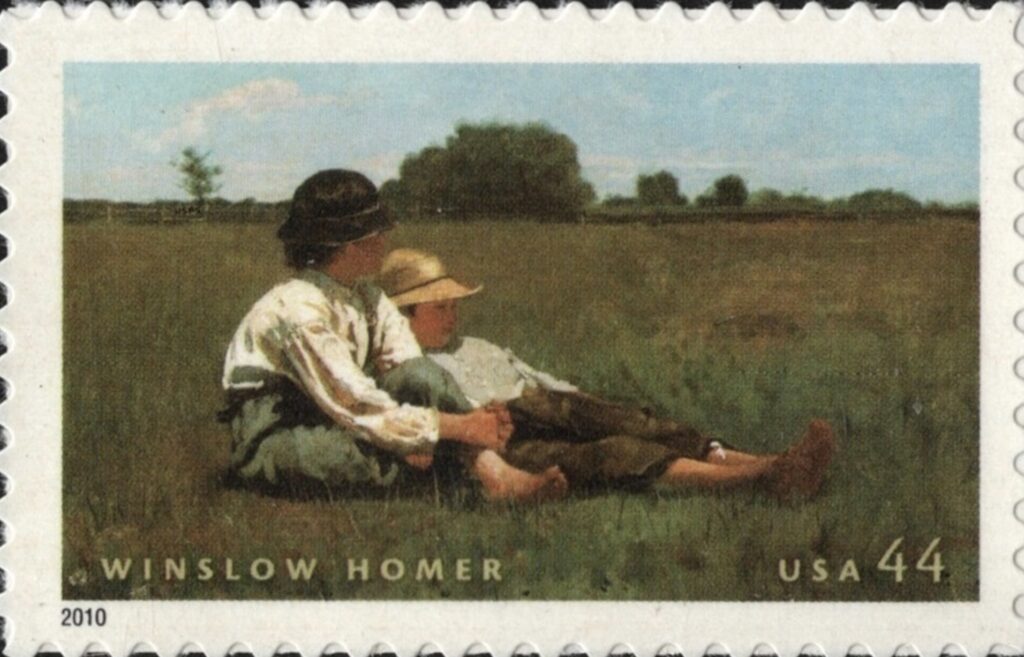
Painted in 1874, “Boys in a Pasture” captures two young boys resting in a sunlit field, hats tilted against the sun, seemingly absorbed in quiet conversation. The scene is simple, but it reflects an important chapter in Winslow Homer’s career, when he turned from Civil War illustration toward tender, observational scenes of rural American childhood.
This painting belongs to a broader group of works from the 1870s — including “Snap the Whip” and “The Nooning” — in which Homer depicted children at leisure in the countryside. These pastoral images offered American audiences a sense of peace and continuity in the years following the war’s devastation.
Homer renders the boys with unsentimental naturalism, their relaxed postures and warm, golden surroundings evoking the unhurried pace of a late-summer afternoon. His handling of dappled light across the grass reflects his growing interest in outdoor observation, a skill he would refine further in his later watercolors.
Rather than idealizing childhood, Homer captured it with quiet authenticity — boredom, daydreaming, and physical ease, free of moralizing narrative.
Today housed at the Museum of Fine Arts, Boston, “Boys in a Pasture” offers a gentle counterpart to Homer’s more famous dramatic seascapes, revealing the artist’s tender, observant eye during his formative years as a painter.