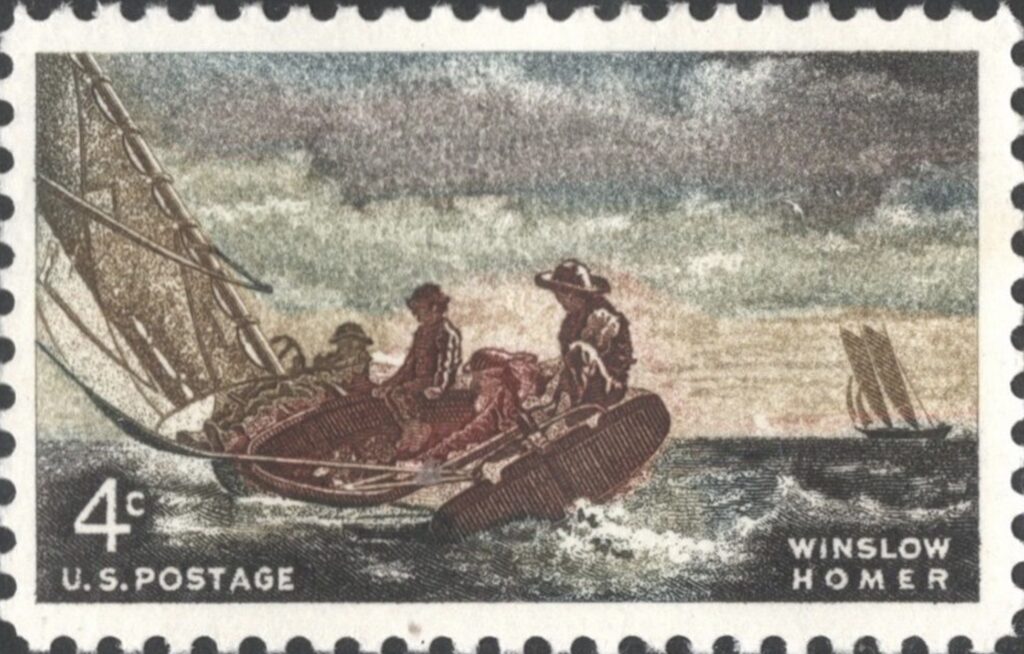
“Breezing Up” (also called “A Fair Wind”), completed by Winslow Homer in 1876, depicts a small catboat carrying three boys and a man as it skims across choppy water under a fresh breeze. Sails taut and whitecaps churning, the scene radiates motion, energy, and youthful confidence.
Homer worked on the painting for several years before its completion, and conservation analysis has revealed he made significant changes to the composition along the way — proof that even his seemingly spontaneous scenes were the product of careful revision.
The timing of the painting’s debut is notable: 1876 marked the United States centennial, and many art historians read “Breezing Up” as a subtle allegory for the nation itself — youthful, resilient, and confidently navigating uncertain waters toward a hopeful horizon.
Technically, the painting showcases Homer’s growing mastery of oil paint, particularly his handling of choppy water and dynamic sky, skills he would refine further in his later, more dramatic seascapes after settling in Prout’s Neck, Maine.
Today, “Breezing Up” hangs in the National Gallery of Art and remains one of the most beloved and frequently reproduced works of 19th-century American art — a perfect snapshot of optimism, skill, and a nation finding its footing.