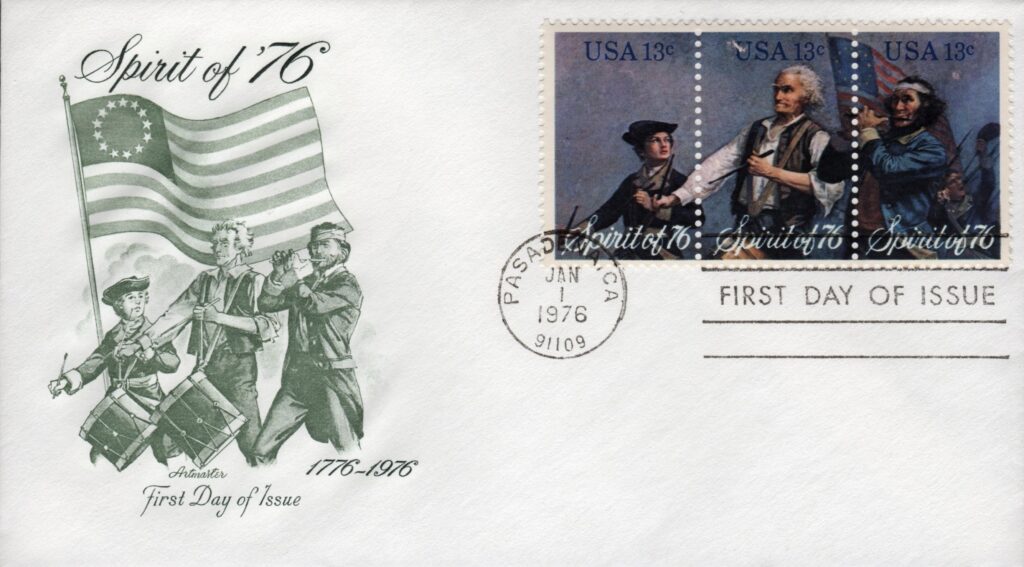
Few images capture the spirit of American patriotism quite like “The Spirit of ’76” — the iconic painting of three Revolutionary War musicians marching defiantly through battle smoke, a tattered flag rippling behind them. It’s appeared on postage stamps, in Disney parades, in classic cartoons, and on countless pieces of memorabilia.
Yet the painting’s origins are far humbler than its legacy suggests, beginning with an Ohio wagon painter and a small-town Fourth of July parade.
From Wagons to Canvas
Archibald MacNeal Willard (1836-1918) was born in Bedford, Ohio, on August 22, 1836, the son of a Baptist pastor. He showed an early love of drawing, often sketching on barns and other structures around his family’s property. As a young man, he moved to Wellington, Ohio, and took a job with wagon maker E.S. Tripp.
He started as a basic wagon painter but was eventually given the chance to create the more elaborate decorative work popular at the time — early training in composition and craft that would later serve him well.
Willard joined the 86th Ohio Infantry Regiment in 1863 during the Civil War, though he saw relatively little direct combat. Still, he sketched and painted scenes from the war throughout his service. After returning home, he sent two humorous paintings of children and a family dog, titled “Pluck” and “Pluck II,” to Cleveland photographer and printer James F. Ryder.
Ryder displayed them in his shop window and found such demand that he produced 10,000 chromolithograph print sets, selling them for $10 each — Willard’s first real taste of commercial success.
A Parade, a Sketch, and a Change of Heart
By the mid-1870s, Willard had relocated to Cleveland and was working as a full-time artist, having picked up some formal training along the way. Encouraged by his earlier success and by Ryder, Willard set out to create what would become his most famous work. The idea struck him close to home: Willard painted what became “The Spirit of ’76” around 1875 in Wellington, Ohio, after watching a Fourth of July parade pass through the town square.
The painting almost wasn’t the solemn, patriotic image we know today. Ryder had originally suggested a semi-humorous patriotic piece, fitting for the upcoming 1876 centennial exhibition in Philadelphia, and the work was initially titled “Yankee Doodle.” Early sketches show a much lighter tone — the older drummer was depicted tossing his stick playfully into the air, rather than marching with grim determination.
Everything changed with a personal loss. Willard had cast his own father, Samuel, a minister, as the central figure of the painting. When his father died before the painting was completed, Willard’s tone shifted from humorous to deeply serious. Willard felt real sentimental weight toward his father’s career as a minister and his own grandfather’s service in the Revolutionary War, and that emotional gravity reshaped the entire composition.
The reworked sketches show the older drummer now marching grimly forward, hatless and in shirtsleeves, while the fifer’s hat became a bandaged head wound, and a wounded soldier in the foreground raises his hat toward a flag waving through the haze. The painting’s other models included Hugh Mosher as the fifer and young Henry Devereux as the boy drummer.
A Slow Climb to Icon Status
Contrary to popular legend, “The Spirit of ’76” wasn’t an instant sensation. Common myths claim Willard was specially invited to exhibit the work and that President Grant personally praised it — but in reality, its initial reception at the 1876 Centennial Exposition was far more modest. Art critics largely dismissed it as little more than a cartoon.
What changed its fortunes was marketing, not critical acclaim. Thanks to Ryder’s skillful promotional campaign, the painting drew huge crowds eager to see it and to buy inexpensive color prints for their own homes.
After the exposition, the painting toured the country, drawing sellout crowds from Boston to San Francisco. It picked up its now-famous title during this tour — the painting acquired the name “Spirit of ’76” while being shown in Boston, before “Yankee Doodle” faded into history.
Demand was so overwhelming that one painting wasn’t enough. Willard ultimately painted a minimum of 14 “original” versions of the piece over the years. The original was purchased in 1880 by Cleveland railroad superintendent John H. Devereux, whose own son had modeled as the drummer boy, and Devereux donated it to his hometown of Marblehead, Massachusetts, where it remains today in Abbot Hall.
A Lasting Symbol
Willard never replicated this level of success again. He spent his later career teaching, founding the Cleveland Art Club, and producing folksy historical paintings that found little recognition or profit.
Yet the image he created took on a life far beyond him. It resurfaced for the Spanish-American War, appeared in the 1931 film “Alexander Hamilton,” was parodied on a 1939 Mickey Mouse Magazine cover, inspired Disney’s “America on Parade,” showed up in Looney Tunes shorts, and was even referenced by Kurt Vonnegut in “Slaughterhouse-Five.”
Fittingly, when the Postal Service chose an image for the nation’s Bicentennial stamp in 1976, “The Spirit of ’76” was the obvious, undisputed choice.
Willard himself put it best, describing the painting not as a tribute to any single year, but as an expression of the enduring, living spirit of American patriotism — a fitting legacy for a self-taught wagon painter from rural Ohio whose Fourth of July inspiration became one of the most recognizable images in American history.
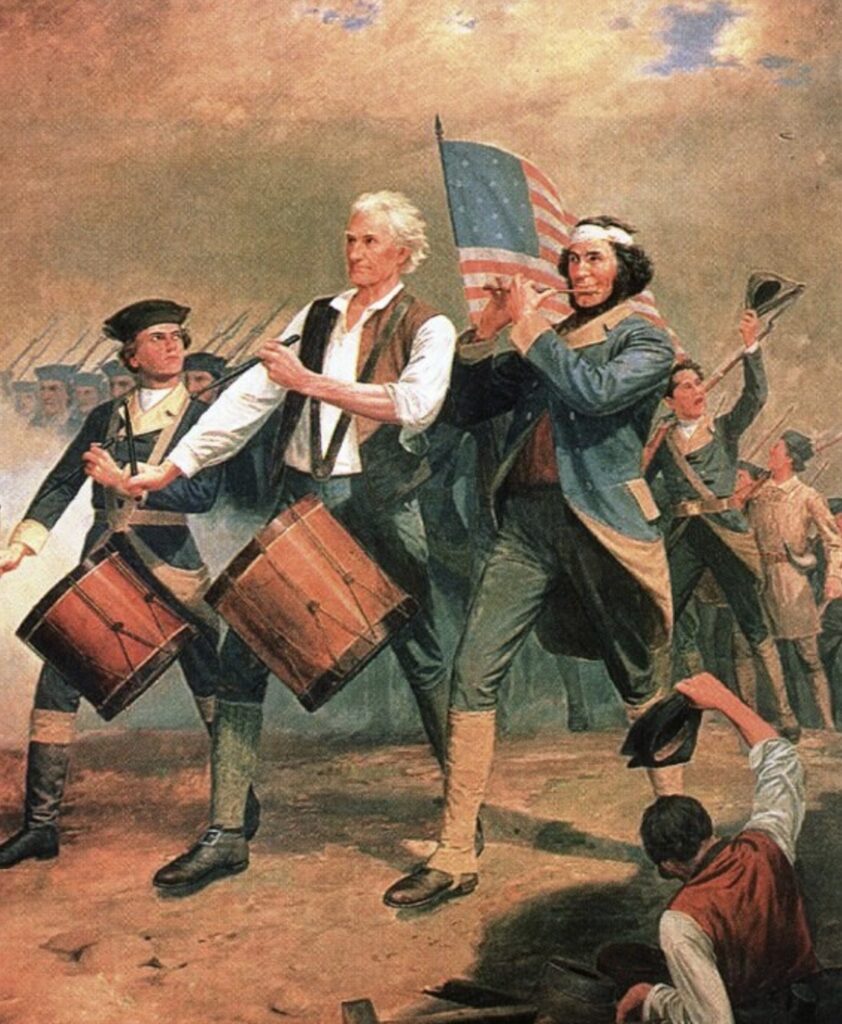
Willard painted this version of “Spirit of ’76” in 1912. It hangs in City Hall in Cleveland.