The image is iconic: a great ring turning slowly against the black of space, its rim housing decks where astronauts walk as if on Earth.
The idea predates spaceflight itself. Konstantin Tsiolkovsky floated the concept as early as 1903, and Herman Potočnik gave it detailed form in his 1929 book The Problem of Space Travel, envisioning a 30-meter rotating station he called the “Wohnrad,” or living wheel.
It was Wernher von Braun, writing in Collier’s magazine in 1952, who made the idea famous — a 76-meter wheel spinning at three revolutions per minute to generate roughly a third of Earth’s gravity, meant as a way station for missions to Mars. Stanley Kubrick immortalized the design in 2001: A Space Odyssey, and the “von Braun wheel” has shaped the public imagination ever since.
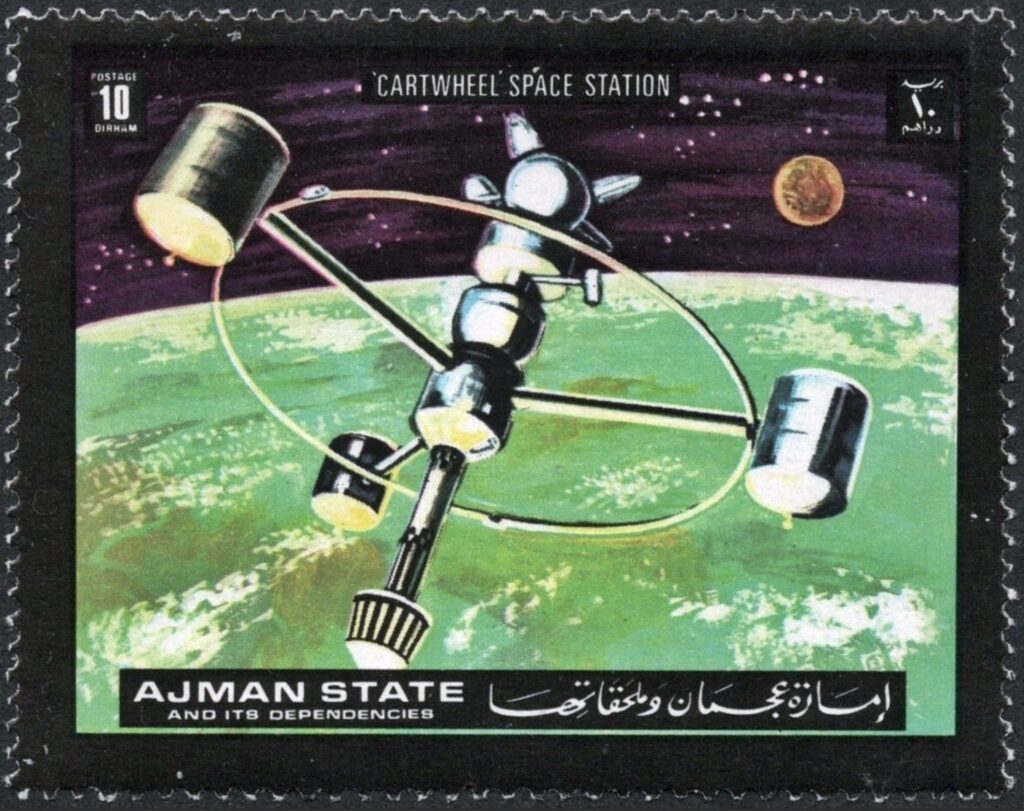
The physics is straightforward: Spin a ring fast enough and centrifugal force presses occupants outward against the rim, mimicking gravity. The appeal is obvious too — extended weightlessness degrades bone density, muscles, and eyesight, and a rotating habitat promises to sidestep those problems entirely.
So why doesn’t one exist? Mostly, scale and cost. To keep the disorienting effects of Coriolis force tolerable — the dizzying sensation of your head spinning at a different rate than your feet — a wheel needs either a large radius or a slow spin, and ideally both. That means tens or even hundreds of meters across, built and pressurized in orbit, an engineering undertaking far beyond anything a small modular station like Mir or the ISS required.
Launch capacity has historically made large, heavy, rigid structures prohibitively expensive, and NASA’s post-Apollo budget retrenchment in the 1970s shelved serious wheel-station planning before it matured. Without a clear medical mandate demanding full gravity for near-term missions, agencies have consistently favored cheaper, incrementally built microgravity stations instead.
That calculus may finally be shifting. Cheaper heavy-lift rockets and inflatable structures, which could deliver a von Braun-scale wheel using a fraction of the mass once assumed necessary, have renewed commercial interest, with several private ventures now designing rotating habitats.
More than 70 years after von Braun’s sketch, the wheel may be closer than we thing to spinning through space.
Great content! Keep up the good work!