Few writers have managed to be as consistently entertaining and as consistently annoying to their audiences as George Bernard Shaw.
For more than 60 years, he used the stage, the podium, and the printed page to challenge Victorian and Edwardian assumptions about class, marriage, war, religion, and the theater itself.
He remains the only person to have won both a Nobel Prize in Literature and an Academy Award, a fitting distinction for a man who refused to stay confined to a single medium or a single fight.
Background, Early Life
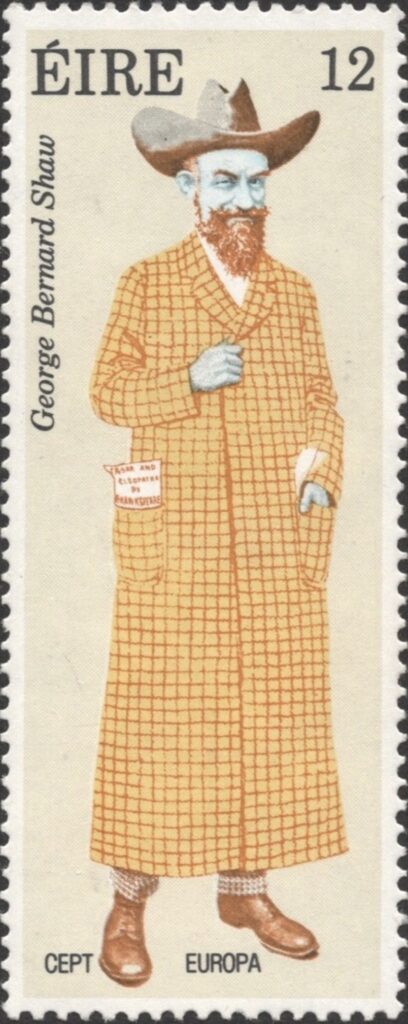
Shaw’s early education was informal and largely self-directed. He hated formal schooling and later credited his real education to the National Gallery of Ireland and to the countless hours he spent reading on his own.
At 20, Shaw followed his mother to London, where he spent nearly a decade in near-poverty, writing novels that publishers routinely rejected. During these lean years he supported himself by ghostwriting music criticism and educating himself in economics, politics, and public speaking.
It was in this period that he encountered the ideas that would define his adult life: he became a committed socialist, joined the Fabian Society in 1884, and threw himself into pamphleteering, lecturing, and debating on street corners across London. The discipline he developed as a platform speaker—clarity, provocation, and a gift for the memorable line—would later become the engine of his playwriting.
Shaw was born on July 26, 1856, in Dublin, Ireland, into a family that was genteel in name but shabby in practice. His father was an ineffectual civil servant with a drinking problem. His mother, a trained singer, eventually left the household for London, taking her musical ambitions—and, in time, her son—with her.
Turning to the Theater
Shaw did not find his true form until his mid-30s, when he turned from unsuccessful novels to drama. He was influenced heavily by the Norwegian playwright Henrik Ibsen, about whom Shaw wrote an influential critical study, The Quintessence of Ibsenism (1891), arguing that theater should confront real social problems rather than merely entertain.
Shaw set out to do in England what Ibsen had done in Norway: use the stage as a forum for ideas.
His early plays were grouped into two provocative categories. The Plays Unpleasant (1898), including Mrs Warren’s Profession, which tackled prostitution, poverty, and slum landlordism with such bluntness that the play was banned from public performance in England for years.
The Plays Pleasant also included Arms and the Man (1894), and used comedy and romance to smuggle in equally sharp critiques of militarism and romantic idealism. This pattern, disarming an audience with wit before landing a serious point, became Shaw’s signature technique and set him apart from more straightforwardly didactic contemporaries.
Major Works
Shaw’s output was enormous, spanning more than 60 plays along with novels, essays, and thousands of letters and reviews. Several works stand out as central to his legacy:
Man and Superman (1903) combined comedy of manners with a philosophical dream sequence, “Don Juan in Hell,” that laid out Shaw’s evolving ideas about creative evolution and the “Life Force.”
Major Barbara (1905) examined the uncomfortable relationship between morality and money through the story of a Salvation Army officer and her arms-manufacturer father, refusing easy answers about whether idealism can survive contact with power.
Pygmalion (1913) is Shaw’s most enduringly popular work, the story of phonetics professor Henry Higgins and flower girl Eliza Doolittle, whom he transforms through speech training into someone who can pass as a duchess.
Though often remembered today as a charming romance—thanks largely to its adaptation as the musical My Fair Lady—Shaw intended it as a pointed commentary on class, language, and the arbitrary markers that separate the “respectable” from the poor. He was famously irritated when audiences insisted on reading a romantic ending into Higgins and Eliza’s relationship, a pairing he explicitly rejected in his own afterword to the play.
Saint Joan (1923), written after the canonization of Joan of Arc, is widely considered Shaw’s dramatic masterpiece. It presents Joan not as a simple martyr but as a complex, historically grounded figure caught between religious conviction, nationalism, and the institutional self-interest of both church and state. The play’s nuanced treatment of faith and political power is often credited as a decisive factor in the Nobel Committee’s decision to award Shaw the Nobel Prize in Literature in 1925.
Beyond these, plays like Candida, Caesar and Cleopatra, Heartbreak House, and The Devil’s Disciple further demonstrate his range, moving between historical drama, domestic comedy, and philosophical fantasy while always returning to his central preoccupation: exposing the gap between social convention and honest thought.
Style and Ideas
Shaw’s plays are distinguished by their extended, often lengthy prefaces—essays in their own right—in which he laid out the social and political arguments underlying the drama to follow. He believed a play should be judged by the seriousness of the questions it raised, not merely by its capacity to entertain, even as he remained a master of comic dialogue and epigram.
His characters tend to talk a great deal, and the talk is the point: Shavian drama is a theater of argument, where ideas rather than plot mechanics drive the action. (Note that his name has become an adjective.)
Politically, Shaw was a lifelong socialist and a founding intellectual force behind the Fabian Society, which favored gradual, democratic reform over revolution. He wrote extensively on economics, most notably in The Intelligent Woman’s Guide to Socialism and Capitalism (1928), and used his public platform to campaign for causes including women’s rights, vegetarianism, spelling reform, and the abolition of censorship in the theatre.
He could be maddeningly contrarian—his later sympathies toward authoritarian figures such as Stalin and Mussolini remain a genuinely troubling and much-debated part of his legacy—but his instinct to question received wisdom was consistent throughout his career, even when it led him astray.
Impact and Legacy
Shaw’s influence on modern theater is difficult to overstate. He helped establish the idea that a serious playwright could also be a popular one, that comedy and social critique were not incompatible, and that the theater had a legitimate role as a forum for public debate.
His insistence on giving actresses and female characters genuine intellectual agency, rather than decorative roles, was ahead of its time and shaped later generations of playwrights.
His 1938 screenplay adaptation of Pygmalion won him an Academy Award, making him, to date, the only individual to hold both a Nobel Prize and an Oscar. My Fair Lady, the musical adaptation of Pygmalion, carried his work to audiences who might never encounter his plays directly, ensuring that Eliza Doolittle’s transformation remains one of the most recognizable stories in the English-speaking theatrical canon.
Shaw died in 1950 at 94, having remained intellectually active almost to the end. He left behind not just a body of plays but a model for what a public intellectual could be: someone who used wit as a weapon, refused to separate art from argument, and insisted that the stage was exactly the right place to ask uncomfortable questions.

1 thought on “George Bernard Shaw: Wit, Provocateur, and Reformer of the English Stage”