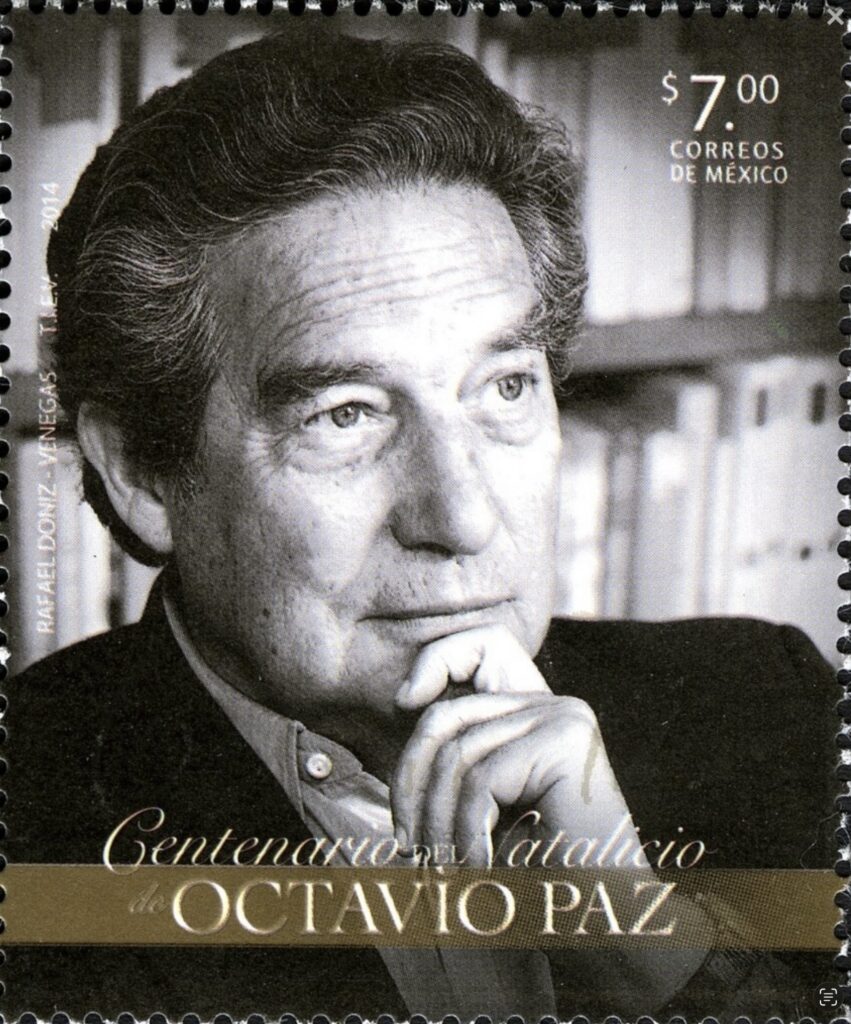
In 1990, when the Swedish Academy awarded the Nobel Prize in Literature to Octavio Paz, it cited “impassioned writing with wide horizons, characterized by sensuous intelligence and humanistic integrity.”
Few phrases could better capture a career that spanned more than six decades and refused, at every turn, to stay within a single genre, ideology, or national tradition. Paz was a poet first and always, but he was also an essayist, a diplomat, a fierce political critic, and one of the most influential interpreters of Mexican identity the country has ever produced.
A Childhood Between Two Mexicos
Octavio Paz was born in Mexico City on March 31, 1914, into a family shaped by upheaval. His father, a lawyer, represented the peasant leader Emiliano Zapata during the Mexican Revolution, and the household carried the weight of that turbulent era throughout Paz’s childhood.
He grew up largely in the care of his grandfather, a journalist and novelist with a library that gave the young Paz early and unrestricted access to literature in Spanish, French, and English. That mixture of revolutionary politics and cosmopolitan reading would define his entire intellectual life: a writer rooted in Mexican soil who never stopped looking outward.
Paz began publishing poetry as a teenager and, by his early 20s, was already a recognizable voice in Mexican letters. In 1937, he traveled to Spain during the Civil War, attending the Second International Congress of Anti-Fascist Writers alongside figures like Pablo Neruda and Ernest Hemingway.
The trip radicalized him politically and artistically, though he would later break decisively with Stalinism and the Soviet-aligned left, a rupture that cost him friendships but confirmed his lifelong suspicion of ideological orthodoxy in any form.
Diplomat and Dissident
For much of his adult life, Paz worked in Mexico’s diplomatic service, with postings in France, Japan, Switzerland, and eventually India, where he served as ambassador from 1962 to 1968. His years in Paris after World War II brought him into contact with the Surrealists, particularly André Breton, whose influence on Paz’s poetry was profound and lasting.
His time in India and Japan opened him to Buddhist and Hindu thought, tantric philosophy, and East Asian poetics, all of which he wove into his later work with a fluency few Western writers of his generation could match.
His diplomatic career ended abruptly in October 1968, when the Mexican government massacred student protesters in the Tlatelolco district of Mexico City just before the Olympic Games opened in the capital. Paz resigned his ambassadorship in protest, a decisive and public break with the government he had served.
The episode confirmed the pattern of his political life. Unwilling to align permanently with left or right, he directed his criticism wherever he saw authoritarianism, whether in Soviet communism, Latin American dictatorships, or the Mexican one-party state itself.
This independence made him a controversial figure in Mexican intellectual circles, admired by some as a model of principled nonalignment and resented by others as insufficiently loyal to the left.
The Labyrinth of Solitude
No single work did more to establish Paz’s reputation than “El laberinto de la soledad” (“The Labyrinth of Solitude”), published in 1950. Part essay, part meditation, part cultural psychoanalysis, the book set out to explain the Mexican character through its history of conquest, colonization, and revolution.
Paz argued that Mexicans carried a wound from the collision of Indigenous and Spanish civilizations, one expressed in masks, fiestas, and a guarded, solitary relationship to the self and to others.
The book was not without critics, who found its sweeping generalizations reductive, but it became a foundational text for understanding Mexican identity and remains widely read and taught today, in Mexico and far beyond.
Paz followed this vein of cultural and historical essay-writing throughout his career, producing studies on art, eroticism, politics, and the nature of poetry itself. “El arco y la lira” (“The Bow and the Lyre,” 1956) laid out his theory of poetry as a form of knowledge distinct from but equal to philosophy and science, a vehicle for recovering the kind of experience that modern, rationalized life tends to suppress.
Poetry: Sunstone and Beyond
As a poet, Paz’s central achievement is often considered “Piedra de sol” (“Sunstone,” 1957), a 584-line poem whose length mirrors the 584-day cycle of the planet Venus in the Aztec calendar. The poem circles obsessively through themes of erotic love, time, and historical memory, ending exactly where it began, a formal structure that enacts the cyclical worldview it describes.
It stands as one of the great long poems of 20th-century Spanish-language literature, placing Paz in conversation with predecessors like the Peruvian César Vallejo and the Chilean Pablo Neruda, while marking out territory distinctly his own.
Across his career, Paz’s poetry moved from the political and surrealist-influenced verse of his youth toward increasingly spare, meditative, and formally experimental work, including concrete poetry and collaborative pieces written with poets in other languages.
He was, throughout, a poet of dualities: solitude and communion, eroticism and asceticism, the ancient and the modern, Mexico and the wider world. He believed that poetry’s task was to reconcile these opposites, if only for the duration of a poem.
Legacy
Beyond his own writing, Paz shaped Mexican intellectual life institutionally. He founded and edited two influential magazines, “Plural” and later “Vuelta,” which became essential venues for literary and political debate in Mexico and Latin America more broadly, showcasing writers, artists, and critics of vastly differing views under Paz’s insistence on open, rigorous argument rather than ideological conformity.
By the time he received the Nobel Prize in 1990, Paz was already recognized as Mexico’s preeminent living writer, a status he held until his death in Mexico City on April 19, 1998.
His influence extends well past his own bibliography. He helped define how several generations of readers, in Mexico and internationally, have thought about Mexican identity, the relationship between poetry and politics, and the possibility of a writer remaining independent of both left and right without abandoning moral seriousness.
Today, “The Labyrinth of Solitude” and “Sunstone” remain standard points of entry into Latin American literature, and Paz himself is remembered not only as a poet of extraordinary range but as one of the 20th century’s most-searching essayists on the meaning of modern life.