From “Bénin” to Dahomey
For most of the 1890s, mail from France’s holdings on the Bight of Benin traveled under borrowed or makeshift labels: the general French Colonies issues, then stamps marked “Golfe de Bénin” and simply “Bénin.” In 1899 the colony finally received stamps bearing its own official name, and that name was a mouthful: DAHOMEY ET DÉPENDANCES — Dahomey and Dependencies.
The Stamps
The stamps used France’s standard colonial “key type,” the Navigation and Commerce design, showing allegorical figures representing the two pillars of empire as Paris saw them. Every French colony shared the same frame and picture; only the colony name and the value, printed separately in a tablet at the bottom, told one territory’s stamps from another’s.
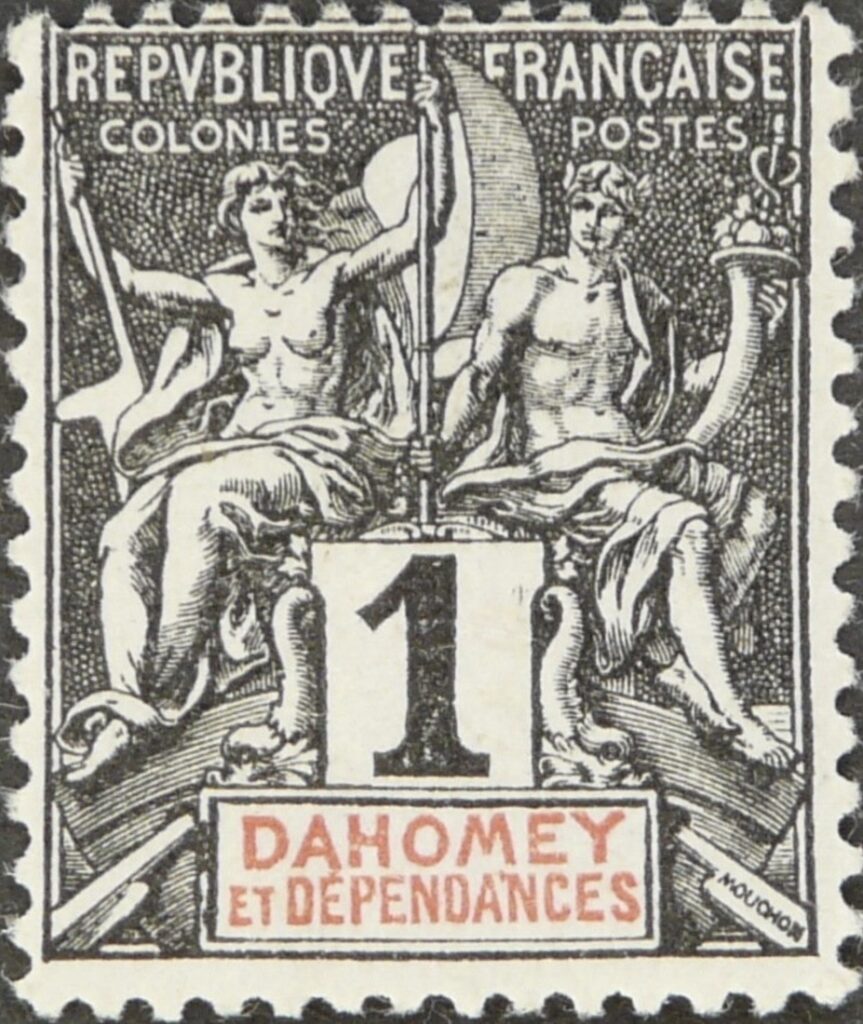
The first five values appeared in 1899. A larger series followed from 1901 through 1905, running from a humble 1-centime stamp up through the franc values, for about seventeen stamps in all. When new designs arrived for French West Africa, the inscription was shortened to plain “Dahomey.” The old Navigation and Commerce stock didn’t go to waste, though; leftover stamps were later surcharged with new values and put back into service.
What Were the “Dependencies”?
The name was not ornamental. A French decree of June 22, 1894, created the Colony of Dahomey and Dependencies after France defeated King Béhanzin in the Second Franco-Dahomean War. The new colony stitched together several very different pieces:
Porto-Novo. The coastal kingdom of King Toffa was France’s oldest foothold. Toffa first accepted a French protectorate in 1863, seeking protection from Abomey and from the British at Lagos, and renewed it in 1882. Porto-Novo became the colonial capital and remains Benin’s capital today.
The Kingdom of Dahomey. The old Fon kingdom centered on Abomey, conquered in the 1892–94 campaigns. France installed a compliant king, Agoli-Agbo, before abolishing the monarchy outright in 1900.
The coastal trading towns. Cotonou, Ouidah, Grand-Popo and Agoué, once centers of the Atlantic slave trade, were annexed directly.
The northern hinterland. The largest “dependency” was the interior: the Bariba kingdoms of Borgou, Djougou and the Atakora highlands, brought in during the late 1890s through treaties and military expeditions as France raced Britain and Germany for territory. Boundary agreements with Germany (Togo) and Britain (Nigeria) fixed the colony’s long, narrow shape.
French administrators sorted all this into three legal categories: territories annexed outright, territories under protectorate where local rulers kept their thrones under French supervision, and “territories of political action,” where French control was still more aspiration than fact. The word “dependencies” covered everything that wasn’t the conquered kingdom itself.
The End of the Long Name
In 1904 Dahomey was folded into the federation of French West Africa (Afrique Occidentale Française), governed from Dakar. The colony would become the Republic of Dahomey at independence in 1960 and take the name Benin in 1975, bringing the story full circle to the “Bénin” stamps of the 1890s.