Arthur C. Clarke spent his career doing something few writers ever manage: He predicted the future accurately enough, and often enough, that engineers and scientists took his fiction as a kind of working blueprint.
He proposed the concept of geostationary communications satellites in a technical paper years before the rocketry existed to launch one, and decades later lived to see that exact system girding the planet’s telecommunications.
He is remembered as one of the “Big Three” of golden-age science fiction, alongside Isaac Asimov and Robert A. Heinlein, but Clarke’s particular gift was fusing hard scientific plausibility with a sense of cosmic wonder, producing fiction that read as much like informed speculation as like storytelling.
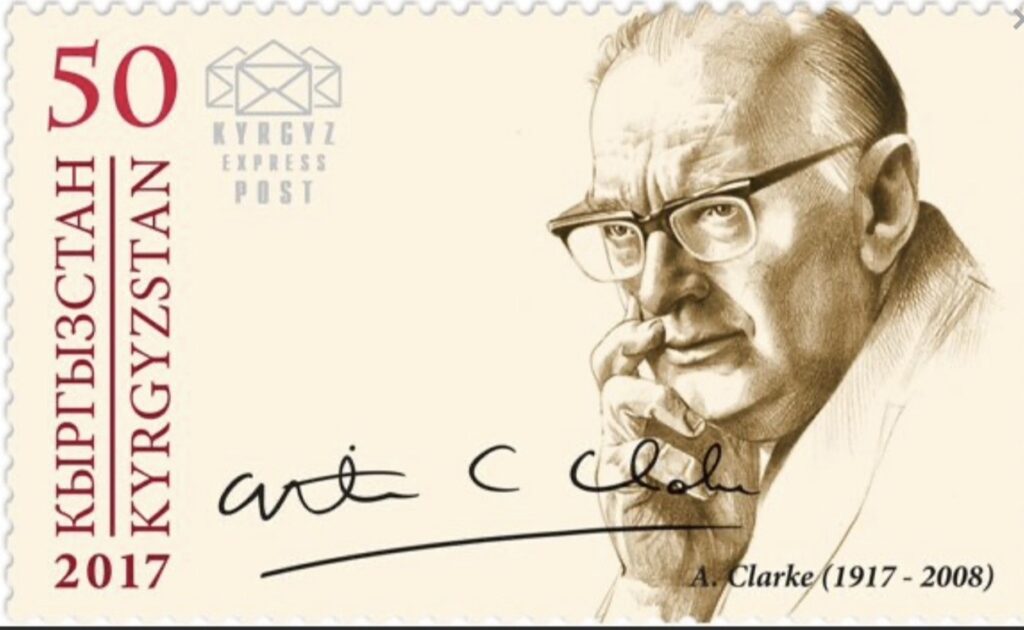
This 2017 stamp from Kyrgyzstan is part of a series on famous persons which included J.R.R. Tolkien and Jonathan Swift. It is one of many worldwide issues, including one from Great Britain, the land of his birth, and two from Sri Lanka, his adopted country.
From Somerset to the RAF
Clarke was born in 1917 in Minehead, a small town in Somerset, England, into a farming family of modest means. He was an avid reader of American pulp science fiction magazines as a boy, and by his teenage years he had already joined the British Interplanetary Society, an amateur organization devoted to the then-fringe idea that spaceflight was achievable. He could not initially afford a university education and worked as a clerk before the Second World War intervened.
During the war, Clarke served in the Royal Air Force, where he specialized in early radar technology, working on ground-controlled approach systems that helped aircraft land safely in poor visibility. This technical, hands-on experience with cutting-edge electronics shaped the rest of his career.
Clarke was never a writer who treated science as decoration; he treated it as a set of hard constraints his stories had to respect. After the war, he used a veteran’s grant to study mathematics and physics at King’s College London, graduating with first-class honors, before turning to writing full-time.
The Satellite Paper and a Reputation for Prophecy
In 1945, before he had published much fiction at all, Clarke wrote a paper for the magazine Wireless World proposing that satellites placed in a specific orbit roughly 22,000 miles above the equator would appear to hang motionless relative to a point on the ground, making them ideal relay stations for global communications.
This geostationary orbit is now sometimes informally called the Clarke Orbit in his honor. He received no patent and little immediate credit, but by the 1960s the technology had caught up to the idea, and Clarke’s paper is now widely regarded as a foundational document in the history of telecommunications.
This episode set the tone for how Clarke would be perceived for the rest of his life: not merely as a science fiction author but as a genuine technological visionary, someone whose imaginative leaps had a track record of arriving early rather than merely entertaining.
He later formalized his interest in forecasting with his famous three laws of prediction, the best known of which holds that any sufficiently advanced technology is indistinguishable from magic.
Major Works
Clarke’s breakout novel was Childhood’s End (1953), in which alien “Overlords” arrive on Earth and guide humanity toward a strange, transcendent evolutionary leap, a book that established his recurring interest in transformation, transcendence, and the limits of human understanding when confronted with vastly superior intelligences.
The City and the Stars (1956), a reworking of an earlier novel, imagined a nearly immortal human civilization a billion years in the future, sealed inside a single computer-run city.
His most famous work by far is 2001: A Space Odyssey, developed in close collaboration with director Stanley Kubrick and released simultaneously as a novel and a landmark 1968 film.
The story follows the discovery of an alien monolith on the Moon, a mission to Jupiter overseen by the increasingly unstable computer HAL 9000 (HAL is one letter away from IBM), and an astronaut’s transformation into a mysterious “Star Child.”
The film and novel were developed in tandem, with Clarke and Kubrick trading ideas throughout production, and the project cemented Clarke’s reputation with a mainstream audience far beyond the usual science fiction readership. He returned to that universe with three sequel novels, including 2010: Odyssey Two, which was also adapted into a film.
Clarke wrote widely beyond the Space Odyssey series. Rendezvous with Rama (1973) depicts a mysterious, vast alien spacecraft passing through the solar system, explored by a human crew who never fully solve its mysteries—a novel praised for its restraint and its refusal to over-explain the alien technology at its center.
The Fountains of Paradise (1979) imagines the construction of a space elevator, another Clarke idea, like the geostationary satellite, that has since been taken seriously by actual aerospace engineers as a long-term possibility.
Style and Themes
Clarke’s prose was generally spare and functional rather than ornate. He was not primarily a stylist, and he said as much himself. What distinguished his work was the scale of his imagination and his particular fascination with transcendence: again and again, his stories depict humanity encountering something vastly older, more advanced, or more evolved than itself, and being changed, humbled, or elevated by the encounter.
Unlike much of the era’s science fiction, which often treated aliens as monsters to be fought or obstacles to be overcome, Clarke’s aliens were frequently indifferent, incomprehensible, or benevolent in ways humans could barely process. This gave his fiction a tone of awe rather than conquest, closer in spirit to religious or mystical writing than to adventure fiction, despite Clarke’s own firm and often outspoken atheism.
He was also unusually disciplined about scientific plausibility, and he maintained working relationships with actual scientists and engineers throughout his career, treating his fiction as a genuine extension of his technical interests rather than a separate creative outlet.
Later Life and Legacy
Clarke moved to Sri Lanka in 1956, initially drawn by his interest in scuba diving and underwater exploration, and he lived there for the rest of his life, eventually becoming a Sri Lankan citizen while retaining strong ties to Britain.
He was knighted in 1998. In his later years he suffered from post-polio syndrome, which confined him to a wheelchair, but he continued writing and collaborating with other authors, including a series of novels co-written with Gentry Lee that extended the Rama universe.
Clarke died in Sri Lanka in 2008 at the age of 90. His influence on both science fiction and actual space exploration is difficult to overstate: NASA engineers, satellite designers, and astronauts have repeatedly cited his work as formative, and Kubrick’s film version of 2001 remains one of the most influential and frequently studied works in cinema.
Alongside Asimov and Heinlein, Clarke helped define what serious, scientifically grounded science fiction could be, but his particular signature—the fusion of rigorous technical speculation with a genuine sense of the numinous—remains distinctly his own, and it is why his name still attaches itself, more than most authors’, to real technologies that came after him.