From a quiet exile’s grave in Santa Marta to a solemn homecoming in Caracas — the long journey of South America’s liberator did not end at death.
On December 17, 1830, Simón Bolívar — El Libertador, the man who had freed six nations from Spanish rule — died at the age of 47 in the hacienda of San Pedro Alejandrino, near Santa Marta, on the Caribbean coast of present-day Colombia.
He died not in triumph, but in defeat. Exhausted by decades of war, ravaged by tuberculosis, and bitterly disillusioned by the political fracturing of the great Gran Colombia he had dreamed into existence, Bolívar had resigned the presidency and was preparing to sail into European exile when death overtook him.
He was buried quietly in the Cathedral of Santa Marta, far from the Venezuela that had given him birth. The ceremony was modest — a reflection of how dramatically his star had fallen in his final years. Politicians who had once adored him now cursed his name. The grand liberator was interred almost as a stranger in a foreign land.
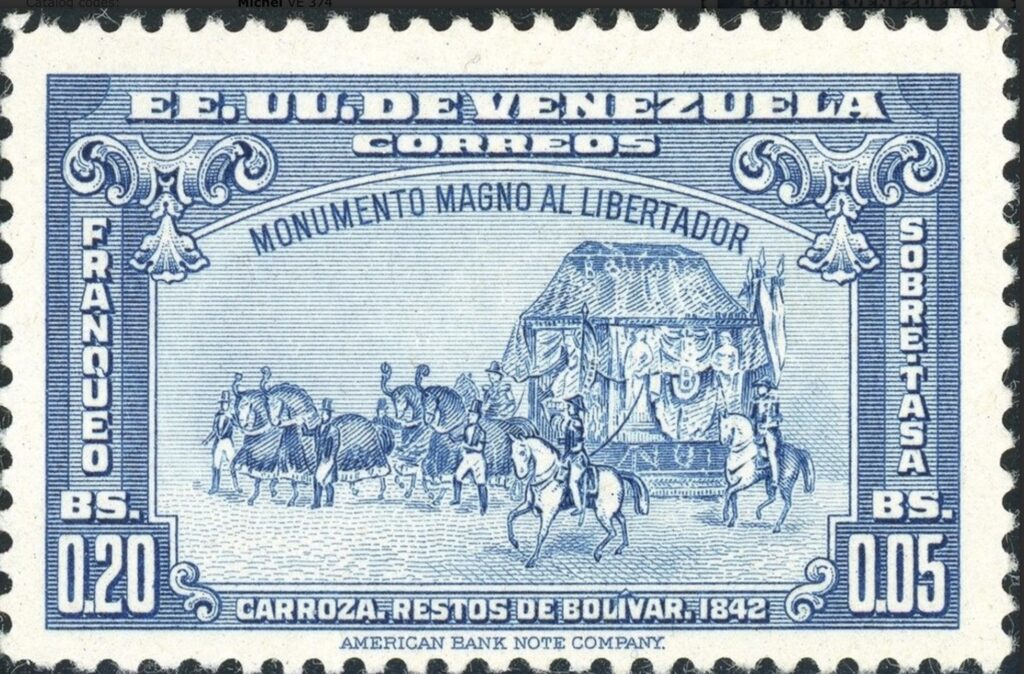
Simón Bolívar was honored by this 1942 Venezuelan postage stamp, which commemorated the centennial of the transfer of his ashes to Caracas. Several other Venezuelan stamps that year, of various denominations, showed an heroic statue of the Liberator.
For 12 years, Bolívar’s remains rested in Santa Marta. During that time, history’s verdict on the man began to shift. As the newly independent republics of South America struggled to forge national identities, they increasingly looked to Bolívar as a founding myth — a unifying symbol of sacrifice and continental destiny. Venezuela, above all, reclaimed him as her greatest son.
In 1842, under the presidency of José Antonio Páez — once Bolívar’s most formidable general and later his political adversary — Venezuela formally requested the repatriation of his remains. On December 17 of that year, exactly 12 years after his death, a military procession conveyed his coffin to Caracas. The city received him with a ceremony befitting a god. Church bells rang, cannons fired salutes, and tens of thousands lined the streets. The man who had been allowed to die nearly forgotten was now a national saint.
His remains were placed in the Cathedral of Caracas, and later moved to the National Pantheon — Venezuela’s shrine to its greatest citizens — where he lay for over 160 years.
The reburial of 2010
In July 2010, Bolívar’s remains were moved once more — this time under circumstances that stirred considerable controversy. Venezuelan President Hugo Chávez, who had long invoked Bolívar as the spiritual patron of his Bolivarian Revolution, ordered the exhumation of the liberator’s bones for scientific examination.
Chávez had publicly embraced a fringe theory that Bolívar had not died of tuberculosis, but had instead been assassinated by his political enemies — a narrative that conveniently mirrored Chávez’s own self-presentation as a besieged revolutionary hero.
The exhumation was conducted with theatrical solemnity. Chávez live-tweeted the event and was visibly emotional on national television as workers opened the tomb. Scientists examined the remains but ultimately found no conclusive evidence of poisoning, and the official cause of death remained tuberculosis complicated by pleurisy.
Following the examination, Bolívar’s remains were reinterred in a newly redesigned National Pantheon in Caracas on July 16, 2010 — a date chosen to coincide with Venezuela’s declaration of independence. The ceremony was lavish, attended by heads of state from across Latin America. A new, custom-designed sarcophagus of crystal and gold was created for the occasion.
Critics — both inside Venezuela and abroad — saw the entire episode as a political spectacle: Chávez conscripting the bones of the liberator in service of his own ideology. Supporters viewed it as a long-overdue act of national homage. Whatever one’s perspective, the reburial underscored a truth that has always attended Bolívar’s legacy: His story belongs as much to the living as to history.
Legacy in stone
Simón Bolívar has now been buried three times — in Santa Marta, in the original Pantheon, and in the redesigned one. Each interment reflects the political moment that demanded it. He remains, two centuries on, one of the most contested and celebrated figures in the Americas: a man whose bones, like his memory, have never quite been allowed to rest.