Why Eva Perón remains one of the most heroic — and enduring — figures of the twentieth century
She was born in poverty, dismissed by the powerful, and dead at thirty-three. Yet Eva Perón — “Evita” — managed to reshape an entire nation’s relationship with its own forgotten people. More than seven decades after her death, her image still graces the walls of Buenos Aires. Flags still fly in her memory. And the word “heroic” still fits her with an honesty that few public figures in history can claim.
A life forged in struggle
Eva María Duarte was born in 1919 in the small Argentine town of Los Toldos, the illegitimate daughter of a farmhand and a seamstress. She grew up in the kind of grinding rural poverty that teaches you, very early, the difference between those who matter in a society and those who are made to feel they don’t. At fifteen, she boarded a bus to Buenos Aires with almost nothing. Through sheer determination, she carved out a career in radio and theatre — not because doors opened for her, but because she forced them open herself.
Most Americans know her story only from the play or the movie — or perhaps the song that outlived both.
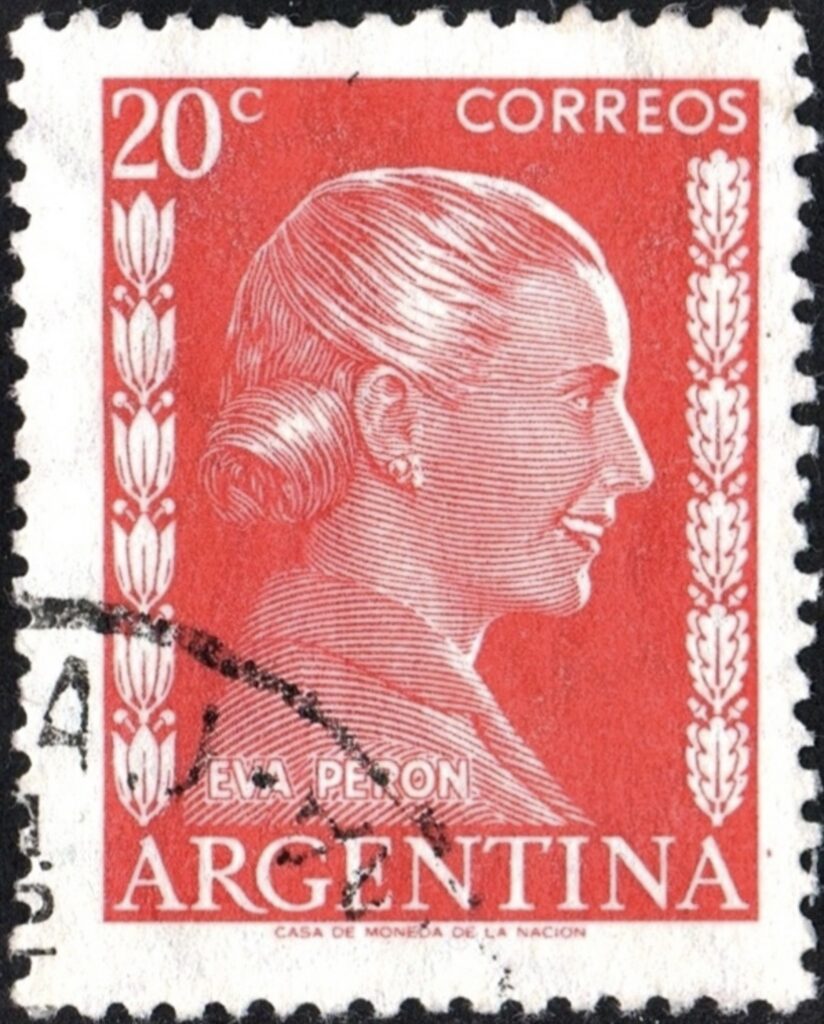
This stamp was issued in 1952, the year of her death at age 33 from cancer.
The country went into mourning. Government and business stopped. The flag was flown at half-staff for 10 days.
If you want to know more, Wikipedia has an extensive article. Or you can get one of many books.
That backstory is not incidental to her heroism. It is the whole point. When she stood before crowds of workers, descamisados — the shirtless ones, Argentina’s poor — and wept alongside them, it was not theater. She had lived their lives. She knew what it meant to be invisible to the state.
Champion of the forgotten
After marrying Colonel Juan Perón in 1945, Eva didn’t retreat to a ceremonial role. She became the most active first lady Argentina had ever seen — and arguably one of the most impactful in world history. She founded the Eva Perón Foundation, which distributed food, medicine, shoes, and sewing machines to hundreds of thousands of poor families. Hospitals were built. Schools were opened. The foundation operated on a massive scale, and Eva personally oversaw much of its work, sometimes meeting with petitioners for up to twenty hours a day.
Her enemies — and she had many, particularly among Argentina’s old aristocracy — called her a demagogue. They resented her power, her origins, and her refusal to be decorative. But for the millions who received direct aid through her foundation, those arguments rang hollow.
Women’s suffrage and lasting justice
In 1947, Eva led a relentless campaign that resulted in Argentine women gaining the right to vote. It was a landmark victory in Latin American history, and she pursued it personally, publicly, and without apology. She understood that political power meant nothing to people who had no voice — and she spent her brief life trying to give that voice back.
By the early 1950s, Eva was dying of cervical cancer, though the Argentine government initially hid her diagnosis from the public. She continued to appear in public, visibly frail, refusing to stop. Her 1952 death at thirty-three triggered a national outpouring of grief so profound that thousands camped in the streets for days, waiting to pay their respects.
Why heroism is the right word
Heroism, at its core, means using what power you have in service of those who have less. By that measure, Eva Perón qualifies unequivocally. She didn’t inherit power or ease. She built influence from nothing, then turned it outward — toward hospitals, toward voting rights, toward human dignity. Flawed, fierce, and utterly committed, she remains proof that a single life, lived with purpose, can genuinely change the world.
Argentina remembers her. History should too.