The flag arrived on a Tuesday.
Eleanor Marsh had known it was coming — the same way she’d known, three weeks before the telegram, that something had shifted in the world. A mother’s knowledge, wordless and bone-deep. She’d been folding laundry when the Army staff car pulled to the curb, and she’d set down her husband’s shirt with the careful precision of someone who understood that ordinary gestures were about to become sacred.
They handed her a folded triangle of red, white, and blue. Her son Thomas was twenty-two years old. He had died on a beach in Normandy on June 6th, 1944.
The gold star had a history before the war made it personal.
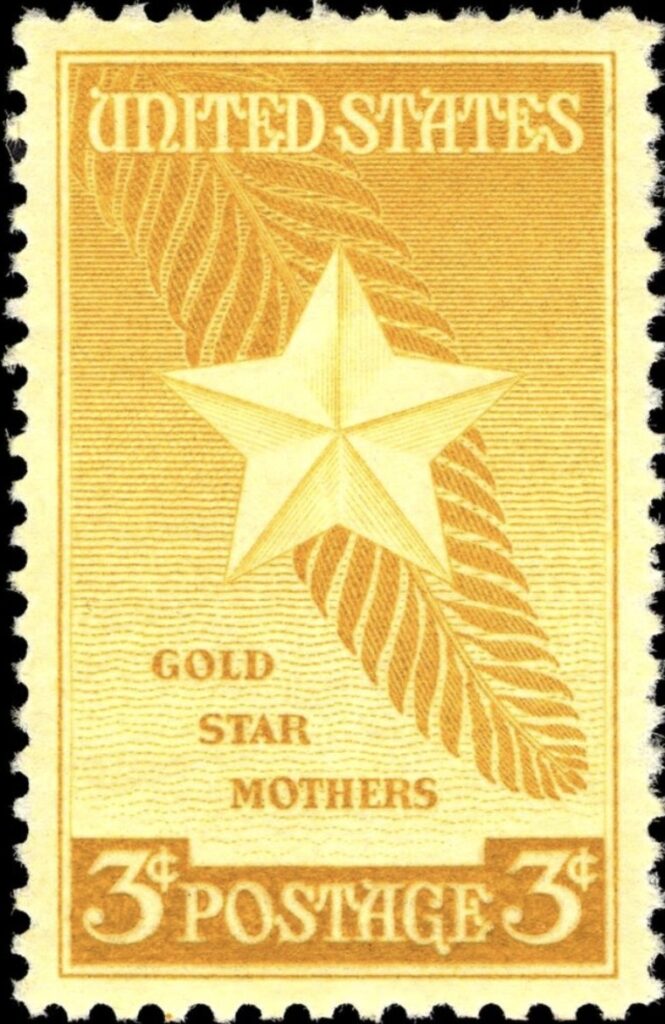
The United States issued this Gold Star Mothers stamp in 1948.
The Post Office printed 77 million copies.
While there is no exact count of the number of Gold Star Mothers that were created by the conflict, more than 400,000 American service members died during the conflict.
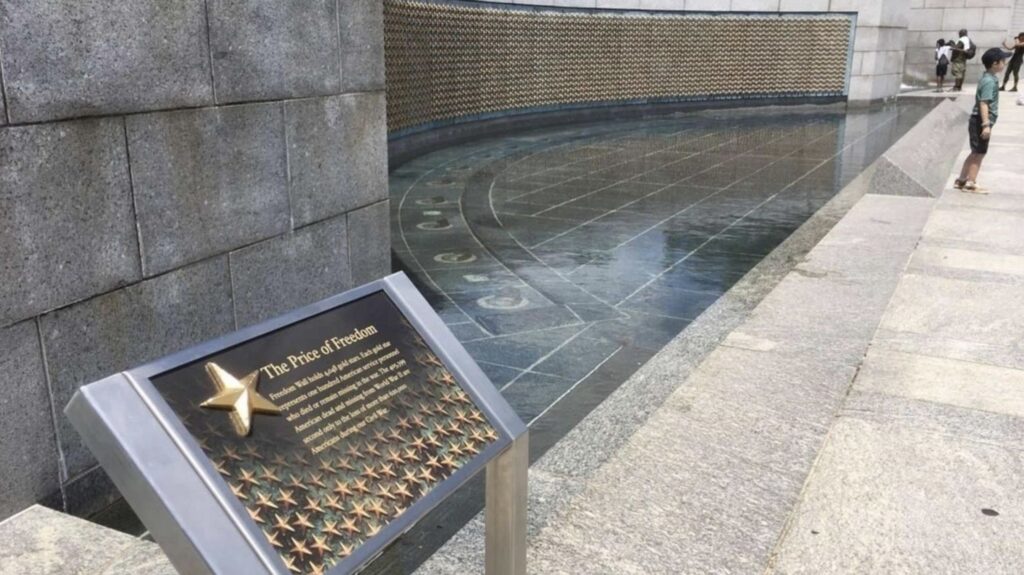
The Freedom Wall at the World War II memorial in Washington features, 4,048 stars, each representing 100 men who died in the conflict.
During the First World War, families had begun hanging service flags in their windows — blue stars for every family member serving, gold for every one who had fallen. By the time America entered the Second World War, the tradition had taken firm root. Gold Star Mothers, the women who bore this particular grief, had even formed an organization, founded in 1928 by Grace Darling Seibold, who had lost her own son in the previous war. She had wanted these women to find one another. She understood what isolation did to a person in the dark.
By 1945, there were hundreds of thousands of gold stars in windows across America.
Eleanor’s neighbor, Ruth Hayashi, lost her son George in the Pacific. He had volunteered from an internment camp — had fought for a country that had imprisoned his family — and still the gold star came to Ruth’s window just the same as any other mother’s. The two women, who had been polite but distant before the war, began meeting on Tuesday afternoons to drink tea and say very little. Sometimes they talked about their boys. Sometimes they only sat.
That, Eleanor would later say, was the truest thing the war gave her.
The grief of a Gold Star Mother was unlike other grief. It carried a particular weight of distance — no body to bury, often no clear account of the final moments, just an official letter and a country’s gratitude folded into a flag. Many women never fully learned how their sons had died. They were left to imagine, which was often worse.
And yet they endured. They organized. They advocated for better notification procedures, for burial benefits, for the acknowledgment that their loss was not a private matter but a national one. They marched in Memorial Day parades, small gold pins on their lapels, and they made the rest of the country look at what the war had truly cost.
Eleanor kept the flag on the mantle until the day she died, in 1979. Beside it she kept a photograph of Thomas at seventeen, laughing at something just outside the frame.
She never stopped wondering what it was.