The Man Who Dreamed in Steam and Stars
There are writers who capture their era, and there are writers who invent the future. Jules Verne did both.
Born on February 8, 1828, in the port city of Nantes, France, Verne grew up watching ships disappear over the Atlantic horizon and spent his boyhood daydreaming about the worlds that lay beyond the edge of sight. That restless imagination — shaped by the docks of Nantes, the lecture halls of Paris, and the voracious reading habits of a true polymath — would eventually make him one of the most translated authors in history, second only to Agatha Christie among fiction writers.
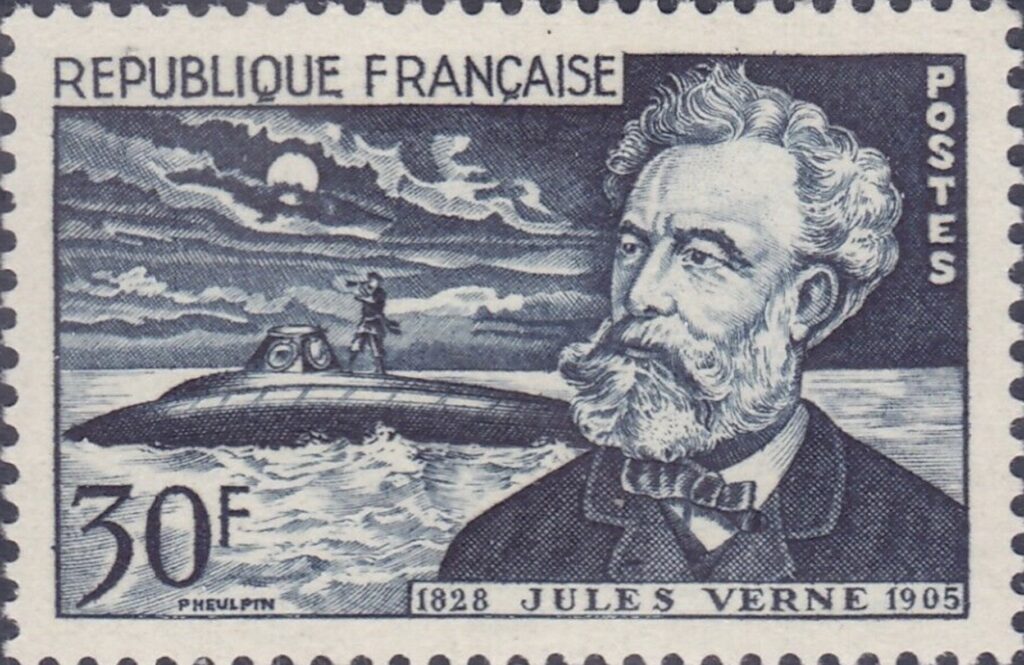
This 1955 French postage stamp, commemorating the 50th anniversary of his death, features a submarine, recognizing that one of his most famous works was Twenty Thousand Leagues Under the Sea. Verne’s Nautalis was prescient of today nuclear-powered boats, and is indelibly etched on the memories of movie fans from 1954 forward.
Verne studied law at his father’s insistence, drifting to Paris in the late 1840s ostensibly to pursue a legal career. But the city had other plans. He fell in love with the theater, began writing plays, and circled the literary salons where ambition and talent competed for attention.
He was befriended by Alexandre Dumas (fils and père), who gave the young Verne his first real break — a slot on the stage of the Théâtre Historique (later the Théâtre-Lyrique). (He would dedicate Mathias Sandorf, published in 1885, to both men.)
The plays were modest successes, but Verne sensed that his true calling lay elsewhere.
He was fascinated by science, geography, and exploration. He read scientific journals the way other men read newspapers. He was building something in his mind, though he hadn’t yet found the form to hold it.
The Partnership That Changed Everything
The form arrived in the person of Pierre-Jules Hetzel, one of the great publishers of 19th-century France. When Verne approached Hetzel in 1862 with a manuscript unlike anything the publisher had seen before, the meeting was almost accidental — but its consequences were enormous.
Hetzel had a clear vision for what French literature needed: engaging, scientifically grounded adventure stories that would educate as well as entertain, suitable for families and young readers. Verne’s manuscript fit that vision so perfectly it seemed destined.
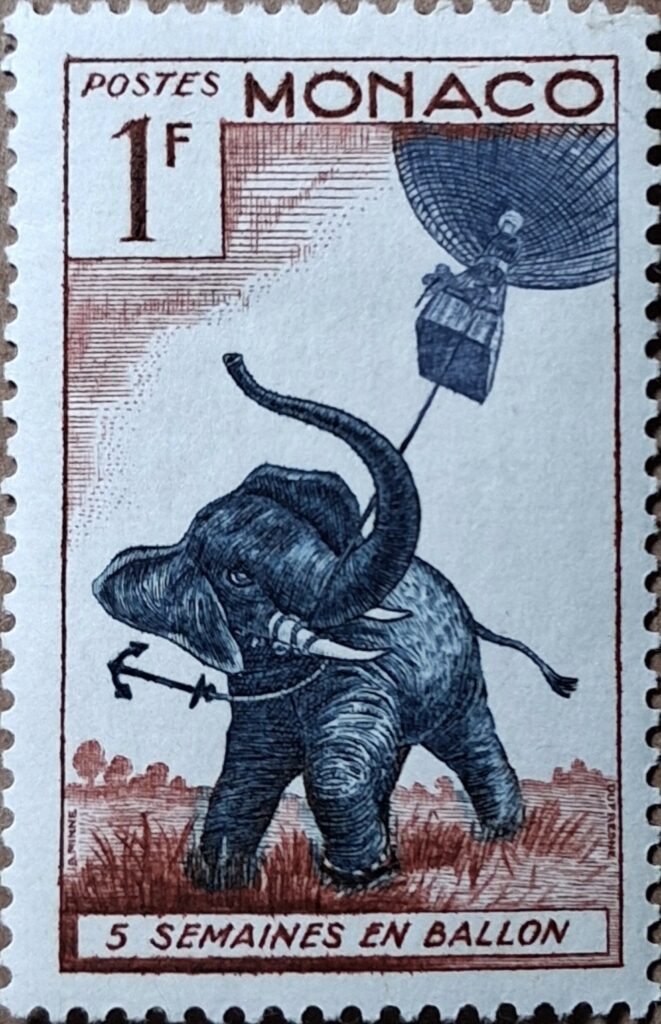
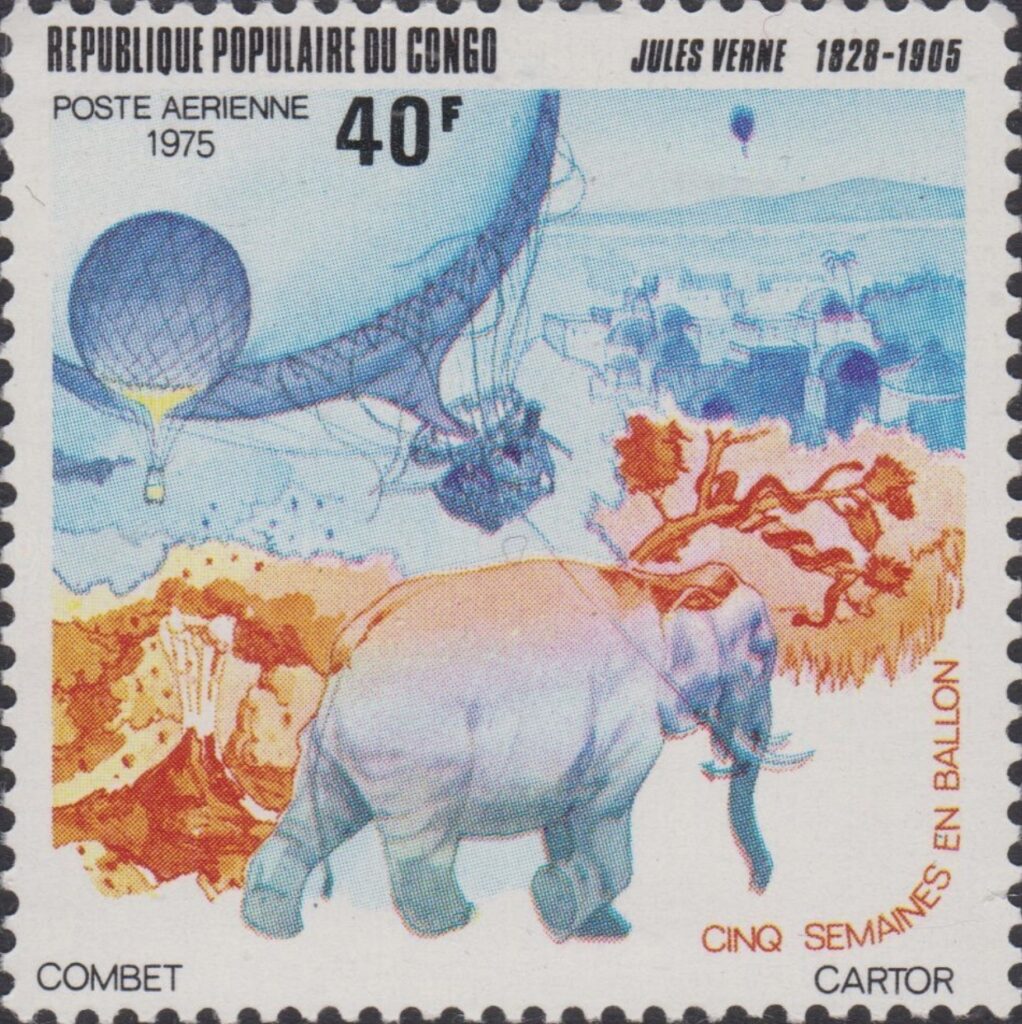
Both Monaco and the Congo have issued postage stamps, in 1955 and 1975 respectively, honoring Verne’s first published novel, Five Weeks in a Balloon.
The two men signed a contract that would bind them for the next 20 years. Verne would produce two novels per year for Hetzel’s new magazine, the Magasin d’education et de Récréation. In return, he would receive a monthly salary, editorial guidance, and the distribution muscle of one of France’s most prominent publishing houses.
It was a remarkable arrangement — part artistic partnership, part industrial production — and it worked brilliantly. Hetzel pushed Verne hard on accuracy, clarity, and narrative drive. Verne pushed back with invention, humor, and sheer creative energy. Together they created a new genre.
Five Weeks in a Balloon: Where It All Began
The novel Hetzel accepted in 1862 was Five Weeks in a Balloon (Cinq semaines en ballon), published in January 1863. It was Jules Verne’s first major published novel, the inaugural entry in what would become the Voyages Extraordinaires — an epic series of 60-plus novels designed to take readers, in Hetzel’s words, “around the whole world, real and imagined.”
The premise is magnificently audacious. Dr. Samuel Fergusson, a brilliant and intrepid English explorer, conceives a plan to cross the African continent by hydrogen balloon, traveling west to east from Zanzibar to Senegal.
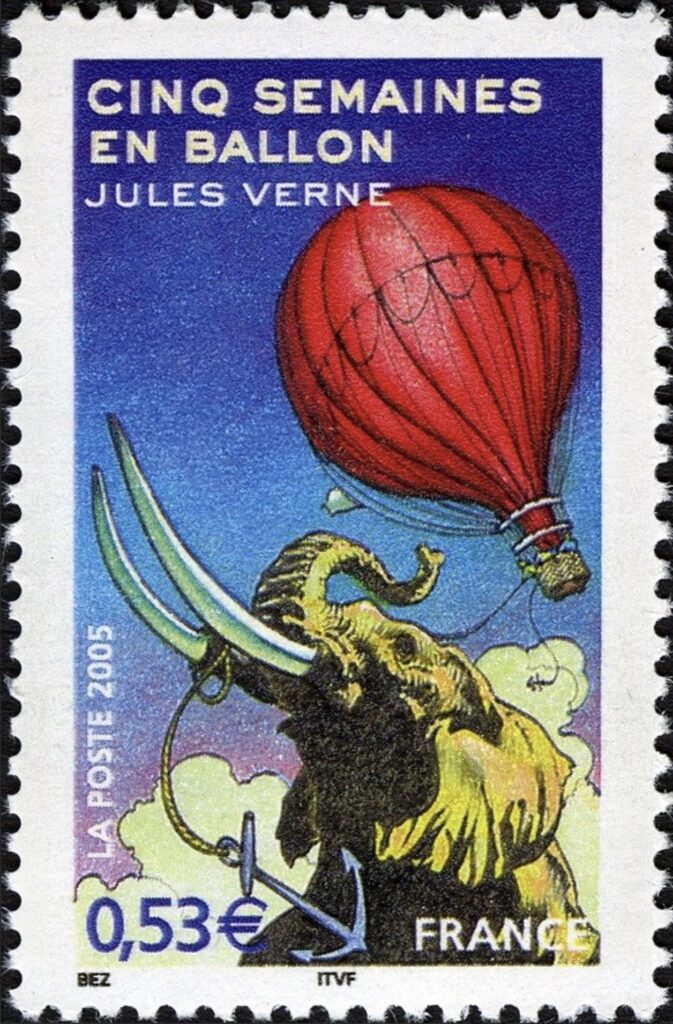
France chose to honor Verne’s first novel with this 2005 issue. All of the issues about this book portray the scene with the elephant, one of the most adventuresome parts of the novel.
He is accompanied by his loyal manservant Joe and his old friend Dick Kennedy, a Scottish hunter who spends much of the novel skeptical of the entire enterprise and yet cannot bring himself to abandon his friend. The balloon itself — named the Victoria — is Fergusson’s masterpiece, equipped with a clever heating system that allows the crew to control altitude without releasing precious gas, a technical innovation that Verne researched with characteristic thoroughness.
The novel unfolds as a series of encounters: with desert sandstorms and tropical storms, with volcanic landscapes and vast savannahs, with crocodile-infested rivers and the looming mystery of the Nile’s source.
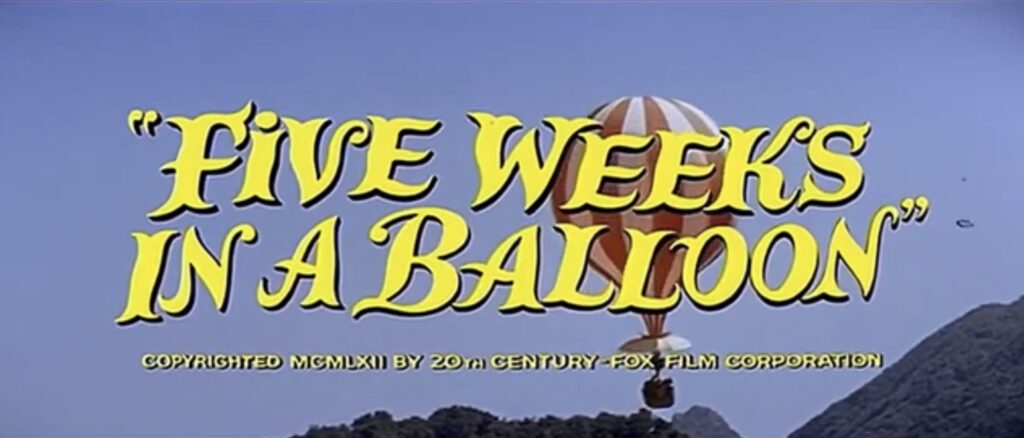
Irwin Allen produced a movie based on the novel in 1962, but chose to do it as a comedy, pretty much a slapstick. Probably not the Verne movie you would want to spend time with.
Verne draws on the real African exploration accounts of his day — Livingstone, Burton, Speke — and weaves fictional adventure through genuinely contemporary geographical debate. The result feels both thrillingly invented and rigorously grounded.
What makes the novel remarkable, especially for its time, is Verne’s understanding of narrative pacing. Each chapter introduces a new peril or discovery. The balloon rises and falls with the tension. Fergusson is calm to the point of serene absurdity, Kennedy is perpetually alarmed, and Joe is irrepressibly cheerful — a comic trio that carries the reader through five weeks of almost unrelenting danger with a lightness of touch that never tips into farce.
Science as Spectacle
Verne’s great innovation was treating science not as dry information but as spectacle. In Five Weeks in a Balloon, the technical details of the balloon’s operation are explained with enough precision to feel plausible without ever becoming tedious.
Fergusson’s heating system — using a pipe to warm the balloon’s hydrogen and thus control lift — is technologically inexact, but it functions perfectly as a narrative device, giving the crew a means of ascent and descent that allows Verne to choreograph their encounters with the landscape below.
This was the Verne method: research deeply, simplify intelligently, dramatize boldly. He spent hours in the Bibliothèque Nationale reading exploration journals, scientific reports, and geographical surveys. The Africa of Five Weeks in a Balloon is recognizably the Africa of contemporary European imagination — vast, mysterious, and awaiting “discovery” — and modern readers will rightly note the colonial assumptions embedded in that vision.
But within the context of its era, the novel’s engagement with real geography was genuinely innovative. Verne was asking readers to take science seriously, to find adventure in knowledge, to see the world’s unknowns not as threats but as invitations.
The Legacy of a First Novel
Five Weeks in a Balloon was an immediate success, going through multiple editions in its first year and launching Verne into the literary prominence he had sought for over a decade. It established the template for everything that followed: Journey to the Center of the Earth (1864), From the Earth to the Moon (1865), Twenty Thousand Leagues Under the Sea(1870), Around the World in Eighty Days (1872).
Each built on the formula refined in that first balloon voyage — a bold technological concept, a trio of contrasting characters, meticulous research married to unrestrained imagination.
Jules Verne died in 1905, having spent four decades reshaping what popular fiction could do and be. He gave readers a world where science was heroic, where curiosity was the highest virtue, and where the horizon — any horizon, terrestrial or oceanic or lunar — was always worth crossing.
It all began in a balloon, drifting east over Africa, with a calm doctor, a nervous Scotsman, and an irrepressible manservant named Joe — and one of the most extraordinary literary careers in history lifting off beneath them.
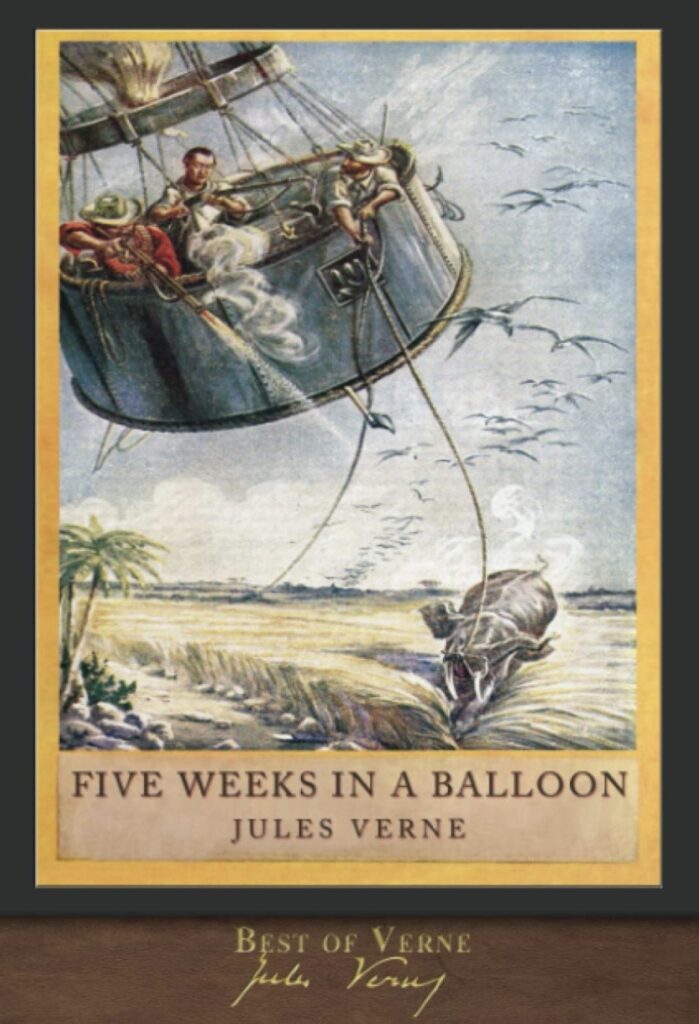
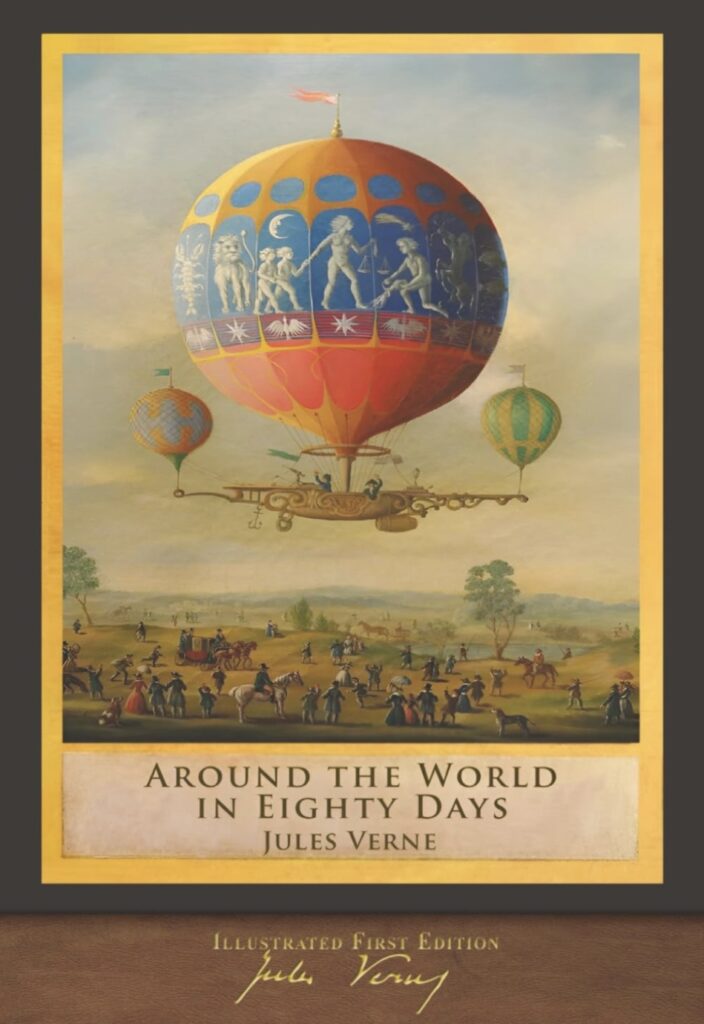
Verne put his characters in a balloon again, at least for part of their trip, in what may be his best-known adventure, Around the World in Eighty Days. It was more luxurious that the one featured in Five Weeks in a Balloon.