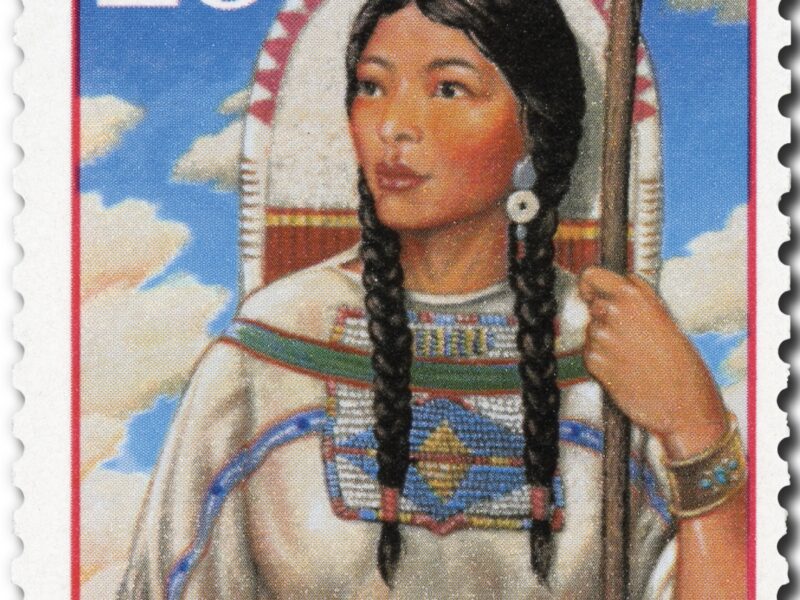
Susan B. Anthony died in 1906, 14 years before the amendment she had spent her life pursuing became law. She would not live to cast a ballot in a national election, but the Post Office would, over the following decades, cast her likeness twice — first in 1936, then again in 1955 — making her one of the earliest women honored on American stamps for what she had actually done, rather than for the family she’d married into or the throne she happened to occupy.
That distinction matters more than it might first appear. In the 90 years following America’s first postage stamp in 1847, the only women to appear on U.S. stamps had been Martha Washington, Pocahontas, Anna McNeill Whistler — commemorated for “Whistler’s Mother” on a Mother’s Day issue — and, improbably, Queen Isabella of Spain, who in 1893 became the first woman honored on American postage, appearing on no fewer than seven stamps. (The Columbus issues.)
Not one of them had been recognized for a career of political labor. It was only in 1936, with the Anthony stamp, that the Post Office finally honored a woman for her accomplishments rather than simply her fame.
Lobbying and Rejection
Getting there took lobbying, and it took longer than it should have. Women’s organizations, led by the National Woman’s Party, had pushed for an Anthony stamp for years, meeting with Post Office officials in 1934 and 1935 — only to be told that stamp collectors, a core constituency the Post Office was loath to alienate, likely wouldn’t be interested in an Anthony issue.
The bureaucratic reluctance eventually gave way, perhaps through the good offices of Eleanor Roosevelt, who had an “in.” The 3-cent purple stamp was issued on August 26, 1936, timed to coincide with the 16th anniversary of the ratification of the 19th Amendment. It carried a portrait of Anthony along with an inscription celebrating “Suffrage for Women.” Issued first in Washington, D.C., the stamp went on to sell nearly 270 million copies — a number that made the earlier bureaucratic hesitation look, in hindsight, badly misjudged.
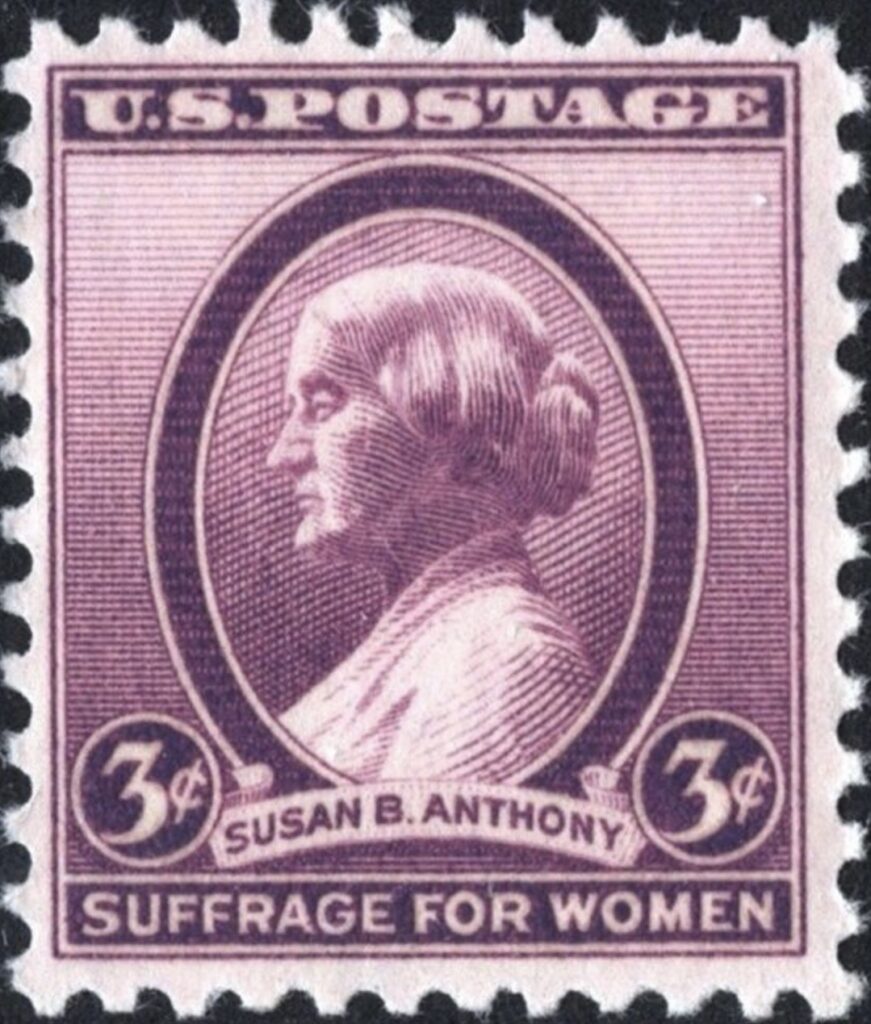
William Hunt, the postmaster in Rochester, New York, where Anthony had spent much of her life, had ordered 600,000 copies for local distribution and then, worried about running short, ordered 400,000 more — a striking bet given that Rochester’s population at the time was only around 325,000.
Anthony’s Rochester connection was not incidental to the enthusiasm. She had lived and worked there for decades, and it was in Rochester that she cast an illegal vote in the 1872 presidential election, an act of civil disobedience that led to her arrest and a widely publicized trial. Rochester’s eagerness to stock up on her stamp was, in its way, hometown pride translated into postal economics.
Nevertheless, Rochester was spurned as the site of the first day of issue, with the honor going to Washington, D.C.
From Commemorative to Definitive
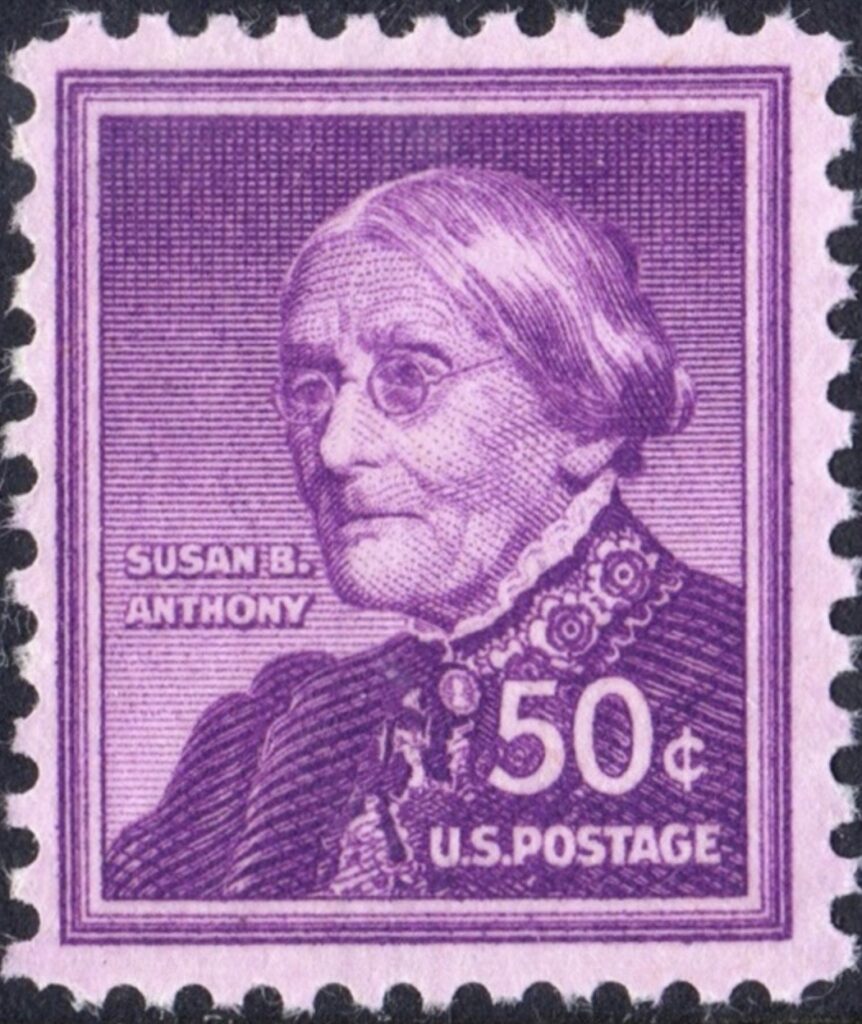
Anthony returned to American stamps 19 years later, in a different denomination. In 1955, the Post Office issued a 50-cent Susan B. Anthony stamp, timed to mark the 50th anniversary of the day Anthony met with President Theodore Roosevelt to discuss submitting a suffrage amendment to Congress.
This second stamp was a bright purple definitive, part of the ongoing Liberty series. Definitives, unlike commemoratives, are the workhorse stamps meant for sustained daily postal use rather than a single anniversary printing, and Anthony’s inclusion in that series signaled a kind of institutional permanence — she had moved from being a one-time honoree to a fixture of the everyday postal system, her face circulating on ordinary mail for years rather than months.
In 1979, the United States Mint began issuing the Susan B. Anthony dollar coin, the first United States coin to honor a female citizen. It would be issued between 1979 and 1981 and again in 1999.
Between the two stamps lies the arc of a life whose full weight the nation was still working out how to honor. Born in Adams, Massachusetts, on February 15, 1820, to a Quaker family, Anthony began as a teacher before joining the women’s rights movement in 1852. Her 50-year collaboration with Elizabeth Cady Stanton helped drive the movement forward, and Anthony appeared before every sitting Congress from 1869 to 1906, petitioning without pause for a constitutional amendment granting women rights equal to men’s.
She died in 1906 at age 86, 14 years before the 19th Amendment finally passed in 1920.
Between 1936 and 1955, the Post Office issued 12 stamps honoring women, including Jane Addams, Clara Barton, and a 1948 issue jointly commemorating Elizabeth Cady Stanton, Carrie Chapman Catt, and Lucretia Mott for the “100 Years of Progress of Women.”
Anthony’s two appearances bookend that slow, halting institutional reckoning — a reminder that even the small rectangle of a postage stamp had to be fought for, argued over, and finally granted, long after the argument it represented had already been won at the ballot box.