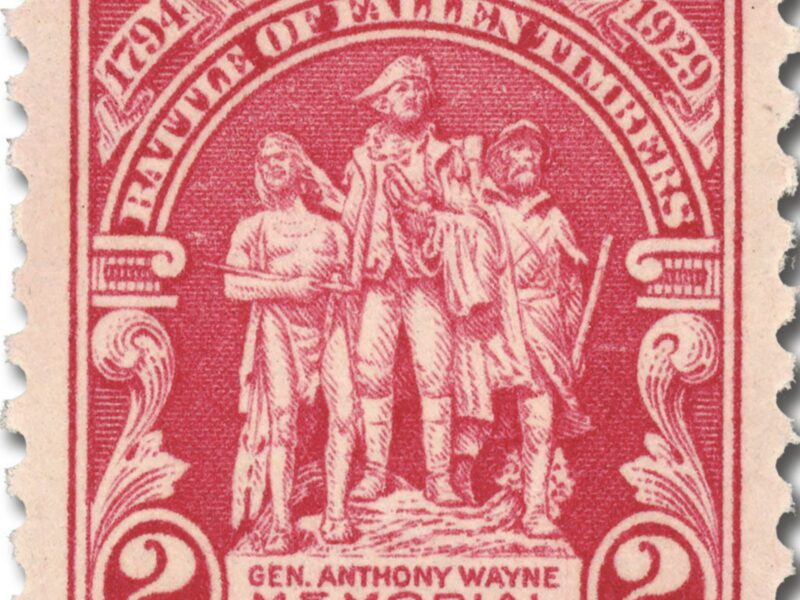
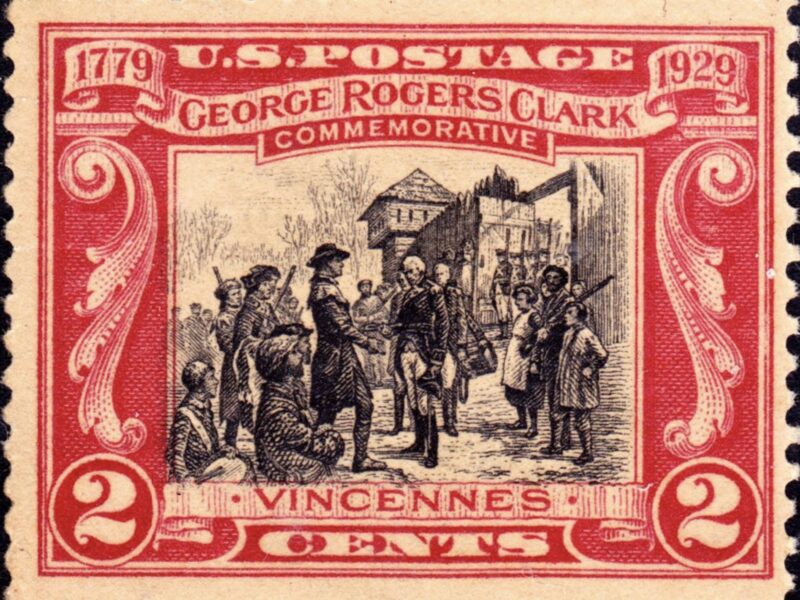
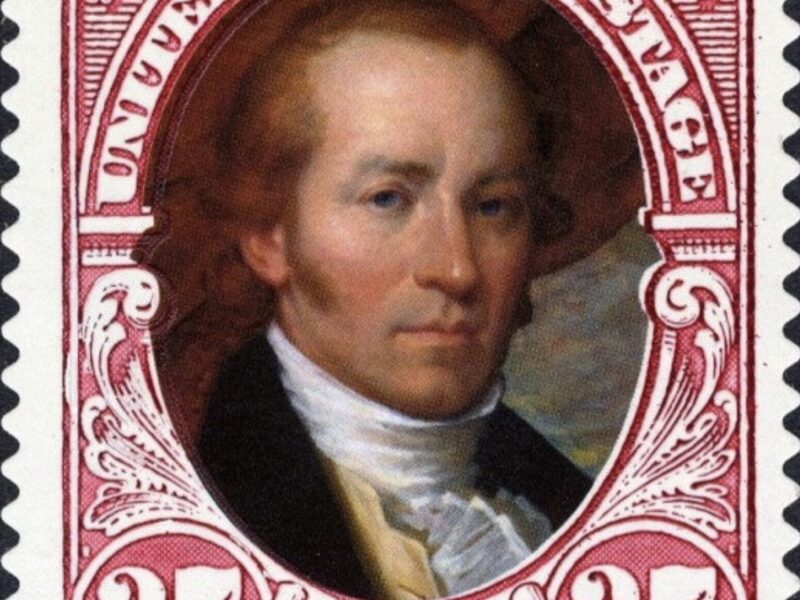
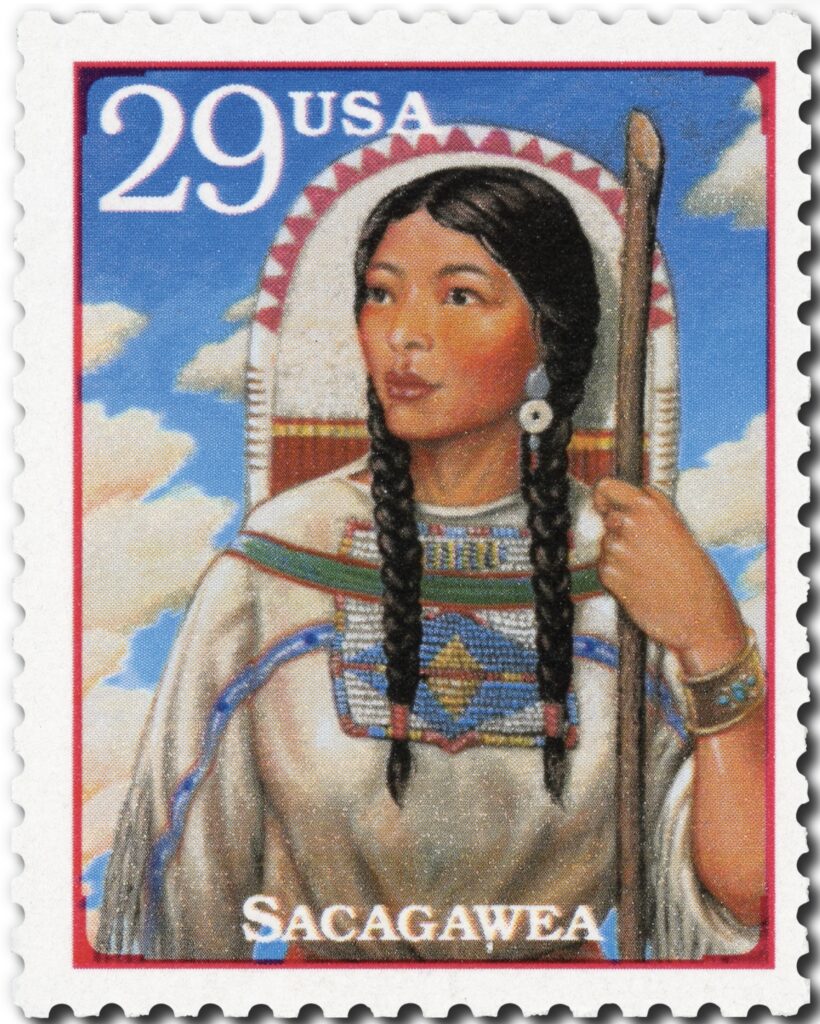
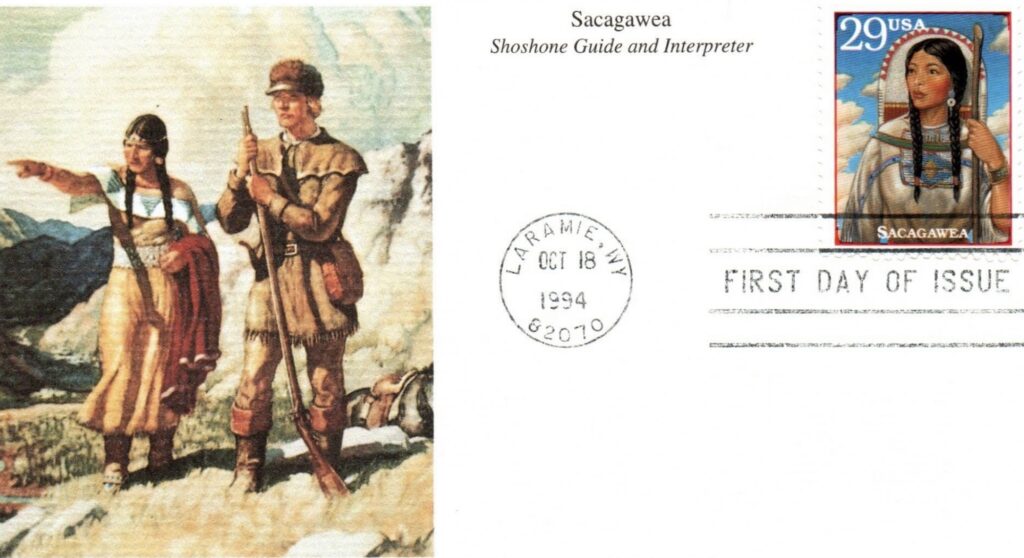
We’ve spent the last few posts working through a small cluster of stamps tied to the opening of the American West — George Rogers Clark at Fort Sackville, Anthony Wayne at Fallen Timbers, and William Clark on the Lewis and Clark bicentennial issue. It seems only fitting to close the loop with the one figure who connects most directly to that last stamp, and who has become, more than almost anyone else from the expedition, a genuine American legend in her own right: Sacagawea, honored on a 29-cent stamp in the U.S. Postal Service’s 1994 “Legends of the West” series.
A Life Shaped by Captivity
Sacagawea was born around 1788 in the Lemhi River valley of present-day Idaho, a member of the Agaidika, or Salmon Eater, band of the Lemhi Shoshone. Her early life was upended around the age of 12, when a Hidatsa raiding party attacked her village, killing several people and taking Sacagawea and other young girls captive.
She was carried hundreds of miles east to a Hidatsa-Mandan village complex along the Knife River, near present-day Bismarck, North Dakota — a very long way, culturally and geographically, from the mountain homeland she’d grown up in.
Not long afterward, she came into the household of Toussaint Charbonneau, a French-Canadian fur trader who had settled among the Hidatsa and who took her, along with another young Shoshone woman, as a wife — accounts differ on whether she was purchased outright or won in a gambling wager.
She was still a teenager, and pregnant with her first child, when history came calling in the person of Meriwether Lewis and William Clark.
Joining the Corps of Discovery
In November 1804, the Corps of Discovery arrived at the Mandan-Hidatsa villages and built Fort Mandan to wait out the winter. Lewis and Clark needed an interpreter who could help them communicate once they reached Shoshone territory further west — country they’d have to cross to find horses and a route over the Rockies.
Charbonneau was hired for the job, but it was really Sacagawea’s fluency in Shoshone, layered underneath Charbonneau’s French, that made the arrangement useful; a message would pass from English to French to Hidatsa to Shoshone and back again, a clumsy relay system but one that worked when it mattered most.
Sacagawea gave birth to a son, Jean Baptiste Charbonneau, on February 11, 1805, just weeks before the expedition resumed its journey up the Missouri that spring. She carried the infant — whom Clark affectionately nicknamed “Pomp” — on her back for the rest of the journey to the Pacific and home again.
Her contributions went well beyond translation: in May 1805, when a sudden squall nearly capsized the boat she was riding in, Sacagawea calmly gathered up papers, instruments, and medicines that would otherwise have been lost overboard, drawing praise from both captains and earning a branch of the Missouri River named in her honor.
She also knew which regional plants were edible, helped make moccasins and clothing for the party, and — perhaps most valuably of all — her mere presence, a young woman traveling with an infant, signaled to the Native nations they encountered that this was not a war party, easing tensions at several crucial moments.
The expedition’s greatest stroke of luck arrived that August, when the Corps encountered a band of Shoshone in the Rocky Mountains and needed to negotiate for horses to carry them over the Continental Divide. The band’s leader turned out to be Cameahwait — Sacagawea’s own brother, from whom she’d been separated since her capture years before.
It’s the kind of coincidence that would seem implausible in fiction, and it proved decisive: The reunion helped secure the horses the expedition needed to survive the mountain crossing.
After the Expedition, and a Disputed Ending
Sacagawea and Charbonneau left the Corps of Discovery at the Mandan villages when the expedition returned east in 1806, having been paid for their service (though considerably less than the other members received). The couple later tried farming near St. Louis, at Clark’s invitation, before giving it up to rejoin the fur trade further up the Missouri.
Sacagawea gave birth to a daughter, Lisette, in August 1812, and by December she had fallen gravely ill with what contemporary accounts called “putrid fever” — likely typhoid. She died at Fort Manuel, in present-day South Dakota, at only about 24 years old. Clark, who had grown close to Sacagawea and doted on young Pomp during the expedition, took over as legal guardian for both of her children afterward.
That should be the end of the story, and for most historians it is — a Fort Manuel Lisa clerk’s journal records her death plainly at the time. But a persistent alternate tradition, tied to Shoshone oral history on the Wind River Reservation in Wyoming, holds that an elderly woman named Porivo, who died there in 1884, was in fact Sacagawea, having outlived her reported death by decades.
Most historians remain skeptical, but the story has never entirely gone away, and it adds a genuine layer of mystery to a life that was already thinly documented in its own time.
The Stamp
That thinness of the historical record turned out to be the central design challenge nearly two centuries later, when illustrator Mark Hess was commissioned to paint Sacagawea’s portrait for the Postal Service’s Legends of the West sheet — twenty 29-cent stamps issued October 18, 1994, at simultaneous ceremonies in Laramie, Wyoming; Tucson, Arizona; and Lawton, Oklahoma.
No photograph or contemporary portrait of Sacagawea exists; every artistic depiction of her, on stamps, coins, or statues, is necessarily an informed act of imagination. Hess researched at least 10 earlier artistic renderings of Sacagawea, studied the earliest surviving photographs of Shoshone women for reference, and based her clothing and the cradleboard carrying her infant on period artifacts, aiming for something historically grounded even without a true likeness to work from.
Sacagawea’s stamp shares the sheet with 15 other frontier figures — Buffalo Bill Cody, Annie Oakley, Chief Joseph, Geronimo, Wyatt Earp, and Kit Carson among them — plus four corner stamps depicting broader Western themes.
It’s worth noting, too, that the sheet became briefly notorious for an entirely different reason: One of its subjects, the pioneering Black rodeo star Bill Pickett, was initially depicted using a photograph that turned out to show his brother Ben instead.
The error, caught by Pickett’s own descendants just months before release, forced a full recall and reprinting of millions of sheets — a genuine collector’s footnote to an issue that otherwise set out simply to put a fittingly wide range of Western lives, Sacagawea’s included, on America’s postage.
Her stamp remains one of the more quietly moving entries in that set: a teenage mother, taken from her home by force, whose knowledge of language and geography — and a near-impossible reunion with her own brother in the Rockies — helped carry an American expedition to the Pacific and back.