If you’ve been following along, you’ll have noticed a pattern forming: a run of stamps from that remarkably fertile year 1929, each one tied to the hard, often brutal business of securing the old Northwest Territory for the young United States.
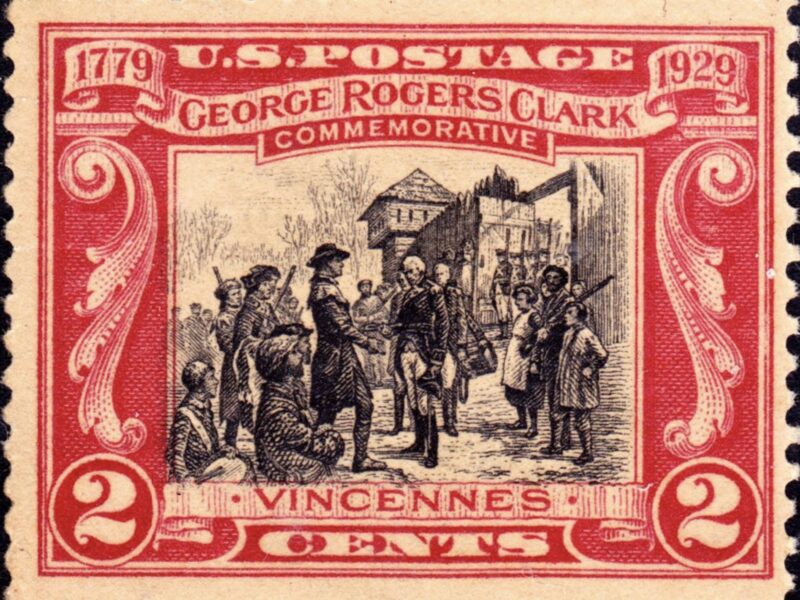
We’ve already covered George Rogers Clark’s capture of Fort Sackville. This time it’s the man whose own campaign, 15 years later and just across the Ohio-Indiana line, finished the job Clark had started: General Anthony Wayne, and the stamp the Post Office issued to mark the 135th anniversary of his victory at the Battle of Fallen Timbers.
From Tanner’s Son to “Mad Anthony”
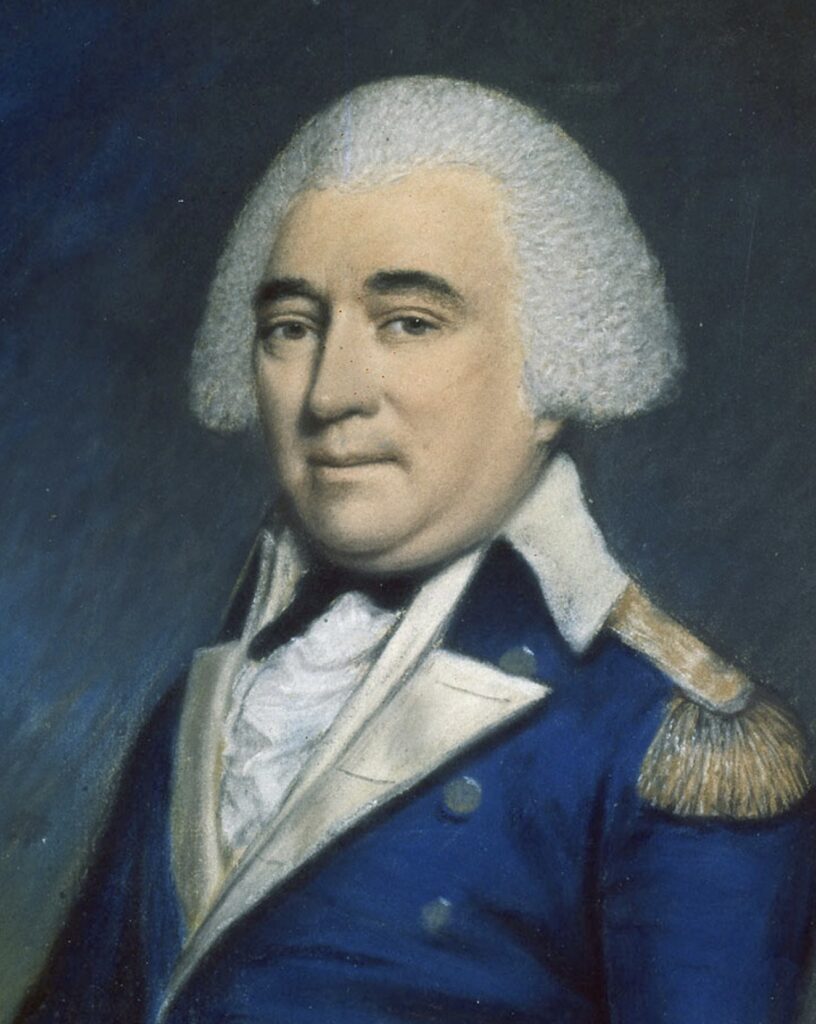
Anthony Wayne was born on New Year’s Day, 1745, in Chester County, Pennsylvania, the son of a tanner and local farmer. He trained briefly as a surveyor — a common enough trade for an ambitious young man on the colonial frontier — before the outbreak of the Revolutionary War redirected his ambitions entirely.
Wayne raised a Pennsylvania militia regiment in 1775, was colonel of the 4th Pennsylvania Regiment within a year, and a brigadier general not long after that. He fought at Brandywine, Germantown, and Monmouth, building a reputation as an aggressive, sometimes reckless field commander who led from the front.
That reputation crystallized at the Battle of Stony Point in 1779, where Wayne led a daring nighttime bayonet assault that captured a fortified British position on the Hudson River — a genuinely audacious operation that became one of the more celebrated American successes of the war.
It’s often assumed his famous nickname came from that kind of battlefield daring, and there’s certainly some truth to that. But the story usually told is more specific and considerably more human. According to popular accounts, a soldier under Wayne’s command, angry that Wayne had refused to commute a flogging sentence for desertion, muttered that “Anthony is mad” — and the phrase stuck, following Wayne for the rest of his career and long after.
After the war, Wayne tried civilian life for a while, serving briefly in the Pennsylvania and Georgia legislatures. It didn’t take. In 1792, President George Washington called him back to uniform for a much harder job than anything he’d faced in the Revolution.
The Legion of the United States
The problem Washington needed solved was the Northwest Territory — the vast region north of the Ohio River that the British had formally ceded to the United States in the Treaty of Paris but that a confederation of Native nations, including the Miami, Shawnee, Delaware, and Wyandot, had never agreed to give up.
Led by skilled war leaders like Little Turtle of the Miami and Blue Jacket of the Shawnee, and quietly supplied by the British, who still held forts in the region despite the treaty, this Western Confederacy had already inflicted two humiliating defeats on American forces in 1790 and 1791 — the second of them, under General Arthur St. Clair, ranking among the worst losses the U.S. Army has ever suffered.
Washington’s answer was to give Wayne command of a newly organized force called the Legion of the United States and, crucially, the time to actually train it. Wayne built a dedicated training camp at Legionville, on the Ohio River — the first facility of its kind purpose-built for drilling American regulars — and spent more than a year turning a demoralized, poorly disciplined army into something considerably more formidable.
It was methodical work, a world away from “Mad Anthony’s” battlefield reputation, and it paid off. In December 1793, Wayne’s men constructed Fort Recovery on the site of St. Clair’s earlier disaster; when Native forces attacked it the following summer, they were repelled.
Fallen Timbers
Wayne advanced his Legion into the Maumee River valley, in present-day northwestern Ohio, through the summer of 1794. On August 20, he met the Western Confederacy’s warriors at a site where a recent tornado had knocked down large stretches of forest — giving the battle its name, Fallen Timbers.
The tangle of downed trees actually favored the defenders’ style of fighting, but Wayne’s disciplined infantry and cavalry broke the Native line in a sharp, relatively brief engagement. Adding to the day’s bitterness, the defeated warriors retreated toward a nearby British post, Fort Miami, only to find its gates closed against them — a clear signal that British support for the Confederacy, in practice, had its limits.
The defeat was decisive. A year later, Wayne negotiated the Treaty of Greenville with Little Turtle and the other Confederacy leaders, ceding most of present-day Ohio, along with a scattering of strategic sites farther west, to the United States.
It’s worth noting that William Clark — yes, that William Clark, of Lewis and Clark, whose own stamp we covered recently — served as a young officer under Wayne during this campaign, one of the many small threads tying these figures and this stamp cluster together. Wayne didn’t have long to enjoy the fruits of his victory; he died at Presque Isle, Pennsylvania, in December 1796, still in uniform.
The Stamp
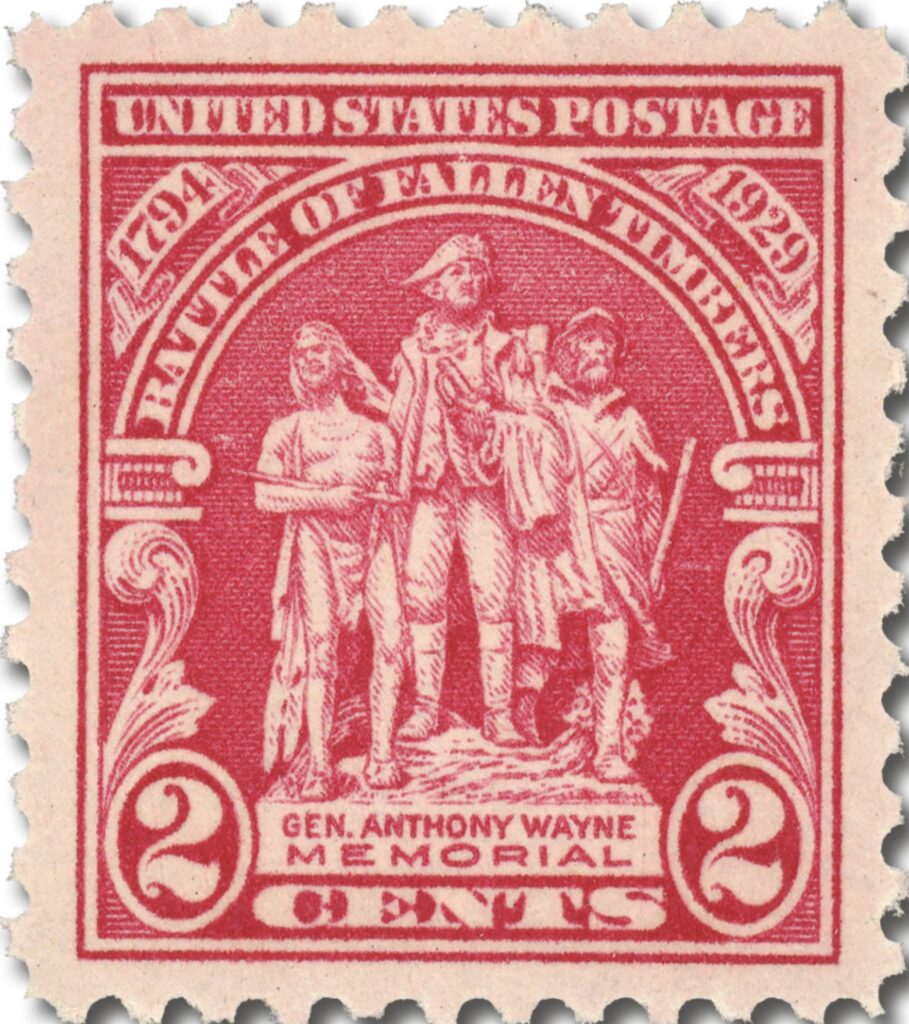
The U.S. Post Office marked the battle’s 135th anniversary with a two-cent red commemorative, issued September 14, 1929, in Erie, Pennsylvania, and five other cities.
Rather than a battle scene, the stamp’s design reproduces the bronze memorial statue that stands at the Fallen Timbers battlefield near Maumee, Ohio — Wayne on horseback, flanked by figures representing a frontiersman and a Native American scout, sculpted by Bruce Saville and dedicated that same year.
Nearly 29.5 million copies were printed, a substantial run reflecting the period’s enthusiasm for commemorating the young nation’s frontier history.
Seen alongside the Clark stamps, the Wayne issue completes a rough trilogy of the U.S. Post Office’s late-1920s fascination with the Northwest Territory’s founding — Clark opening the door at Fort Sackville in 1779, Wayne slamming it shut on organized Native resistance 15 years later at Fallen Timbers, and, a generation after that, a young officer who’d served under Wayne setting out with Meriwether Lewis to see what lay beyond the territory both men had helped secure.