By 1978, crossing the Atlantic by balloon had become one of aviation’s most stubborn unfinished feats. Human flight itself had begun in the 1780s with the Montgolfier brothers’ hot-air experiments, and lighter-than-air gas balloons soon followed, but an ocean crossing by balloon proved a different order of problem entirely — one of endurance, weather, and sheer nerve.
Between 1859 and 1978, 17 attempts to cross the Atlantic by balloon had failed, and at least seven balloonists had died trying. By some countings the tally of failed missions ran to 14, depending on how strictly an “attempt” was defined, but however counted, it was a graveyard of ambition.
Two of the men who would finally succeed had already failed once themselves. In September 1977, Ben Abruzzo and Maxie Anderson, both of Albuquerque, New Mexico, launched the Double Eagle I and were blown off course, forced to ditch off Iceland after covering 2,950 miles in 66 hours.
That flight, the 11th recorded attempt at the crossing, was designed to honor Charles Lindbergh and timed to the 50th anniversary of his solo Atlantic flight. Abruzzo spent months recovering from frostbite suffered in the ordeal, but neither man gave up because of the failure. By 1978 the two were ready to try again, and this time they added a third pilot, Larry Newman, a hang-glider pilot and manufacturer.
Leaving from Presque Isle, Maine
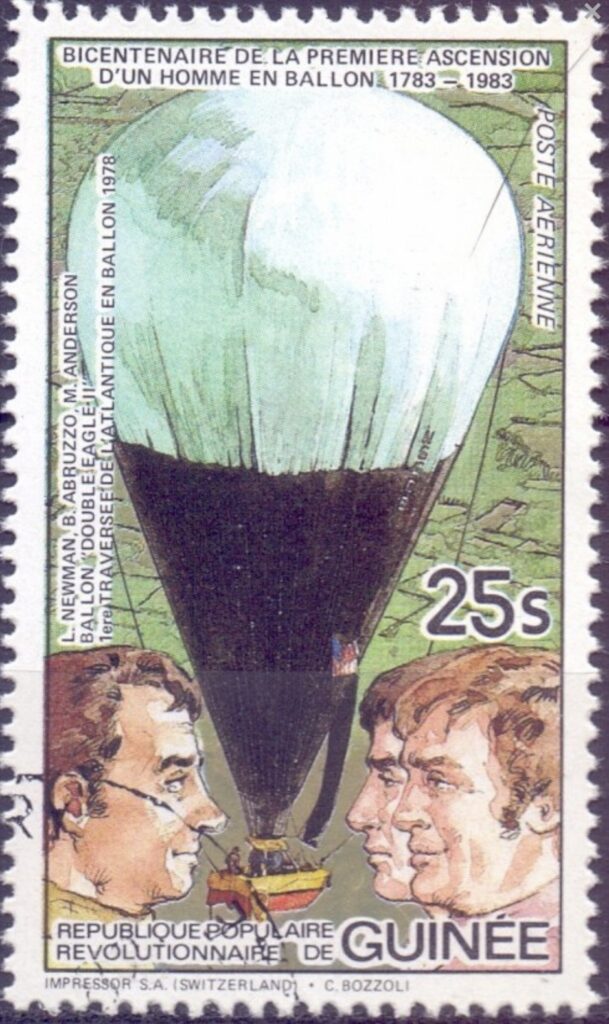
The Double Eagle II lifted off from Presque Isle, Maine, at 8:42 p.m. on August 11, 1978. The balloon stood 112 feet high, 65 feet in diameter, with a capacity of 160,000 cubic feet of helium, and the three men rode in a gondola just 15x7x4.5 feet, named the Spirit of Albuquerque and fitted with a twin-hulled catamaran in case of a water landing. (Go here for a photo of the gondola.)
Newman had also brought along a hang glider, lashed to the gondola with the idea of using it for the final descent, though it had to be jettisoned early to lighten the balloon.
The crew slept in three-hour shifts and, by most accounts, survived largely on hot dogs and canned sardines.
Newman managed to repair the balloon’s radio around the third day, which allowed the crew to communicate with the ground and navigate more precisely — a small technical fix that mattered enormously, since the earlier failure had come down largely to being blown hopelessly off course.
Forced dangerously low
The one real crisis of the crossing came on the night of August 16, when atmospheric conditions forced the balloon down from 20,000 feet to a dangerous 4,000 feet, but the crew recovered and pressed on.
By the evening of August 16, the balloon had crossed the Irish coast, at which point the crossing could reasonably be called a success, with Shannon Airport radioing the news to the crew.
The Double Eagle II came down in a wheat field near Miserey, France, about 60 miles northwest of Paris, on August 17, 1978, 137 hours and 6 minutes after lifting off — a journey of roughly 3,100 miles.
That night, Larry Newman, at 31 the youngest of the three, was given the honor of sleeping in the same bed Charles Lindbergh had slept in after his own historic landing more than 50 years earlier.
Word of the landing brought thousands of spectators and journalists to the field, and the three pilots returned home to a hero’s welcome — 15,000 people met them in Albuquerque, escorted by 60 hot-air balloons lining the route and six more floating overhead. Congress later passed a resolution declaring the crew Modern Day Explorers, and all three received the Congressional Gold Medal.
Not the final adventure
None of the three men treated the Atlantic crossing as a capstone. Abruzzo went on to captain the Double Eagle V, which completed the first transpacific balloon crossing in November 1981, flying from Nagashima, Japan, to northern California in 84 hours and 31 minutes, alongside Newman, Ron Clark, and restaurateur Rocky Aoki.
Anderson, for his part, made the first nonstop trans-North American balloon flight with his son Kristian in May 1980, and afterward turned his ambitions to an even larger target, twice attempting to circumnavigate the globe by balloon, without success.
The partnership that had carried them across the Atlantic did not endure in friendship. Abruzzo and Anderson drifted apart in the years after their celebrated flight together. Both men, however, kept flying, and both died doing it, within roughly two years of each other.
Maxie Anderson was killed on June 27, 1983, near Bad Brückenau in West Germany, at age 48. He and co-pilot Don Ida died when the gondola of their balloon was released too early and from too great a height during a landing maneuver in the Coupe Charles et Robert / Gordon Bennett endurance race that had started in Paris.
The release mechanism, meant to drop the basket gently near the ground, triggered instead at a dangerous altitude. West German investigators found the two men died of massive internal injuries, and officials said the fall was unsurvivable.
Ben Abruzzo died a year and a half later, on February 11, 1985, in Albuquerque, when his twin-engine Cessna 421 crashed shortly after takeoff on what was meant to be a ski trip to Aspen. The plane developed trouble just after liftoff; Abruzzo tried to turn back but struck trees and went down in flames. He was 54, and the crash also killed his wife, Patricia, and four other women aboard.
Both men are remembered together in Albuquerque, home to the ballooning culture they helped build. Anderson and Abruzzo are memorialized at the Anderson-Abruzzo International Balloon Museum, a fitting tribute in the city that gave the world’s largest ballooning gathering, the Albuquerque International Balloon Fiesta, much of its founding energy.
Larry Newman, the third member of the crew, had helped popularize hang gliding and founded an ultralight aircraft manufacturer. He sold his business in 1985 and became a pilot for American West airlines. Newman died in 2010.