By the time John Charles Frémont arrived in Arizona Territory in October 1878 to take up the governorship, he was 65 years old and had already lived enough lives for several men. He had planted a flag on a mountain few Americans had ever heard of and made himself famous for it.
He had helped wrest California away from Mexico, stood trial for it, and survived the court-martial that followed. He had run for President of the United States as the first nominee of a brand-new party, and lost. He had made and lost a fortune. Arizona, when it finally came to him, was not really a job. It was a consolation prize for a man who had run out of better offers — and he treated it, for the most part, exactly that way.
How a Disgraced Lieutenant Became “The Pathfinder”
Frémont’s early life gave little hint of any of this. Born in Savannah, Georgia, in 1813 to parents who weren’t married to each other — his mother had fled an older husband for a younger, more charming French-Canadian tutor — he grew up without money or particularly steady prospects, and got himself expelled from Charleston College for skipping too many classes.
What he did have was a gift for mathematics and an interest in the unmapped corners of the continent. A teaching post on a Navy survey ship led, eventually, to a commission in the Army’s Corps of Topographical Engineers in 1838, the branch tasked with charting the parts of the country that hadn’t yet been charted.
He married well, too — Jessie Benton, daughter of powerful Missouri senator Thomas Hart Benton, a marriage that gave him both a political patron and, in Jessie herself, a writing partner sharp enough to turn his dry survey reports into bestsellers.
It was the second of those reports that made him a household name. In the summer of 1842, Frémont led a government expedition west along what would become the Oregon Trail, with the mountain man Kit Carson serving as his guide.
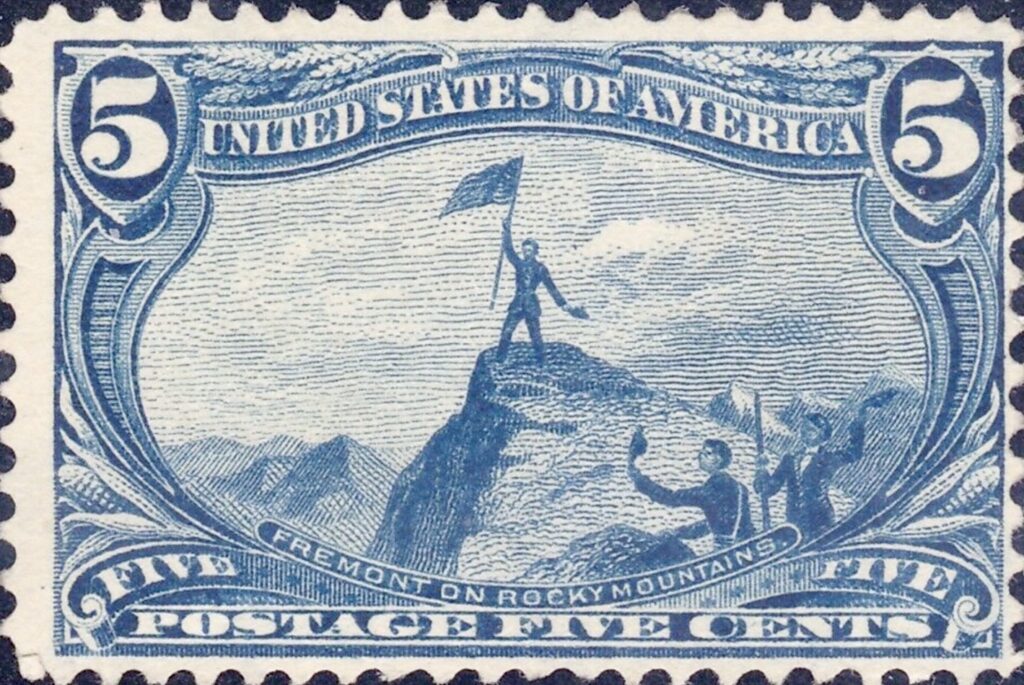
Climbing into Wyoming’s Wind River Range, Frémont and a small party scaled a 13,745-foot peak that was, at the time, mistakenly believed to be the highest point in the entire Rocky Mountain chain. At the summit, he planted an American flag — a small, theatrical gesture that nonetheless meant something very real. It was a claim, made on government paper and confirmed in person, that this mountain range and the territory around it belonged, or soon would, to the United States.
The peak was later named Fremont Peak in his honor. When he and Jessie turned his expedition notes into a published report the following year, the writing was vivid enough that the poet Henry Wadsworth Longfellow said it had touched his imagination. Newspapers, borrowing a name from a popular novel of the period, started calling him the Pathfinder, and it stuck for the rest of his life.
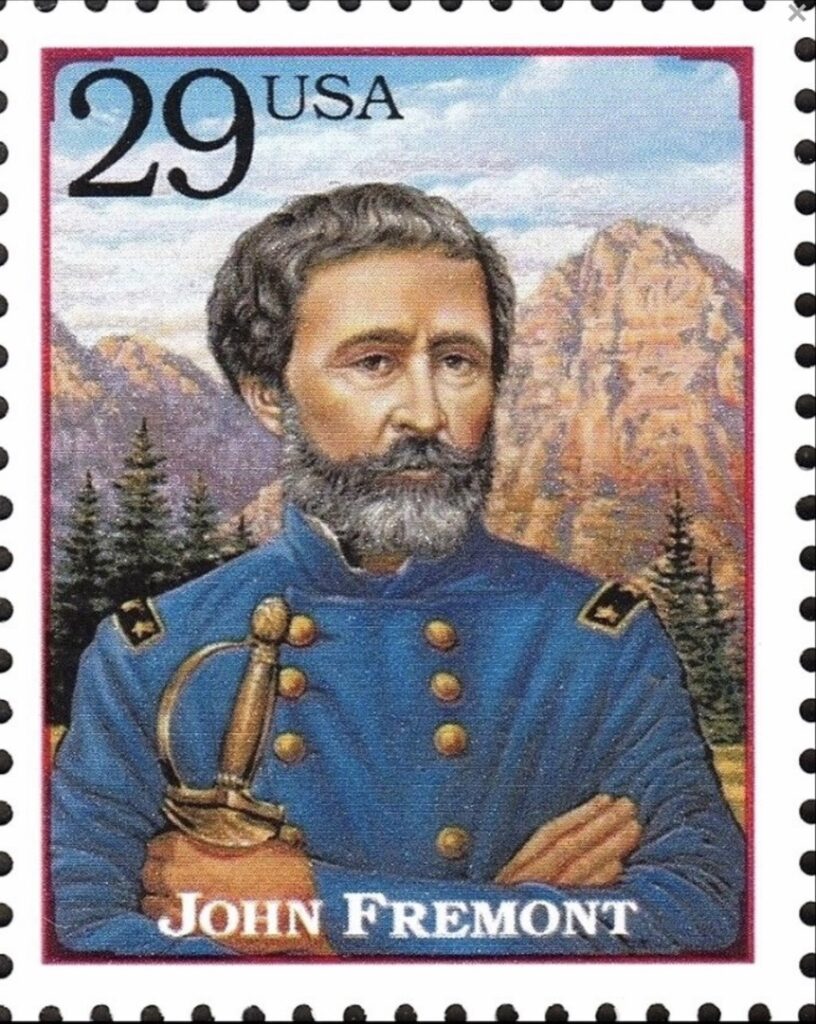
Four more expeditions followed over the next decade, covering more ground, by some later estimates, than the far more celebrated Lewis and Clark expedition four decades earlier.
Frémont mapped the Great Basin, named it as a distinct geographic region, charted routes through the Sierra Nevada, and helped settle, for American readers at least, just how vast and how crossable the West really was. He happened to be in California in 1846 when tensions between American settlers and Mexican authorities boiled over into the Bear Flag Revolt, and he played a leading, controversial role in the uprising and the broader U.S. conquest of California that followed.
It was controversial enough that a dispute over authority with his commanding general led to a court-martial in 1847, a conviction, and a dismissal from the Army that President Polk later overturned on the question of discipline alone, without erasing the conviction itself.
From Presidential Candidate to Forgotten Governor
None of that ended his career — if anything, it added to the legend. By 1856, with the country splitting apart over slavery and a new Republican Party looking for a candidate who could embody its opposition to slavery’s expansion without the baggage of a long political record, Frémont was the obvious choice.
The campaign ran on the slogan “Free Soil, Free Speech, Free Men, and Frémont,” with Jessie playing an unusually active role in shaping his public image — by most accounts, the first time a candidate’s wife had taken on that kind of role in an American presidential race. He lost to James Buchanan, carrying the Northern states but not enough of them, and four years later the party he’d represented first would win the White House with Abraham Lincoln instead.
The Civil War gave Frémont one more turn at prominence and another fall from it. Commissioned a major general, he was given command of the Department of the West in 1861 and, on his own authority, issued an order freeing the slaves of Confederate sympathizers in Missouri — a move so far ahead of official Union policy at the time that Lincoln overruled and rescinded it, and relieved Frémont of his command not long after.
His Civil War service ended in frustration, his finances collapsed in a string of bad railroad investments through the 1860s and ’70s. By the time Rutherford B. Hayes became president in 1877, Frémont was, in plain terms, broke and largely finished as a public figure.
What he had left was the Republican Party’s long memory and a willingness to ask for a favor. Frémont lobbied for a federal appointment and was offered his choice of two territorial governorships — Idaho or Arizona.
He chose Arizona, and Hayes appointed him in 1878, the fifth man to hold the territorial governor’s office. It was, like most such appointments of the era, less a job than a reward: a way for the party to take care of a loyal but financially ruined old soldier, with a salary attached and comparatively little expected in return.
Frémont seemed to understand the arrangement in exactly those terms. He arrived in Prescott, the territorial capital, in October 1878 with his wife and his daughter Lily, who would later leave behind a detailed diary of their time there.
He was gone again within months, departing for Washington in February 1879 to lobby on a boundary dispute involving the Gila River Indian Reservation, a trip that was supposed to take five or six weeks and instead kept him away until August. He left the territory again the following spring and didn’t return until January 1881, leaving the territorial secretary to run things in his absence for months at a stretch.
He did manage a few lasting marks on the territory in between — his administration established Thanksgiving as an official territorial holiday, and he pushed, with mixed success, for a territorial lottery to help fund public buildings and schools — but Arizona’s newspapers grew openly contemptuous of a governor who seemed more interested in his own mining ventures than in actually governing. By 1881 the criticism had become impossible to ignore. Pressed to either return to his post for good or step down, Frémont resigned that October.
He never came back West for long. He and Jessie lived out the 1880s largely on the income from her writing, and in 1890, just months after Congress finally restored his rank and granted him a military pension, Frémont died in New York at 77.
He is remembered, rightly, for the flag on the mountain and the maps that opened the West to a nation eager to cross it. Arizona, for its part, mostly remembers him for how rarely he was there.