How one of the Aztec world’s most terrifying gods also became its greatest healer — and why the two were never contradictory
Of all the gods in the Aztec pantheon, few were as paradoxical — or as misunderstood — as Xipe Totec. His name means “Our Lord the Flayed One,” and his iconography was unmistakably grim: He wore the skin of a sacrificed human like a garment, his face a loose mask of another man’s flesh.
To modern eyes, the image reads as pure horror. But to the Nahua-speaking peoples of central Mexico, Xipe Totec was something far more layered — a god of agriculture, medicine, renewal, and the strange beauty hidden inside suffering.
A God of Many Domains
Xipe Totec held dominion over a striking range of concerns. He was revered as a patron of goldsmiths and silversmiths, possibly because the process of hammering raw ore into gleaming metal mirrored his own themes of stripping away the old to reveal something precious beneath.
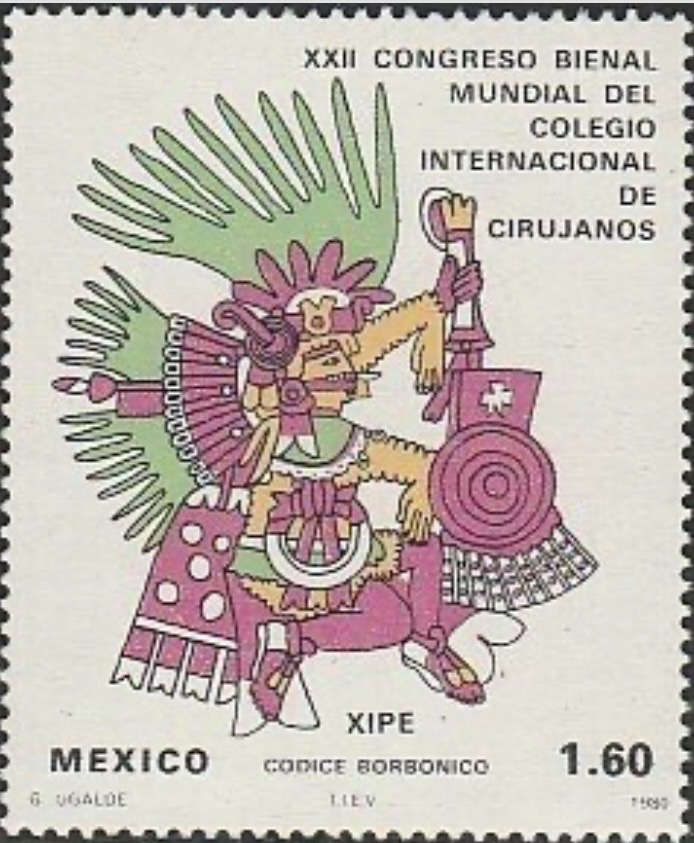
The International College of Surgeons would has held its biennial congress in Mexico City three times, the final one being in 1980, the release date of this stamp. It also met there in 1941, 1957 and 1966.
At the 1980 congress, the keynote speaker was Dr. Halfdan Mahler, then-director general of the World Health Organization.
His address was “Surgery and Health for All,” a call to treat surgery, like other medicine, as a social justice issue, to be equitably distributed to everyone.
He was also associated with the seasons, particularly with the arrival of spring — the moment when a seed’s dull outer husk splits apart to release new growth. In this sense, the flayed skin was not a symbol of cruelty but of transformation: the dead layer shed so that life could continue.
His role as a god of medicine was closely tied to these agricultural associations. Xipe Totec was specifically invoked for diseases of the skin and eyes — rashes, lesions, infections, and blindness. Those who suffered from such ailments prayed to him and sought his mercy.
Priests who served in his name wore the skins of sacrificial victims for 20 days during his festival, believing that whoever touched the garment might be healed. The diseased and suffering would grasp at the rotting skins as sacred medicine, hoping the god’s power resided within.
To touch the skin of the Flayed One was not degradation — it was a plea for transformation, a reaching toward the new life hidden inside the dead shell.
The Festival of Tlacaxipehualiztli
Xipe Totec’s most important ritual was Tlacaxipehualiztli — “the flaying of men” — celebrated in the second month of the Aztec solar calendar, roughly coinciding with late February or early March. The festival opened planting season and was one of the most elaborate in the Aztec ceremonial year.
Captive warriors were sacrificed atop the great temples, and their skins were carefully removed and worn by priests for the duration of the festival.
The ceremony also included a form of ritual combat called gladiatorial sacrifice, in which captive warriors — weakened and tethered to a large stone — were given mock weapons and forced to fight fully armed jaguar and eagle warriors.
Those who survived long enough were honored; those who fell were sacrificed. The entire ritual complex reinforced Aztec cosmological beliefs: The universe required blood and renewal to continue turning. Xipe Totec was the divine engine of that renewal.
Origins and Iconography
Xipe Totec’s origins likely predate the Aztec empire. Scholars believe his cult was borrowed or adapted from the Yopi people of the southwestern Gulf Coast, among whom worship of a similar flayed deity is well-attested.
When the Mexica — the Aztecs — absorbed surrounding peoples and their religious traditions, Xipe Totec was folded into the Aztec pantheon and given a permanent home among the great gods of Tenochtitlan.
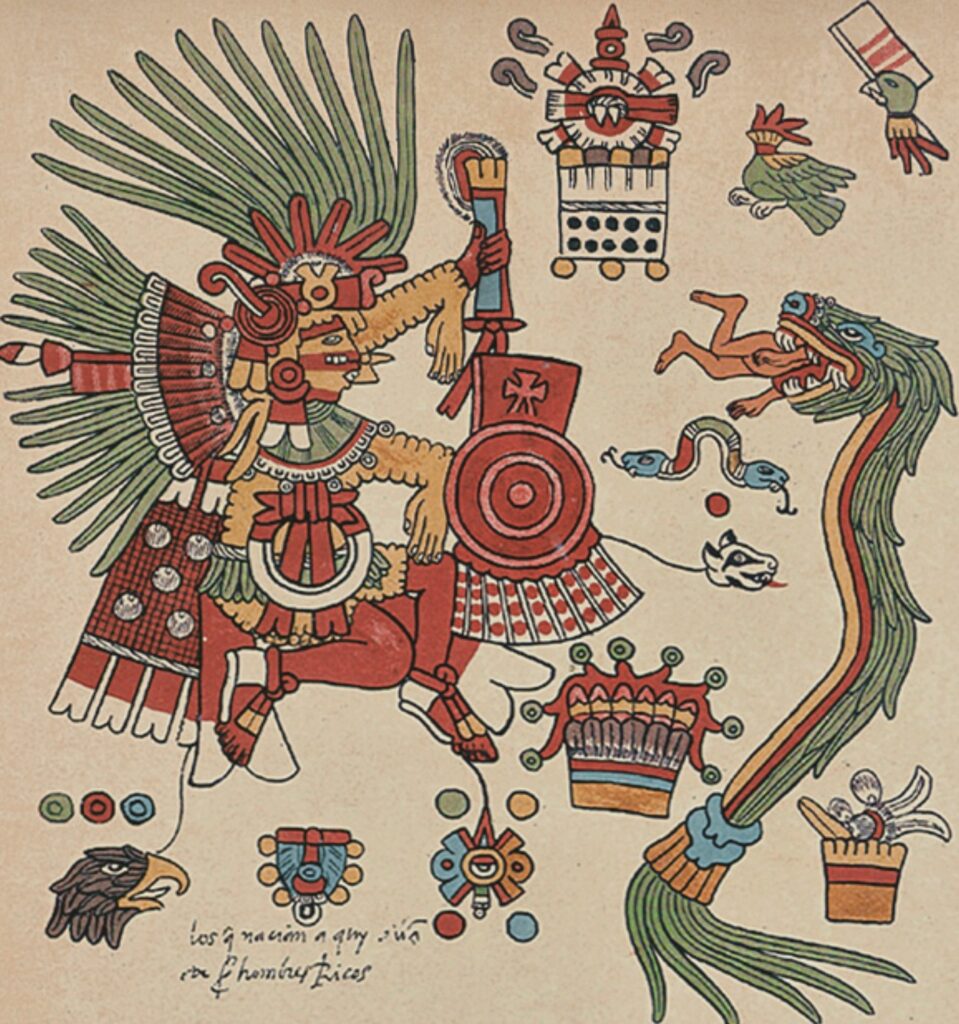
The illustration on the stamp was taken from this leaf in the Codex Borbonicus, a 46.5-foot-long sheet of paper, and one of the few Aztec “books” to survive the Spanish conquest.
In sculpture and codex illustration, he is recognizable by several key attributes: the double layer of skin worn over his own body, a golden or yellow coloring (sometimes interpreted as the golden corn husk), and a vertical stripe across his face.
He often holds a rattle staff and a solar shield. His statues, some of the most expressive in all of pre-Columbian art, show him with features simultaneously serene and unsettling — a god comfortable in the space between death and life.
The Logic of the Flayed God
What made Xipe Totec coherent within Aztec thought was the culture’s profound comfort with the intertwining of death and regeneration. In a worldview where the sun required blood sacrifice to rise each morning, where the dead were thought to nourish the soil, the image of a god clothed in shed skin was not grotesque — it was theologically precise.
The old skin was the earth in winter: withered, spent, wrapped around something not yet born. The flaying was not an ending. It was the act that made spring possible.
Xipe Totec endures as one of the most compelling figures in Mesoamerican religion precisely because he refuses easy interpretation. He was the god who wore death so that life could be seen clearly — a physician whose medicine was transformation itself.
The stamp in this blog is from La Filatelia Mexicana.