C.S. Lewis and J.R.R. Tolkien met at Oxford in 1926 and became two of the closest literary friends of the 20th century, reading each other’s unfinished manuscripts aloud for decades within the informal group they called the Inklings.
Tolkien built Middle-earth from the ground up, inventing languages first and letting stories grow out of them. Lewis worked almost the opposite way: He started with pictures in his head—a faun carrying an umbrella through a snowy wood, a lion, a witch—and let the story follow the images rather than the other way around.
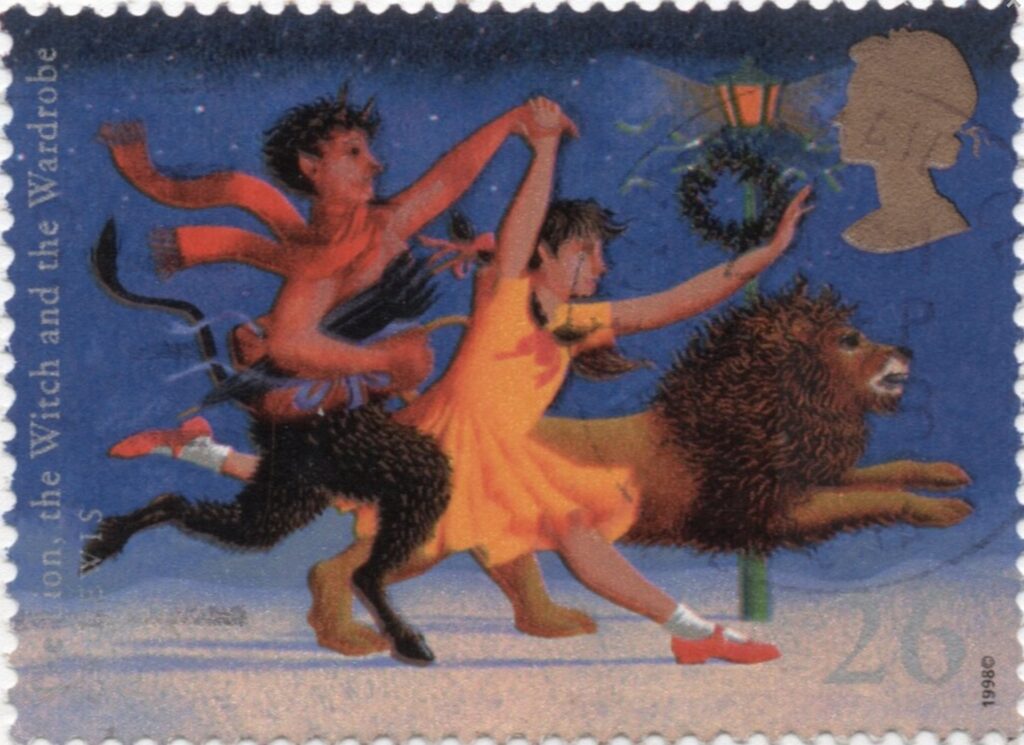
This 1998 stamp from Great Britain honors C.S. Lewis and the first book in the Narnia series, The Lion, the Witch and the Wardrobe.
That difference in method produced two of the most enduring imagined worlds in English literature, and it’s worth understanding the man behind the second of them, and the seven slim books that made Narnia a permanent fixture of childhood reading.
From Belfast to the Trenches to Oxford
Clive Staples Lewis was born in Belfast, Ireland, in 1898, and went by the name Jack for his entire life, a name he reportedly chose for himself as a small child.
His mother died of cancer when he was nine, an early loss that, as with Tolkien, left a permanent mark. He was sent to a series of English boarding schools he mostly disliked, though he found real intellectual companionship under a private tutor, William Kirkpatrick, a rigorous rationalist who taught Lewis to argue with precision—a skill that would later define his career as a Christian apologist as much as his career as a scholar.
Lewis served as an infantry officer in the First World War and was wounded by a shell at the Battle of Arras in 1918. He went on to Oxford, first as a student and then, from 1925, as a fellow and tutor at Magdalen College, where he taught English literature for nearly three decades.
He was, for much of his early adulthood, an avowed atheist, and his slow, reluctant conversion to Christianity in the early 1930s—a process he credited in part to long conversations with Tolkien, a devout Catholic—became one of the defining turns of his life. Lewis wrote about that conversion at length in his autobiography, Surprised by Joy, and his newfound faith would go on to shape nearly everything he wrote afterward, including the books he is best remembered for today.
Scholar and Apologist Before Narnia
Before Narnia made him famous to children, Lewis was already well known as a literary scholar and as one of the most prominent lay defenders of Christianity in Britain. His academic work, particularly The Allegory of Love, established him as a serious medievalist.
During the Second World War, he delivered a series of radio talks on Christian belief that were broadcast by the BBC and later collected as Mere Christianity, a book that remains one of the most widely read works of Christian apologetics. He also wrote The Screwtape Letters, a satirical set of letters from a senior demon instructing a junior one in the art of tempting a human soul, which became a bestseller in its own right.
By the time he began writing Narnia in the late 1940s, Lewis was already a public figure, but nothing in his output to that point looked much like a children’s fantasy series.
The Chronicles of Narnia
Lewis published the seven Chronicles of Narnia between 1950 and 1956, beginning with The Lion, the Witch and the Wardrobe. In it, four English children—Peter, Susan, Edmund, and Lucy Pevensie, evacuated from London during the Blitz—step through a wardrobe into the snowbound land of Narnia, ruled by the White Witch and awaiting the return of its true king, the lion Aslan.
The book set the template for the series: children from our world crossing into Narnia, encountering talking animals and mythological creatures, and getting swept into a moral and often explicitly spiritual conflict.
The books that followed expanded and complicated that world considerably. Prince Caspian returns the Pevensies to a Narnia aged centuries in their absence. The Voyage of the Dawn Treader sends Edmund, Lucy, and their insufferable cousin Eustace Scrubb on a sea voyage to the edge of the world.
The Silver Chair follows Eustace and a schoolmate, Jill Pole, on a rescue mission into an underground kingdom. The Horse and His Boy is set entirely within Narnia’s timeline and follows characters native to that world rather than visitors from ours. The Magician’s Nephew, published second to last, is actually a prequel, showing the creation of Narnia and Aslan singing the world into being.
And The Last Battle, the final volume, brings the series to a close with Narnia’s apocalypse and the characters’ passage into a truer, more permanent version of the world they had loved.
Lewis did not write the books in the order in which the story unfolds chronologically, and readers, publishers, and scholars have argued for decades over whether the series is best read in publication order or internal chronological order.
Lewis himself, late in life, expressed some sympathy for reading it chronologically, though many longtime readers and critics still prefer starting with The Lion, the Witch and the Wardrobe as originally published.
Faith, Allegory, and a Few Disagreements
The Christian framework underlying Narnia is not subtle, and Lewis never pretended otherwise. Aslan’s death and resurrection in The Lion, the Witch and the Wardrobe map closely onto the crucifixion and resurrection of Christ, and The Last Battle draws directly on Christian ideas of apocalypse and paradise.
Lewis preferred to describe this not as strict allegory but as “supposal”—an imaginative exercise in asking what a Christ-figure might look like if he appeared in a different world, among different creatures. Tolkien, notably, disliked this quality of the books; he found the explicit religious symbolism heavy-handed and felt Lewis had written the series too quickly and without the patient, internally consistent world-building Tolkien prized in his own work. The two remained friends, but Narnia was a point of real aesthetic disagreement between them.
Legacy
Lewis died on November 22, 1963—the same day as John F. Kennedy’s assassination and the death of Aldous Huxley, a coincidence that somewhat overshadowed his passing in the press at the time.
But the Chronicles of Narnia have shown no sign of fading. They have sold over 100 million copies worldwide, been translated into dozens of languages, and been adapted repeatedly for film, television, and radio, including a major film series in the 2000s.
Beyond their commercial success, the books occupy a distinctive place in 20th-century literature as a rare example of popular children’s fantasy built openly and unapologetically on a coherent theological foundation, written by a man whose day job was defending that same theology to adults.
Alongside Tolkien’s Middle-earth, Lewis’s Narnia helped define what modern fantasy for young readers could look like, and the friendship and rivalry between the two Oxford dons remains one of the more fruitful literary relationships of the century.