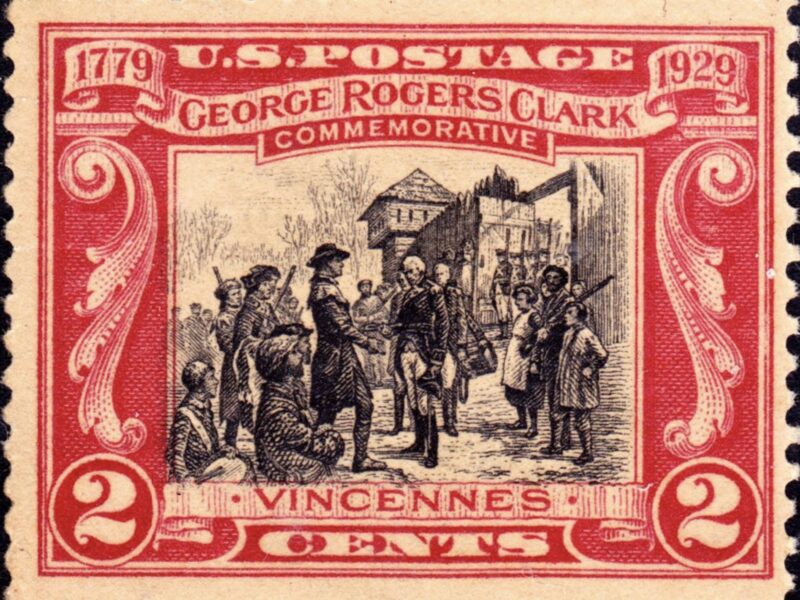
Having spent some time with the elder brother — George Rogers Clark, the frontier general whose 1779 capture of Fort Sackville earned him a handsome commemorative stamp in 1929 — it’s only fair to turn to the brother most people actually know: William Clark, co-commander of the Corps of Discovery.
His moment on a U.S. stamp came 75 years after George’s, in 2004, as part of a set marking the bicentennial of the expedition that made him famous. (He was pictured as part of a group of four in a 1954 stamp commemorating its 150th anniversary of the expedition.)
A Life Before the Expedition
William Clark was born in 1770 in Caroline County, Virginia, the ninth of 10 children born to John and Ann Rogers Clark. He was 18 years younger than George, and by the time William was old enough to notice the world around him, his big brother was already a celebrated Revolutionary War hero on the Kentucky frontier.
In 1785, the Clark family relocated to Kentucky, settling near Louisville — drawn there, by most accounts, by George’s own glowing reports of the Ohio Valley.
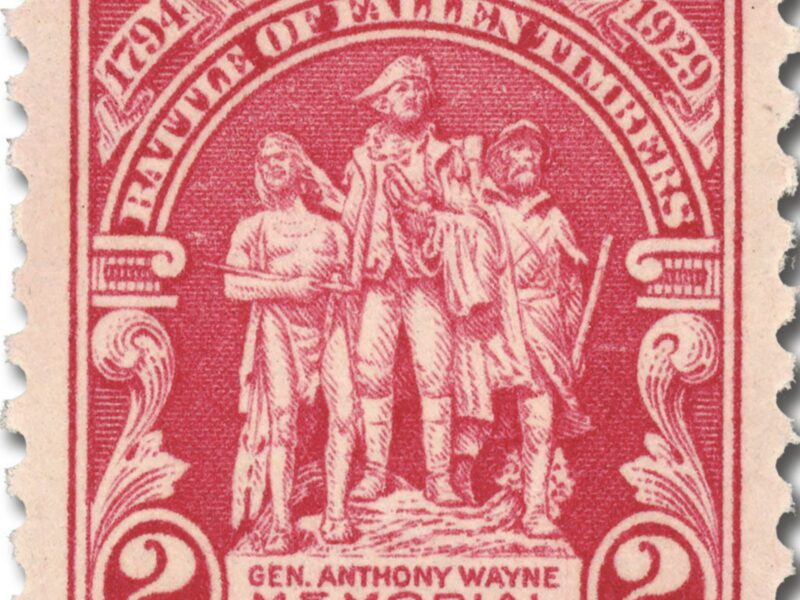
William grew up steeped in the same frontier military culture that had shaped George. He joined the Kentucky militia in 1789 and saw action against Native American tribes in the Ohio Valley conflicts of the era, eventually receiving a commission and serving under General Anthony Wayne in the regular U.S. Army during the campaign that culminated in the 1794 Battle of Fallen Timbers.
It was during this stretch of frontier soldiering that Clark first crossed paths with a young lieutenant named Meriwether Lewis, who served briefly under his command — a connection that would prove enormously consequential a decade later.
Clark resigned his army commission in 1796, worn down by poor health and mounting family debts, and turned to managing the family’s business affairs and property near Louisville.
For several years he lived the relatively ordinary life of a Kentucky planter and merchant, a far cry from the exploring career for which history would remember him.
That changed in 1803, when Meriwether Lewis — by then a captain and President Thomas Jefferson’s personal secretary — wrote to Clark asking him to help lead an expedition into the newly acquired Louisiana Territory.
Co-Commander of the Corps of Discovery
Technically, Clark never received the army rank Lewis had promised him; bureaucratic delays meant he was formally commissioned only as a second lieutenant, well below Lewis’s captaincy. Lewis, to his credit, never treated Clark as a subordinate. He insisted on calling him “Captain” throughout the expedition, and the men of the Corps of Discovery never knew there was any difference in the two men’s official rank. It was, in practice as much as history remembers it, a genuine partnership.
The expedition left Camp Dubois, near St. Louis, in May 1804, ascending the Missouri River toward the Mandan villages in present-day North Dakota, where the party wintered before pushing on in 1805.
Clark’s particular strengths were on full display throughout the journey: he was the expedition’s principal waterman, responsible for navigating its boats and canoes, and its cartographer, producing the maps that would give the United States its first real geographic understanding of the trans-Mississippi West.
After crossing the Continental Divide and descending the Columbia River, the party reached the Pacific in November 1805, wintering at Fort Clatsop before beginning the long return journey. The Corps of Discovery arrived back in St. Louis on September 23, 1806, having traveled roughly 8,000 miles in just under two and a half years.
Life After the Expedition
Clark and Lewis returned as national celebrities, each awarded double pay and 1,600 acres of land by Congress for their service.
But where Lewis’s postwar life ended tragically — he died in 1809 under circumstances still debated by historians — Clark went on to a long and consequential second career on the frontier he had just helped map.
Jefferson appointed him brigadier general of the Louisiana Territory militia and federal Indian agent for the region, and in 1807 Clark settled permanently in St. Louis, the city that would remain his home for the rest of his life.
Clark’s subsequent career reads almost as an inventory of the young republic’s expanding western bureaucracy: governor of Missouri Territory from 1813 to 1820, surveyor general of Illinois, Missouri, and the Arkansas Territory in the mid-1820s, and superintendent of Indian affairs at St. Louis from 1822 until his death in 1838.
In that last role especially, Clark became the government’s most prominent point of contact with Native nations west of the Mississippi — a position that made him, by most accounts, respected and trusted by many tribal leaders, who reportedly called him the “Red Headed Chief,” even as the policies he administered steadily opened Native land to white settlement.
It’s a complicated legacy: Clark spent decades negotiating with the very peoples whose displacement his own career helped accelerate, and he continued to hold York, the enslaved man who had accompanied the expedition to the Pacific and back, in bondage for years afterward before eventually freeing him.
The 2004 Stamp
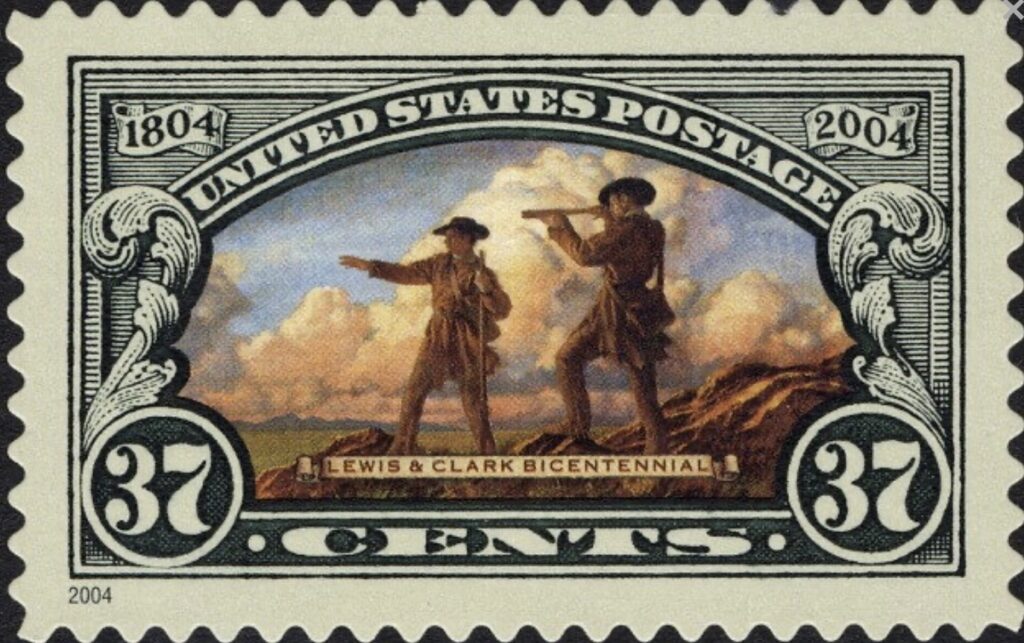
The bicentennial of the expedition’s launch, in 2004, gave the U.S. Postal Service an opportunity to honor both captains properly. On May 14 of that year — exactly 200 years after the Corps of Discovery departed St. Charles, Missouri — the Postal Service issued a set of three 37-cent stamps simultaneously at 11 cities along the expedition’s route, from Astoria, Oregon, to Washburn, North Dakota.
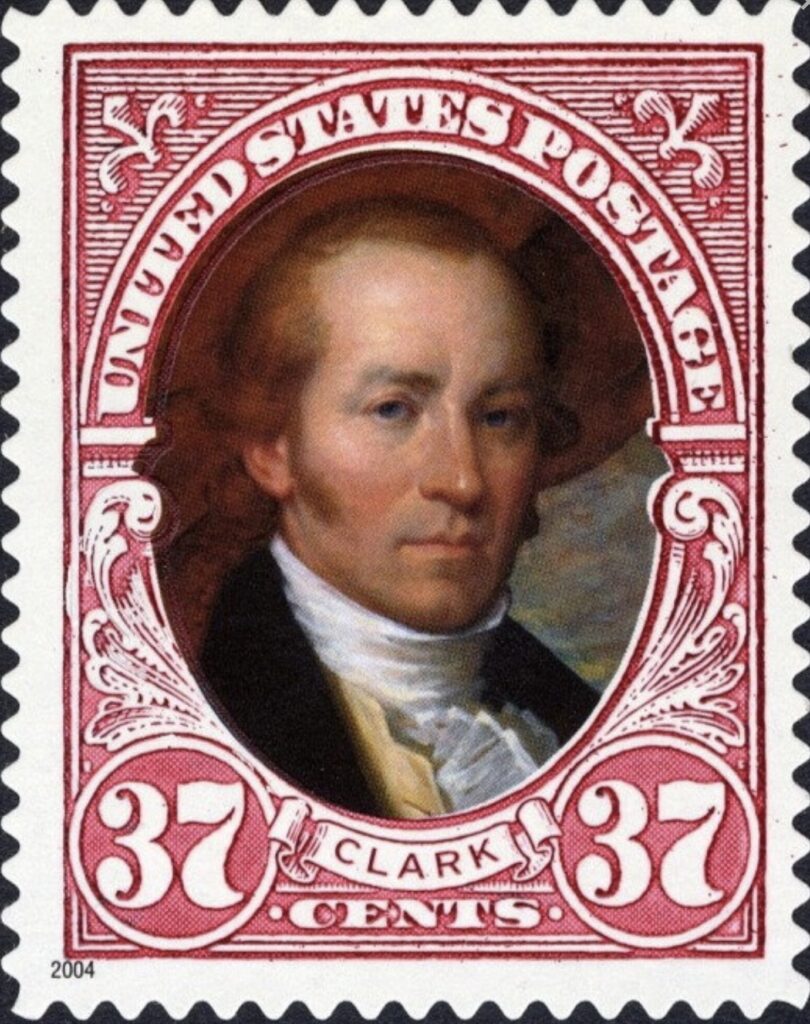
One stamp shows Lewis and Clark together, standing on a promontory surveying the country before them; the other two are individual portraits, one of Lewis and one of Clark, rendered in a style deliberately reminiscent of early 19th-century portraiture. All three images were painted by the illustrator Michael J. Deas, who also designed the accompanying 32-page prestige booklet, Lewis & Clark: The Corps of Discovery, 1804–1806, which paired the stamps with historical text, maps, and period images.
Deas was already a veteran of stamp design by 2004, with prior gold-medal-winning work on the Postal Service’s James Dean and Thornton Wilder issues, and he would go on to receive the Hamilton King Award — given annually for the best illustration produced for the Society of Illustrators — the same year the Lewis and Clark stamps appeared.
His portrait of Clark captures something of the steadiness the man was known for on the trail: a settled, watchful gaze, more surveyor than swashbuckler, fitting for a man whose real talents lay in navigation, cartography, and the patient work of holding an expedition together across two and a half brutal years.
Seen side by side with his brother George’s stamp from 1929, the pairing tells a tidy little story of its own: two Clark brothers, a generation apart, each commemorated on U.S. postage for opening up a different piece of the American West — George at the point of a bayonet outside a frozen fort in Indiana, William at the prow of a canoe on the Columbia.
2 thoughts on “The Younger Clark: William Clark and the 2004 Lewis & Clark Bicentennial Stamp”