Ask most people to name a famous American explorer named Clark, and you’ll get “Clark” of Lewis and Clark — William Clark, co-captain of the Corps of Discovery, who paddled and portaged his way to the Pacific in 1805.
Far fewer people will mention his older brother George Rogers Clark, whose one desperate winter campaign in 1779 did more to secure the western United States than almost anything else that happened during the Revolutionary War.
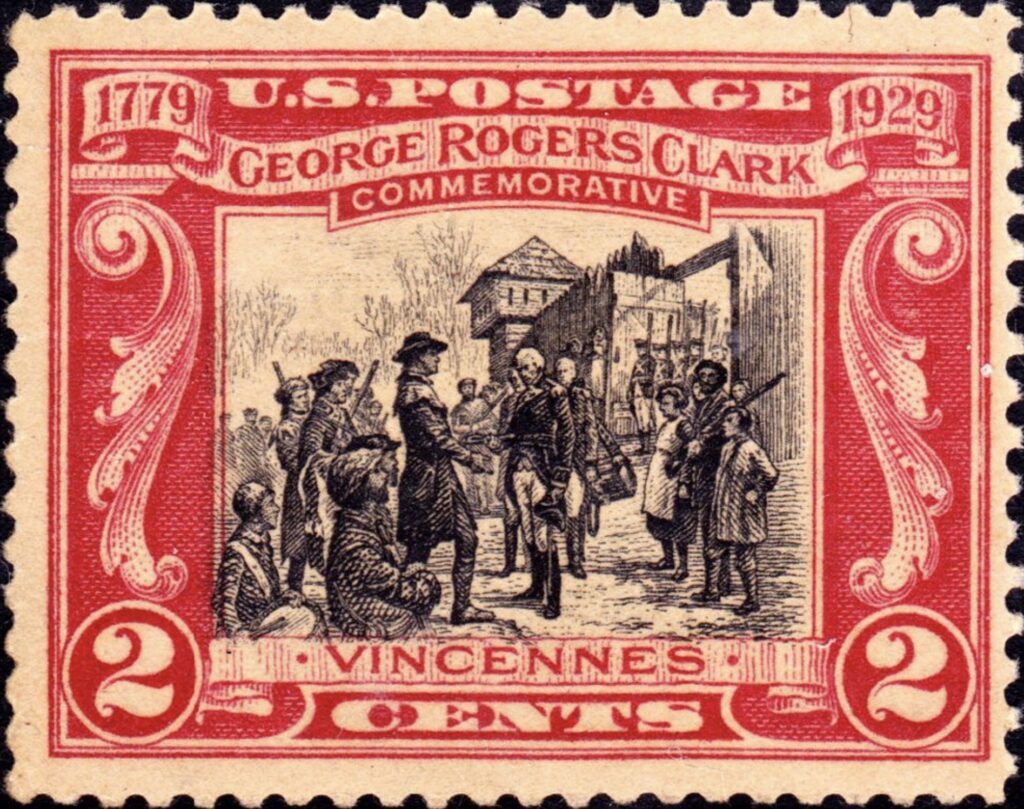
It’s George Rogers Clark, not William, who appears on a genuinely striking U.S. commemorative stamp — one worth knowing the whole story behind.
The Frontier General
George Rogers Clark was born in 1752 near Charlottesville, Virginia, into a large family — six sons and four daughters — that would go on to produce two of early America’s more consequential frontiersmen.
George was the second-oldest son. William, the youngest of the brood, wasn’t even born until 1770, when George was already 18 and working as a surveyor in the Kentucky backcountry. That 18-year age gap matters for the story: by the time William Clark was old enough to hold a rifle, his big brother had already become one of the most celebrated (and most indebted) military figures on the American frontier.
By the mid-1770s, Clark had thrown himself into the defense of Kentucky’s scattered settlements, which were under near-constant pressure from Native American raiding parties — many of them armed and encouraged by British officials operating out of forts in the Illinois Country.
Clark became convinced that the only way to protect Kentucky was to go on the offensive and take those British-held outposts himself. In 1778, with a commission from Virginia governor Patrick Henry and a small, poorly supplied force of frontiersmen, Clark captured the French villages of Kaskaskia and Cahokia along the Mississippi without firing a shot, winning over their largely French and Native populations through diplomacy as much as force.
The March on Fort Sackville
The real test came at Vincennes, on the Wabash River in present-day Indiana, where the British had reoccupied Fort Sackville under Lieutenant Governor Henry Hamilton — a man American frontiersmen had nicknamed the “Hair Buyer” for his role in arming and rewarding Native raiders.
Rather than wait for better weather or reinforcements, Clark decided that surprise was worth more than comfort. In early February 1779, he set out from Kaskaskia with roughly 170 men — Kentucky militia and French volunteers — on a punishing overland march of more than 200 miles, much of it through flooded, ice-choked prairie in the dead of winter, with men wading through water up to their chests.
They reached Vincennes on February 23, 1779, exhausted but undetected. Clark, never one to waste a psychological advantage, marched his small force back and forth behind rises in the terrain with extra flags unfurled, so that from the fort it looked like an army several times its actual size.
His riflemen, all expert marksmen, kept up such a heavy, accurate fire on the fort’s gun ports that the garrison inside became convinced it was surrounded by overwhelming numbers. After a tense standoff — and after Clark’s men captured and executed several Native raiders returning to the fort in full view of the garrison, a brutal episode meant to break British and Native resolve alike — Hamilton agreed to surrender.
On February 25, 1779, Fort Sackville fell without Clark losing a single soldier.
The victory was enormously consequential. It broke British power in the Illinois Country and the Wabash valley, and it gave American negotiators the leverage to claim the entire Northwest Territory — the land that would become Ohio, Indiana, Illinois, Michigan, and Wisconsin — when the Treaty of Paris was signed in 1783.
Without Fort Sackville, the young United States’ western border might well have stopped at the Appalachians.
Yohn’s Painting
More than a century later, the Indiana Historical Bureau commissioned the New York-based illustrator Frederick Coffay Yohn to paint the surrender scene for the sesquicentennial commemorations being planned around Vincennes.
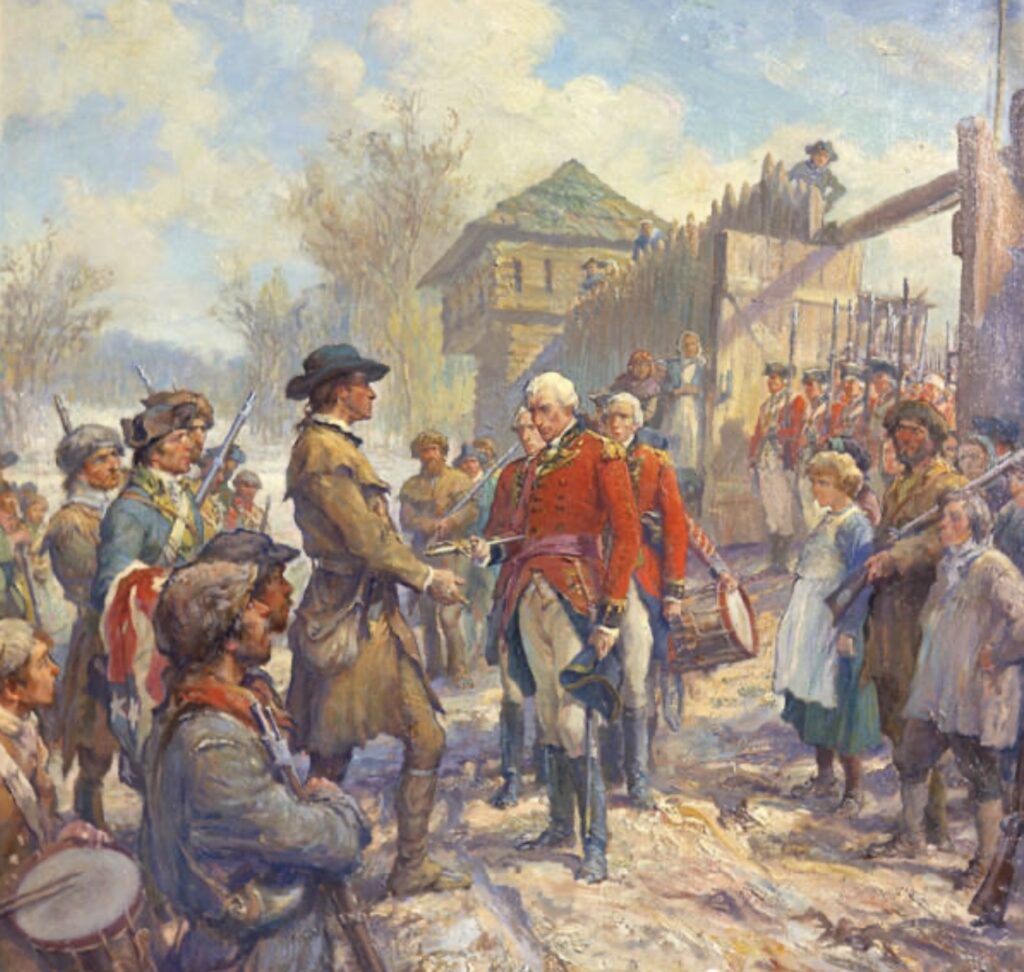
Yohn was already well known for his historical and military illustrations, and in 1923 he completed The Fall of Fort Sackville (also referred to as Surrender of Fort Sackville), a dramatic composition showing Hamilton yielding the fort to Clark amid a crowd of soldiers, militia, and onlookers. The painting became — and remains — the property of the State of Indiana.
The Stamp
The painting’s real leap into popular memory came six years later. On February 25, 1929 — exactly 150 years after Hamilton’s surrender — the U.S. Post Office issued a two-cent commemorative stamp based directly on Yohn’s canvas. It’s an unusually handsome piece of 1920s stamp design: an oversized format with a red border framing a black vignette adapted from the painting, one of only a small handful of bicolored commemoratives the Post Office issued that decade.
The stamp went on sale first, and exclusively, at the post office in Vincennes itself, where first-day collectors snapped up more than 400,000 copies — a striking number for a local-only release, and a good indicator of how seriously Indiana took the anniversary.
It’s worth being precise about the dates here, since they’re easy to conflate: Yohn painted the scene in 1923, but the stamp itself wasn’t issued until 1929, timed to the sesquicentennial of the actual battle rather than to the anniversary of the painting.
Two Clarks, One Family
It’s the kind of historical irony that stamp collectors tend to enjoy: George Rogers Clark’s Fort Sackville campaign, arguably the single most decisive frontier victory of the Revolutionary War, is far less famous today than the transcontinental expedition led a generation later by his kid brother.
William Clark grew up largely in George’s shadow — quite literally, since after their parents’ deaths William moved to Clarksville, Indiana, to live near George, and the two remained close for the rest of George’s life.
When Meriwether Lewis and William Clark passed through the Falls of the Ohio in 1803 recruiting men for the Corps of Discovery, they stopped at George Rogers Clark’s home — by then in poor health and increasingly forgotten by the government he’d helped secure so much territory for.
The 1929 stamp, then, is a small but pointed corrective: a reminder that there were two Clark brothers who shaped the American West, and that the elder one, half-frozen and badly outnumbered on the banks of the Wabash, arguably made the younger one’s famous journey possible in the first place.