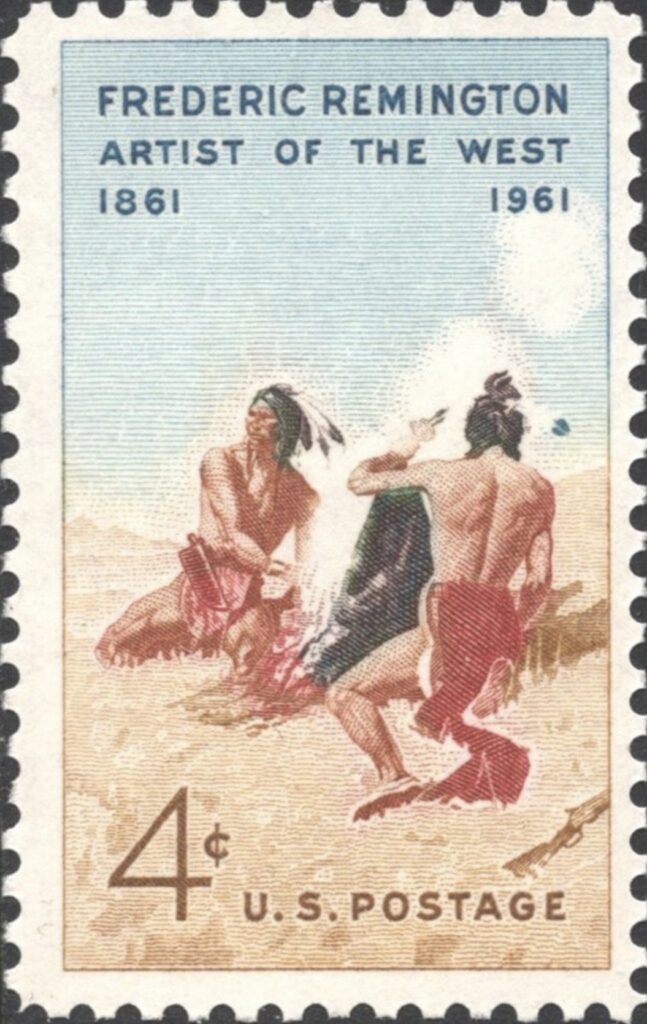
On October 4, 1961, the United States Post Office Department issued a 4-cent stamp honoring the 100th anniversary of the birth of Frederic Remington — an artist who, more than perhaps any other, shaped how generations of Americans pictured the Old West.
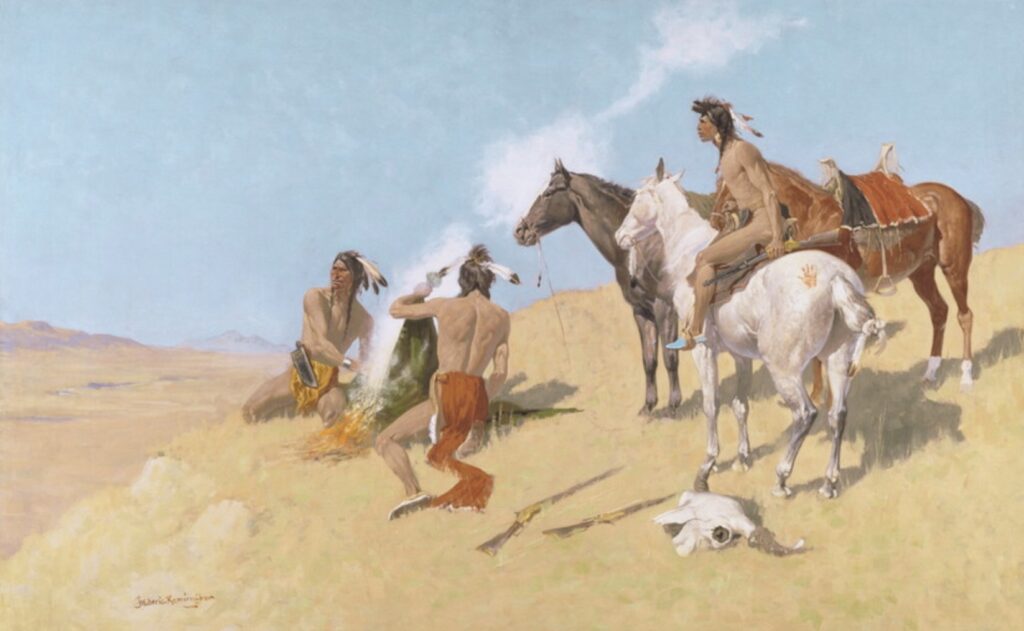
The stamp borrows a tightly cropped vertical slice from one of his paintings (see below), and to really understand what’s happening in that small rectangle of paper, it helps to step back and look at both the man who painted it and the picture in full.
The Artist
Frederic Sackrider Remington was born in Canton, New York, in 1861, the only child of a newspaper editor and cavalry officer who fought in the Civil War. That military connection may have planted an early fascination with soldiers and horses that never left him.
Remington studied briefly at Yale’s School of Fine Arts — he was reportedly more interested in football than painting there — before his father’s death cut short his formal education and sent him west in 1880 on the first of many trips across the Great Plains.
What he found there, and what he kept returning to over the next two decades, became the raw material for his life’s work: cowboys, cavalry troopers, ranchers, and the Native peoples of the Plains. All of this was captured at the exact historical moment when that world was disappearing under the pressure of railroads, barbed wire, and westward settlement.
Remington sensed the West was closing even as he painted it, and there’s a documentary urgency to much of his output, as if he were racing to get it all down before it vanished for good.
He was extraordinarily prolific. Over a 25-year career, Remington produced roughly 3,000 paintings and drawings, 22 bronze sculptures, a novel, a Broadway play, and more than a hundred magazine articles and stories.
He got his start as an illustrator, and that background shows in his work: his paintings are built for narrative clarity, staged like scenes from a story rather than composed as pure studies in light and color. Readers of Harper’s Weekly and Century Magazine knew his black-and-white illustrations for years before critics took his oil paintings seriously as fine art.
That changed later in his career. Around 1900, Remington began experimenting with nighttime scenes — his “nocturnes” — pushing himself technically in ways that impressed contemporaries who had dismissed him as a mere magazine illustrator.
He was, by his final decade, actively trying to loosen his brushwork and deepen his color sense, moving closer to the Impressionist painters he admired without ever fully abandoning the realism that had made his reputation.
He didn’t get to take that evolution much further. In 1909, at just 48 years old, Remington died of complications from an emergency appendectomy, cutting short a career that was still visibly changing shape.
The Painting
The Smoke Signal, sometimes referred to as Smoke Signals, is a product of that later, more mature period. Remington painted it in 1905, four years before his death, in oil on canvas, measuring roughly 30 by 48 inches — a wide horizontal format that gives the scene room to breathe.
The composition shows three Native American men on a high, open plain, pausing to send up a column of smoke to communicate with the comrades in the distance. There’s no galloping, no gunfire, none of the violent action Remington is often associated with.
Instead, the painting is built around stillness and attention — the riders and their horses have gone quiet, all focus directed outward toward a message being sent across empty space. It’s a picture about communication itself: how information could travel across the vast, undivided distances of the Plains without a word being spoken or a letter written.
That quiet, watchful mood also lets Remington show off skills that don’t always get credit in his more famous action scenes. The horses are rendered with real anatomical precision, caught in relaxed, alert postures rather than mid-stride. The palette leans into the soft, luminous colors of an open sky meeting an endless plain, giving the whole scene an atmospheric depth that critics have linked to his growing interest in Impressionist light effects.
It’s a painting that rewards a long look rather than a quick one — fitting, since it’s about the patience of watching and waiting for a signal to arrive.
The painting entered the collection of Fort Worth oilman Amon G. Carter, an avid collector of Remington and his contemporary Charles M. Russell. After Carter’s death, his collection became the founding core of the museum that bears his name.
Today The Smoke Signal hangs at the Amon Carter Museum of American Art in Fort Worth, Texas, part of one of the most important public collections of American Western art anywhere.
From Canvas to Stamp
When the Post Office Department went looking for an image to mark Remington’s centennial in 1961, The Smoke Signal offered exactly what a stamp designer needs: a strong, legible central subject that reads clearly even at postage-stamp scale. But translating a wide horizontal canvas into a small vertical stamp meant sacrifice — the design team cropped in tightly, isolating the two signalers and losing the expansive sense of open plain that gives the original painting so much of its meaning.
It’s a reminder that a stamp is never really a reproduction; it’s an adaptation, built to a completely different set of constraints than the artwork it’s drawn from.
Seeing the full painting alongside the stamp — as pictured here — restores what the crop leaves out: the horizon, the sky, the distance the smoke has to travel before anyone can read its message.
Stamp Data
- Nation: United States
- Date of Issue: October 4, 1961
- Denomination: 4 cents
- Number Printed: 111,600,000
- Location of First Day of Issue: Washington, D.C.
- Subject: 100th anniversary of the birth of Frederic Remington
- Image Source: The Smoke Signal (1905), Frederic Remington, Amon Carter Museum of American Art, Fort Worth, Texas, Amon G. Carter Collection