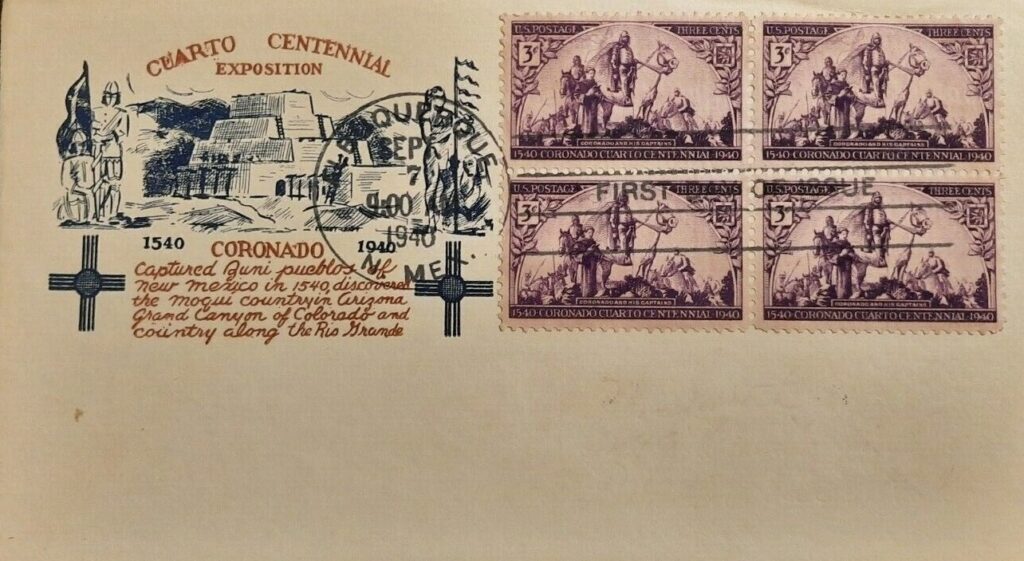
On September 7, 1940, the U.S. Post Office issued a three-cent violet stamp from Albuquerque, New Mexico, commemorating the 400th anniversary of an expedition that never found what it was looking for, yet changed the map of North America.
The 1940 Coronado Expedition stamp commemorates the 400th anniversary of Francisco Vásquez de Coronado’s two-year exploration of the American Southwest, reproducing Gerald Cassidy’s painting “Coronado and His Captains,” with the Coronado coat of arms worked into the corner. [Note that he is called Coronado in English-language references, but Vásquez in Spanish, following the way that names work.]
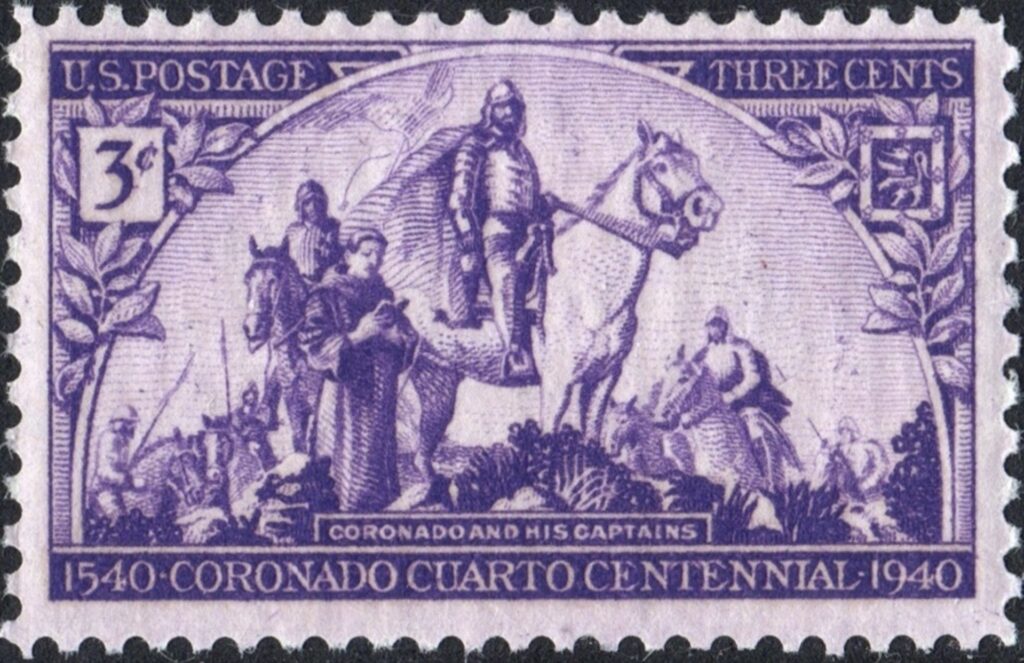
It was, in its way, a modest thing — one issue among 1.7 billion stamps printed in 1940 and 1941 combined — but for Arizona, and for the country’s understanding of its own deep past, it marked something worth pausing on: the moment the entrada, Coronado’s long march north out of Mexico, entered the official visual language of the nation.
The Search for Gold
The expedition itself began in 1540, when Coronado, a Spanish conquistador and governor of the Kingdom of Nueva Galicia, set out in search of the fabled Seven Cities of Gold. The rumor was worth chasing — the tale traced back to the earlier account of the Spanish friar Marcos de Niza, who described the fabled Seven Cities of Cíbola, said to lie in what is now Arizona.
De Niza’s report, whether born of genuine belief, mirage, or outright fabrication, was enough to launch one of the largest and most consequential expeditions in the history of the Spanish borderlands. Coronado led a huge company north — some 400 Europeans, roughly 2,000 native Mexican allies and laborers, four Franciscan priests, and a number of enslaved Native Americans and Africans pressed into the effort.
It was less a scouting party than a small army on the move, dragging livestock, supplies, and ambition across a landscape that gave up its secrets slowly and often violently.
The Seven Cities of Gold, when the expedition finally reached them, turned out to be the pueblos of the Hopi, the Zuni and others — adobe towns, real and impressive in their own right, but containing nothing like the wealth of Cíbola’s legend. Undeterred, or perhaps unwilling to return empty-handed, Coronado pushed the search onward.
Discovering the Grand Canyon
His men and subordinate parties fanned out across a staggering swath of territory over the following two years, ranging as far as the Grand Canyon and, by some accounts, out onto the plains of present-day Kansas in pursuit of yet another mirage, the golden city of Quivira. What they found instead, again and again, was land — vast, ungoverned in Spanish terms, and inhabited by peoples with their own long histories, none of which figured into the fantasy that had launched the whole enterprise.
For Arizona specifically, the entrada holds a founding-document kind of significance, even though nothing was founded in the conventional sense — no mission, no presidio, no colony grew directly from Coronado’s passage. What the expedition established instead was priority: the first documented European incursion into what would become Arizona territory, more than 60 years before Jamestown, and 80 years before the Mayflower.
That claim to primacy is precisely why the nation, sitting in the anxious summer of 1940 with war already loose in Europe, chose to mark the anniversary at all. The Coronado stamp belongs to a cluster of 1940–41 commemoratives that leaned hard into American continuity and deep roots — Pony Express, Pan American Union, state centennials for Idaho and Wyoming — issued in a moment when the nation seemed eager to remind itself, and perhaps the world, of how long and how far its story actually ran.
The physical trace of the expedition on the ground in Arizona is the Coronado National Memorial, established near the international border southwest of Bisbee, in the same mountainous borderland country the expedition is believed to have crossed on its way north out of Mexico. The memorial does not mark a single decisive event — no battle, no city founded — but rather a passage, a corridor of movement, which is itself an honest way to commemorate an expedition whose entire character was restless searching rather than settling.
It is a fitting companion to the postage stamp: both memorialize transit rather than arrival, motion rather than a fixed accomplishment. Coronado’s expedition, judged by its own stated goal, was a failure — no gold, no Cíbola, no Quivira worth the name.
Judged by its historical footprint, it was nothing of the kind. It opened, however roughly and however tragically for the peoples already living across that territory, the corridor through which Spanish, and later Mexican and American, claims to the Southwest would flow for centuries afterward.
That tension — a mission that failed by its own lights but succeeded in reshaping the map — is worth sitting with as Arizona’s postage-stamp story properly begins. Unlike Greece reaching back to Hermes to dress a young nation in borrowed antiquity, the United States in 1940 reached back only four centuries, to an episode still within reach of documented history, yet the impulse was not so different: a modern nation using a small rectangle of engraved paper to assert a lineage, to say that its story started earlier and ran deeper than the more familiar founding narratives of the eastern seaboard.
The Coronado stamp does that work quietly, a violet three-cent claim staked in 1940 for events 400 years gone, and it makes a natural opening chapter for the story of Arizona as told by the stamps that have, since then, tried to capture it.