The mountain lion — feared, misunderstood, and magnificent
Deep in the forests and canyons of the American West, a predator moves in near-total silence. It has dozens of names — cougar, puma, panther, catamount — but most people who live in its territory simply call it the mountain lion. Few have ever seen one. Fewer still forget the encounter.
Puma concolor holds the remarkable distinction of having the widest natural range of any wild land mammal in the Western Hemisphere. From the Canadian Yukon to the southern tip of Patagonia, it has adapted to deserts, rainforests, grasslands, and snowcapped peaks alike. This extraordinary flexibility is a testament to the species’ intelligence and resilience — and to why, despite centuries of persecution, it endures.
“The mountain lion is not merely a predator. It is an architect of ecosystems, shaping the land long before we arrived.”
An adult male can weigh up to 220 pounds and stretch nearly nine feet from nose to tail. Yet despite its size, the mountain lion is a master of invisibility. Its tawny coat blends seamlessly with the dry grasses and rocky outcrops of its habitat. It hunts alone, typically at dawn and dusk, relying on an explosive burst of speed and powerful hindquarters to ambush prey — most often deer — with a precise bite to the back of the skull or neck.
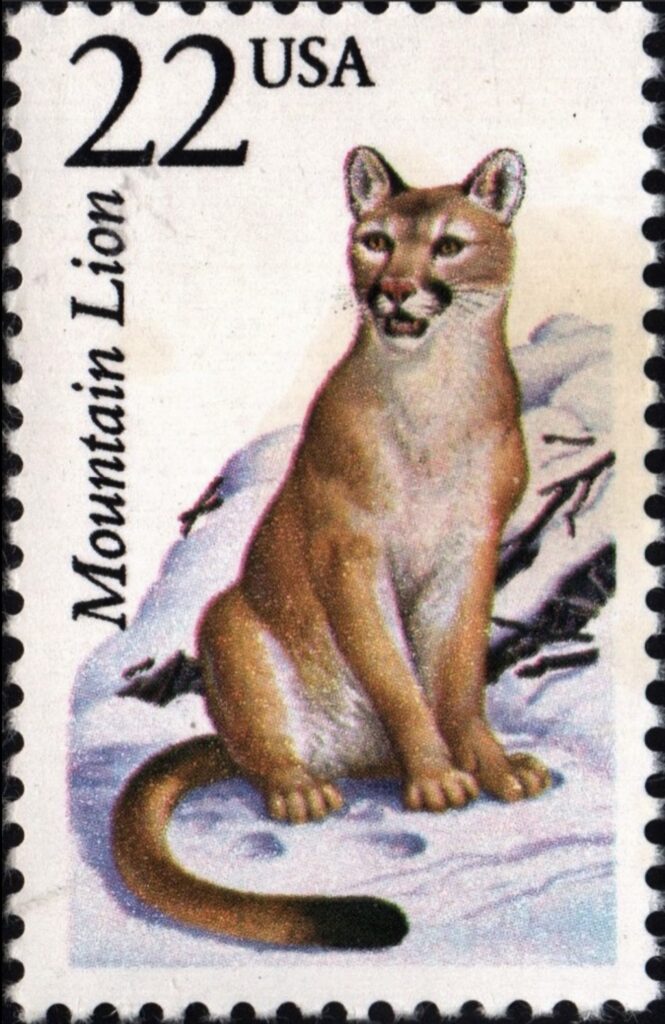
This big cat goes by many names — mountain lion, puma and cougar are a few.
The reason it gets an early introduction on the blog is that it happens to be — as a puma — the mascot of my high school team!
When I first learned about this critter, it was known scientifically as Felis concolor, the name given him by Carl Linnaeus in 1771. But in the 1980s, after DNA research became more common, it was decided he should be with other big cats rather than with the smaller ones of the Felis genus.
Whatever! He will always just be a puma to me.
And yes, I have seen them in the wild. They are impressive — and frankly somewhat scary. But oh so majestic!
The stamp is from a wildlife series of 50 introduced in 1987.
Beyond its role as a hunter, the mountain lion is a keystone species whose presence ripples through the entire food web. Where populations are healthy, deer and elk are kept in check, preventing overgrazing and allowing riverbanks and forests to regenerate. The celebrated “trophic cascade” observed in Yellowstone — usually credited to wolves — plays out similarly wherever mountain lions roam undisturbed. Remove the apex predator, and the landscape itself begins to unravel.
Human conflict remains the animal’s greatest threat. As suburban development pushes into wild land, encounters increase — and mountain lions almost always lose. Many states still permit trophy hunting. Yet fatal attacks on humans are extraordinarily rare: fewer than 30 confirmed deaths have been recorded in North America over the past 120 years. The animal is, statistically, one of the least dangerous large predators a person is likely to live alongside. The fear, experts argue, is largely cultural — a hangover from an era when wilderness was something to be conquered, not coexisted with.
Conservation efforts are gaining ground. Wildlife corridors, crossing structures over busy highways, and coexistence programs that compensate ranchers for livestock losses are slowly changing the relationship between people and mountain lions. In California, where a small, isolated population clings to the Santa Monica Mountains above Los Angeles, a landmark wildlife crossing over Highway 101 is expected to reconnect fragmented habitat and prevent inbreeding for the first time in decades.
The mountain lion asks nothing of us except space. In return, it offers something invaluable: a living measure of wildness, proof that vast, self-regulating landscapes can still exist. To see one — even briefly, even at dusk through a stand of pines — is to be reminded that we share this continent with something ancient and irreplaceable. That glimpse, for most who experience it, is enough to change everything.