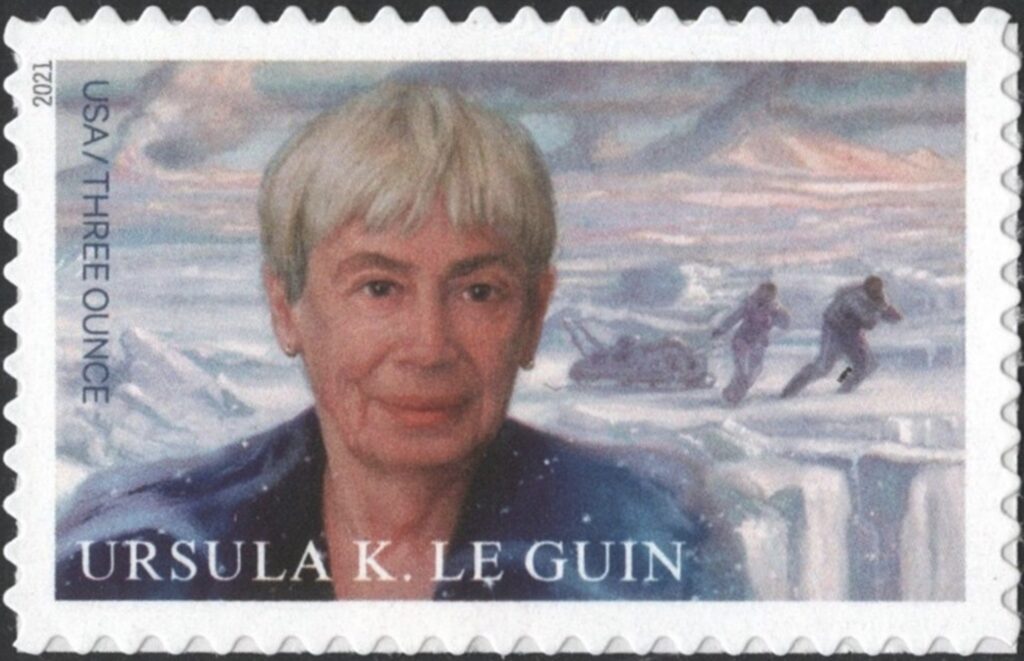
In 2021, the U.S. Postal Service issued a Forever stamp honoring Ursula K. Le Guin, depicting her portrait against a frozen, alien landscape drawn from one of her most celebrated novels. It was a fitting tribute for a writer who spent her career proving that science fiction and fantasy deserved a permanent place in serious literature — and who, more than almost any author of her generation, expanded what those genres were capable of saying about being human.
An Anthropologist’s Daughter
Ursula Kroeber was born on October 21, 1929, in Berkeley, California, where her father, Alfred, worked as an anthropologist at the University of California, Berkeley, while her mother, Theodora, was a biographer who also wrote extensively on anthropology.
Growing up surrounded by discussions of culture, myth, and human society left a lasting imprint on her imagination — themes that would surface again and again throughout her fiction. From a young age, she was also deeply interested in Native American cultures, an interest that further shaped her worldbuilding instincts.
She pursued formal education in literature rather than science, studying French and French literature at Radcliffe College in Cambridge, Massachusetts, and at Columbia University in New York City, where she earned her master’s degree in 1952. She married historian Charles Le Guin the following year, and the couple settled in Portland, Oregon, in 1958, the city that would remain her home for the rest of her life.
Finding Her Voice
Le Guin’s first published work was a poem, “Folksong from the Montayna Province,” which appeared in 1959 — an early sign of the literary ambition she’d eventually bring into genre fiction. In 1966, she published her first novel, “Rocannon’s World,” blending elements of fantasy and science fiction, which laid the groundwork for what became known as the Hainish Cycle, a loosely connected series of novels and stories set across a shared fictional universe of human-settled worlds.
She earned widespread acclaim in 1968 with “A Wizard of Earthsea,” a novel exploring the difficult education of a young wizard across a vast archipelago — a book that would go on to influence generations of fantasy writers and become a foundational text in young adult fantasy literature.
Breaking New Ground
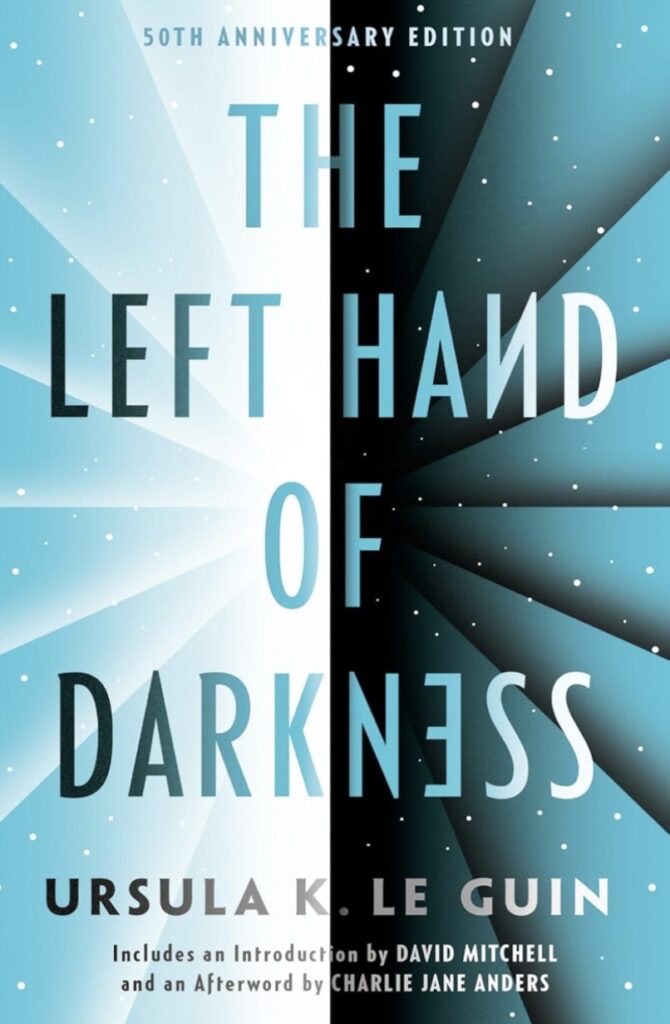
Le Guin’s most groundbreaking achievement came in 1969 with “The Left Hand of Darkness.” The novel follows a human ambassador sent to an icebound planet whose inhabitants have no fixed gender, using the premise to interrogate assumptions about gender, identity, and social structure that few science fiction writers of the era had dared to touch.
The book won both the Hugo and Nebula Awards and is widely credited with permanently raising the literary bar for what science fiction could accomplish.
She continued pushing boundaries throughout the 1970s. “The Farthest Shore” (1972), part of the Earthsea series, won the 1973 National Book Award for children’s books, while “The Dispossessed” (1974), set within the Hainish Cycle, won the Nebula Award that same year. “The Dispossessed” in particular became known for its nuanced exploration of anarchism and competing political systems, reflecting Le Guin’s lifelong interest in social structures and alternative ways of organizing human life.
A Writer Without Borders
What set Le Guin apart from many of her contemporaries was her refusal to stay confined to any single genre or form. Beyond her novels and stories, she published volumes of poetry, wrote realistic fiction set in small-town Oregon, and even started a blog at age 81 that later became a published essay collection. Her 1985 novel “Always Coming Home” imagined the distant future lives of a fictional people called the Kesh, continuing her exploration of speculative anthropology.
Her work as a translator further reflected her wide-ranging intellectual interests. She translated authors from Chile, Argentina, and Romania, and in 1998, published a translation of the ancient Chinese text the “Tao Te Ching,” the product of 40 years of Taoist study and reflection.
Le Guin was also notable for the social impact of her work. She championed the literary legitimacy of science fiction and fantasy, encouraged more women to write and read within those genres, and placed nonwhite characters at the center of her fiction while engaging thoughtfully with issues of racial injustice and colonialism.
Recognition and Legacy
Her honors accumulated steadily over a long career. She received nine Hugo Awards, six Nebula Awards, the 1973 National Book Award, and the National Book Foundation Medal for Distinguished Contribution to American Letters. The Library of Congress named her a Living Legend in 2000, and the Science Fiction and Fantasy Writers of America named her a Grand Master in 2002. She died at her home in Portland on January 22, 2018, at age 88.
In 2021, the Postal Service honored her with the 33rd stamp in its Literary Arts series, featuring a portrait based on a 2006 photograph set against a scene from “The Left Hand of Darkness.” As one observer noted at the stamp’s unveiling, being featured on a postage stamp carries a particular kind of cultural weight — more than an award or a bestseller list, it marks someone as a lasting icon of American letters.
For a writer who spent her career insisting that imagination shouldn’t be fenced in by genre, it was a fitting, permanent tribute.
How deep do you want to go? Will reading the novel be enough, or would you also want to spend some time with a study guide? (These links will take you to Amazon. If you buy anything, I will get a small commission.)