In the early 1960s, a remarkable thing happened on the stamp counters of West and Central Africa. Nations that had been French colonies only a few years before began issuing handsome airmail stamps celebrating their new partnership with Europe. The series came to be known as Europafrique, and it tells the story of a continent trying to redefine its relationship with its former rulers.
A New Kind of Relationship
When the Treaty of Rome created the European Economic Community in 1957, France insisted that its overseas territories be associated with the new common market. Within three years, most of those territories had become independent nations, and the old arrangement needed a new legal footing.
The answer was the Yaoundé Convention, signed on July 20, 1963, in the capital of Cameroon. It linked the six EEC members with eighteen newly independent states known as the Associated African and Malagasy States. The convention granted African exports preferential access to European markets and channeled development money through the European Development Fund into roads, schools, clinics and ports.
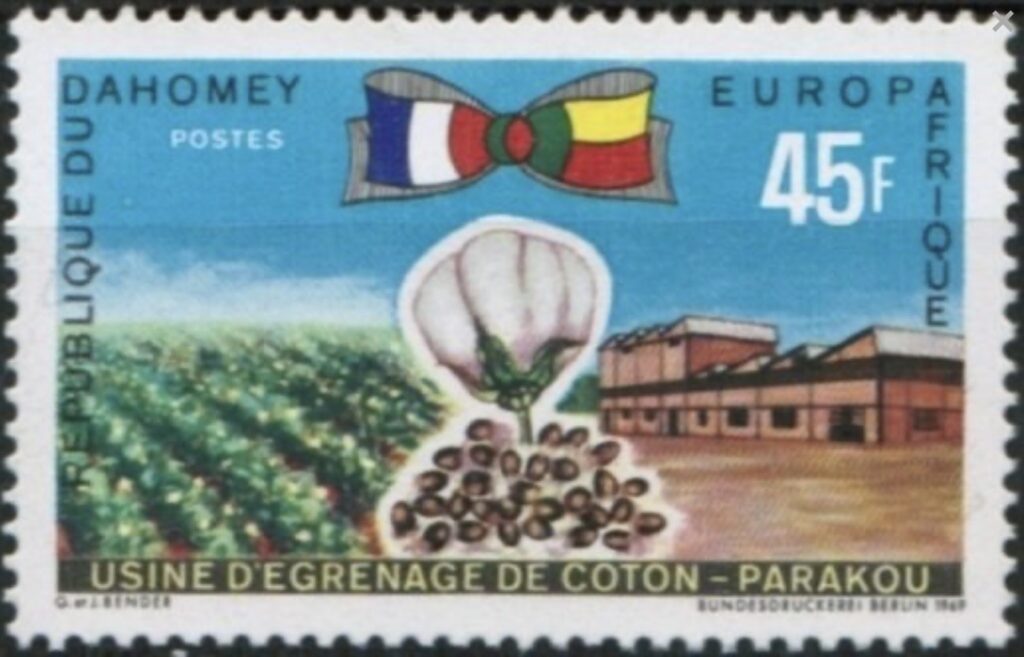
This 1969 issue from Dahomey (Benin) is an example of the Europafrica issues.
For governments only a few years removed from colonial status, this was something to celebrate. Unlike the old system, the convention was an agreement between sovereign nations, negotiated at an African capital and signed by African heads of state.
The Stamps
The new nations marked the occasion the way nations do: with postage stamps. In 1963, several of the associated states, among them Gabon and the Republic of the Congo, issued airmail stamps honoring the European-African Economic Convention. The following year brought first-anniversary issues bearing the name Europafrique, and the series continued through the 1960s and into the 1970s from countries including Cameroon, the Central African Republic, Dahomey (today’s Benin), Upper Volta (Burkina Faso) and Niger.
The designs are a study in optimism. Many show the two continents joined by bridges, handshakes, interlocking symbols or stylized maps. Others feature sheaves of grain, factory gears, oil derricks and cargo ships, the hoped-for products of shared prosperity. Most were printed in France in the rich, multicolored engraving style of the period, and their high airmail denominations meant they traveled on letters between Africa and Europe, carrying the message of partnership along the very routes the convention was meant to strengthen.
Promise and Reality
The partnership was renewed by a second Yaoundé Convention in 1969, then replaced in 1975 by the Lomé Convention, which widened the arrangement to dozens of African, Caribbean and Pacific nations, including former British colonies.
Critics have long argued that these agreements kept African economies tied to the export of raw materials and to their former colonial powers. Supporters point to the infrastructure and trade they made possible. Both views have merit, and the debate continues.
The Europafrique stamps remain as a record of a hopeful moment. Readers of our earlier post on the CEPT Europa stamps will recognize the impulse: in both cases, small rectangles of paper were enlisted to tell citizens that a new era of cooperation had arrived. In Europafrique, the newly independent nations of Africa announced to the world that they would face that era as partners, not subjects.
1 thought on “Europafrique: Stamps for a Partnership of Equals”