In January 1892, in Bloemfontein, in what was then the Orange Free State in southern Africa, a British bank employee and his wife had a son they named John Ronald Reuel. Nothing about the circumstances of that birth suggested the child would grow up to reshape an entire genre of literature, invent working languages complete with their own grammars, and become one of the most widely read authors of the 20th century.
But J.R.R. Tolkien would do exactly that, and he would do it not as a novelist by trade but as an Oxford professor of Anglo-Saxon who treated storytelling as an extension of his scholarly obsessions with myth, language, and the deep past.
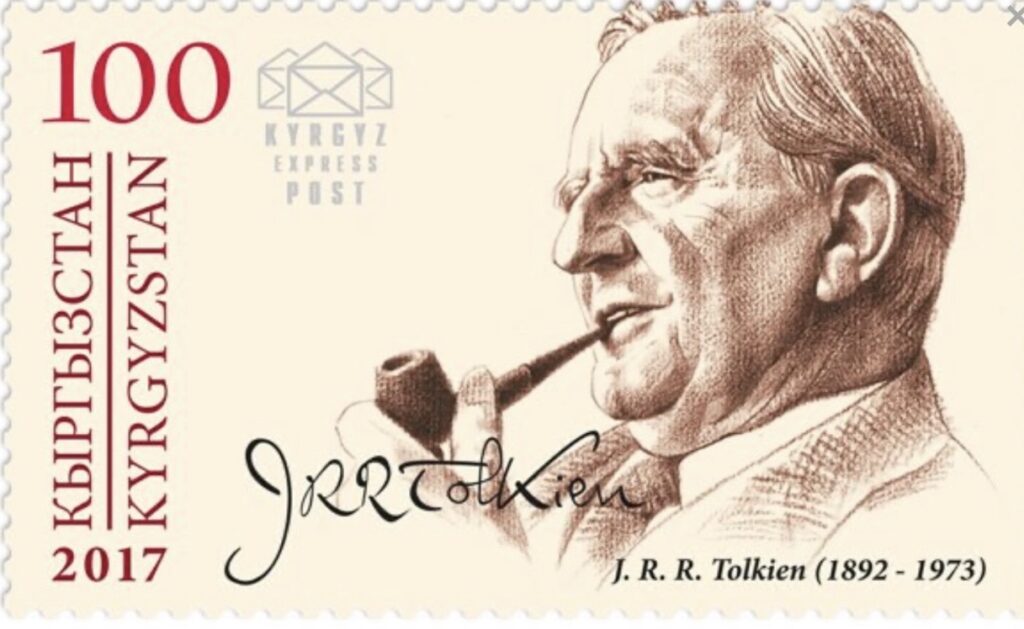
This 2017 stamp from Kyrgyzstan is part of a series that includes Arthur C. Clarke, who has his own post elsewhere. Many stamps from around the world honor Tolkien, but this is the only one with his image. The rest show characters and scenes from his works, such as Smaug the dragon and the Shire.
An Early Life Marked by Loss
Tolkien’s father died in South Africa in 1896 when Ronald, as he was known, was just four years old, and his mother Mabel brought him and his younger brother Hilary back to England, settling near Birmingham. Mabel converted to Catholicism, a decision that estranged her from much of her family and left the household in financial precarity.
She died of diabetes in 1904, when Tolkien was 12, and the boys became wards of a Catholic priest, Father Francis Xavier Morgan, who saw to their upbringing and education. Tolkien would later describe his mother as a martyr for her faith, and Catholicism became a lasting, load-bearing element of his worldview and, eventually, of the moral architecture beneath his fiction.
At King Edward’s School in Birmingham, Tolkien showed an early and unusual gift for language. He devoured Old English and Old Norse texts, taught himself Finnish so he could read the Kalevala in its original form, and began inventing languages purely for pleasure—a habit that never left him.
He went on to Exeter College, Oxford, to study first Classics and then English Language and Literature, graduating in 1915 with the shadow of the First World War already lengthening over his generation.
War, Oxford, and the Beginnings of a Mythology
Tolkien was commissioned into the Lancashire Fusiliers and served on the Western Front, including at the Battle of the Somme in 1916, one of the war’s bloodiest engagements. He contracted trench fever and was sent home, which likely saved his life; most of his close friends from school did not survive the war.
The experience left a permanent mark on him, though he consistently resisted readings of his later fiction as direct allegory for the war, insisting instead that any resemblance came from shared human experience rather than one-to-one correspondence.
After the war, Tolkien worked briefly on the Oxford English Dictionary before taking academic posts, first at the University of Leeds and then, from 1925, at Oxford itself, where he became Rawlinson and Bosworth Professor of Anglo-Saxon. It was at Oxford that he formed his most consequential friendship, with C.S. Lewis, and joined the informal literary group known as the Inklings, where the two writers read drafts of their work aloud to one another for decades.
It was also at Oxford, reportedly while grading examination papers, that Tolkien scrawled an idle sentence on a blank page: “In a hole in the ground there lived a hobbit.” That sentence became the seed of The Hobbit.
Long before that, however, Tolkien had already begun building the mythological framework that would underlie everything he wrote. Starting around 1917, he worked on what he called his “legendarium”—stories of Elves, Men, and the god-like Valar set in an imagined age called Middle-earth. This material, developed obsessively and never fully finished in his lifetime, would eventually be published posthumously as The Silmarillion.
The Major Works
The Hobbit, published in 1937, began as a children’s story but carried within it the deeper mythology Tolkien had already been constructing. Its warm, comic tone and its success prompted his publisher to ask for a sequel, and what emerged over the next 17 years was something far larger and darker: The Lord of the Rings, published in three volumes between 1954 and 1955.
Tolkien had intended it as a single continuous work, and its division into The Fellowship of the Ring, The Two Towers, and The Return of the King was a decision made for practical publishing reasons.
The Lord of the Rings follows the hobbit Frodo Baggins as he undertakes to destroy a Ring of immense and corrupting power, and it draws together the languages, histories, and peoples Tolkien had spent decades inventing.
Critics were initially divided—some dismissed it as childish escapism, while others recognized its formal ambition—but readers embraced it overwhelmingly, and it has never been out of print.
Tolkien followed it with smaller works, including Farmer Giles of Ham and Smith of Wootton Major, but the vast bulk of his legendarium remained unpublished at his death in 1973. His son Christopher Tolkien spent decades afterward editing and releasing this material, most notably The Silmarillion in 1977, along with the 12-volume History of Middle-earth.
Craft, Language, and Method
What set Tolkien apart from most fantasy writers before or since was that the invented languages came first and the stories grew to explain them. He held that a language implies a history and a people to speak it, and he built Quenya and Sindarin, his two principal Elvish languages, with the same rigor he applied to his professional study of real ones.
This philological foundation gives Middle-earth a density that few imagined worlds have matched: place names, genealogies, and songs all cohere because they were generated from an internally consistent linguistic and historical logic rather than invented on the fly for narrative convenience.
Tolkien also thought of his fiction in terms of “sub-creation,” a concept rooted in his Catholic faith: the idea that human beings, made in the image of a Creator, have a natural impulse to create secondary worlds, and that doing so well is a legitimate and even sacred act. This is laid out most directly in his 1939 lecture “On Fairy-Stories,” which remains one of the foundational theoretical texts of fantasy literature.
Legacy
The scale of Tolkien’s influence on modern fantasy is difficult to overstate. The Lord of the Rings established many of the conventions later writers would treat as genre furniture—the sweeping quest narrative, the invented world with its own deep history, the moral clarity of a struggle against an overwhelming darkness.
Peter Jackson’s film trilogies, released in the early 2000s and again in the 2010s, introduced Middle-earth to new generations and became among the most commercially successful films ever made. Tolkien’s work has sold hundreds of millions of copies worldwide and has been translated into dozens of languages, an irony not lost on a man who spent his career studying how languages diverge and change.
Beyond popularity, Tolkien reshaped the intellectual respectability of fantasy as a literary mode. Where the genre had often been treated as trivial, Tolkien approached it with the seriousness of a medievalist, drawing on Beowulf, Norse sagas, and Finnish epic to build something that felt ancient rather than merely invented.
He died in 1973, but Middle-earth has continued to expand in the decades since, edited and extended first by his son and now inherited by an audience that shows no sign of setting it down.
1 thought on “J.R.R. Tolkien: The Philologist Who Built a World”