On the morning of February 23, 1945, five days into the bloodiest fighting the Marine Corps had ever seen, a patrol scrambled up the loose volcanic ash of Mount Suribachi and planted a small American flag on its summit. It was a modest thing, barely visible from the beach below, but the Marines fighting for their lives on Iwo Jima’s black sand saw it and roared.
A few hours later, an officer decided the flag should be bigger, so a second detail climbed the mountain with a larger one and a length of pipe to serve as a staff. Associated Press photographer Joe Rosenthal, following behind, nearly missed the moment. He swung his camera up without even framing the shot through the viewfinder and caught six Marines heaving the pole upright against the sky.
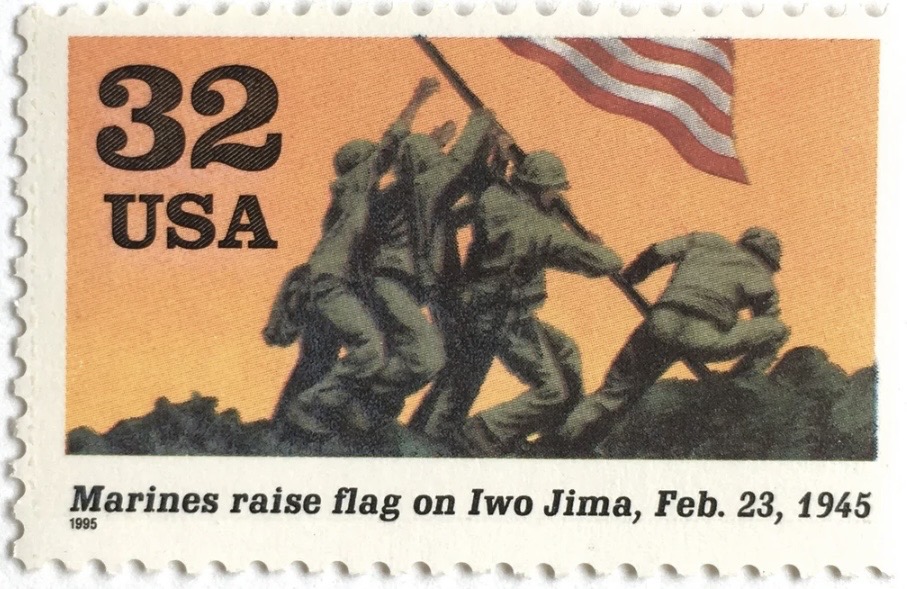
The picture became the most reproduced photograph in American history, and within days the six men in it belonged to the country, whether they wanted to or not. One of them was a shy, watchful 22-year-old from the Gila River Indian Reservation in Arizona named Ira Hamilton Hayes.
Hayes was born in Sacaton in January 1923 and raised a few miles south in Bapchule, a member of the Akimel O’odham, the Pima people. His mother, determined that her children be literate in the language of a country that would not let Pima people vote in Arizona until 1948, taught him to read early, and he grew into a serious, bookish young man who could sit through hours of company without saying much.
He enlisted in the Marine Corps Reserve in August 1942, not long after Pearl Harbor, and volunteered for parachute training, where instructors nicknamed him “Chief Falling Cloud.” He fought at Vella Lavella and Bougainville before landing on Iwo Jima with the 5th Marine Division in February 1945.
Of the 45 men in his platoon, five survived the battle. Of the 250 men in his company, most were killed or wounded. Hayes was one of the ones who walked off the island, and one of the six who happened to be holding the flagpole when Rosenthal pressed his shutter.
The Marine Corps did not get the names right at first, and it took 74 years, three private historians, and an FBI digital-evidence lab to sort out exactly who was in the frame. The final, corrected roster tells its own story about who fought at Iwo Jima.
Sergeant Michael Strank, the detail’s leader, had been born in the village of Jarabina in what was then Czechoslovakia and immigrated to Pennsylvania coal country as a boy of six; his father worked the mines that fueled American industry.
Corporal Harlon Block was a Texas farm boy.
Private First Class Franklin Sousley came from rural Kentucky. All three were dead within days of the photograph, killed in the fighting that raged on for another month after the flag went up; Strank died on March 1, cut down by a shell that, cruelly, may have been fired by an American ship.
The three who survived the battle were Hayes, Corporal Harold Schultz, and Corporal Harold Keller — some of them only correctly restored to the historical record in 2016 and 2019, after decades in which other Marines had mistakenly worn the credit.
Hayes, Gagnon, and Bradley — the three the Marine Corps believed at the time to be survivors — were pulled off the front lines and sent home to headline the Seventh War Loan Drive, a cross-country bond tour meant to cash in on the photograph’s power.
Hayes hated nearly every minute of it. He had not asked to be a symbol, and he could not square the parades and the handshakes with the fact that so many better men, in his own accounting, were still lying in the volcanic sand of Iwo Jima.
“They were better men than me and they’re not coming back,” he said, “much less back to the White House, like me.” In 1946, still troubled that Block’s family had not been told their son helped raise the flag, Hayes hitchhiked 1,300 miles from Arizona to Texas on his own dime to tell them himself.
The fame never fit him, and the drinking that had started as a way to get through the bond tour hardened into something he could not shake. He returned to the reservation, worked irrigation and farm labor, was arrested repeatedly for public intoxication, and struggled for a decade with what would today be recognized plainly as combat trauma layered on survivor’s guilt.
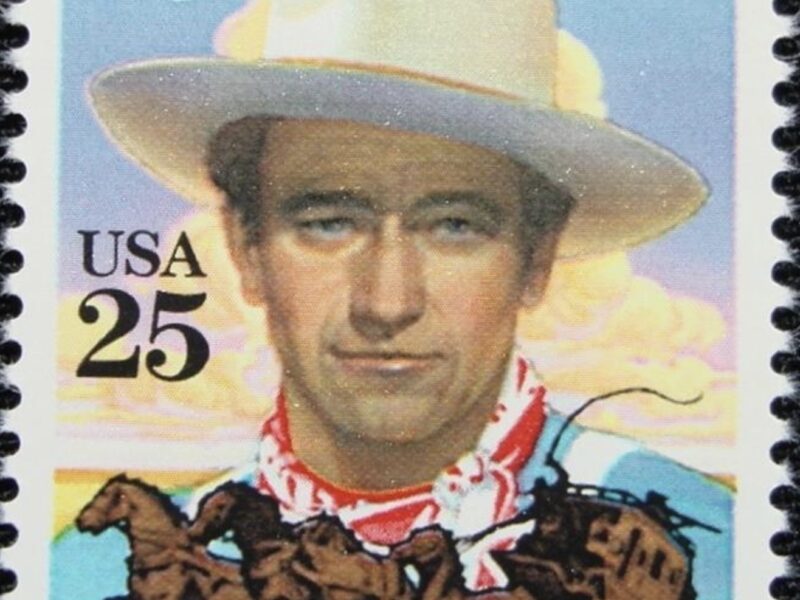
Hollywood came calling too: he consulted on and appeared in the 1949 John Wayne picture Sands of Iwo Jima, and Tony Curtis played a fictionalized version of him in 1961’s The Outsider. Neither made his life easier. On January 24, 1955, not yet 32 years old, Hayes was found dead near an irrigation ditch outside Bapchule, on the reservation where he had grown up, the cause a combination of exposure and alcohol.
Nine years later, the folk singer Peter La Farge wrote “The Ballad of Ira Hayes,” a stark accounting of a man the country celebrated and then let fall through the cracks; Johnny Cash’s 1964 recording of it carried Hayes’s name to an audience that had mostly forgotten him.
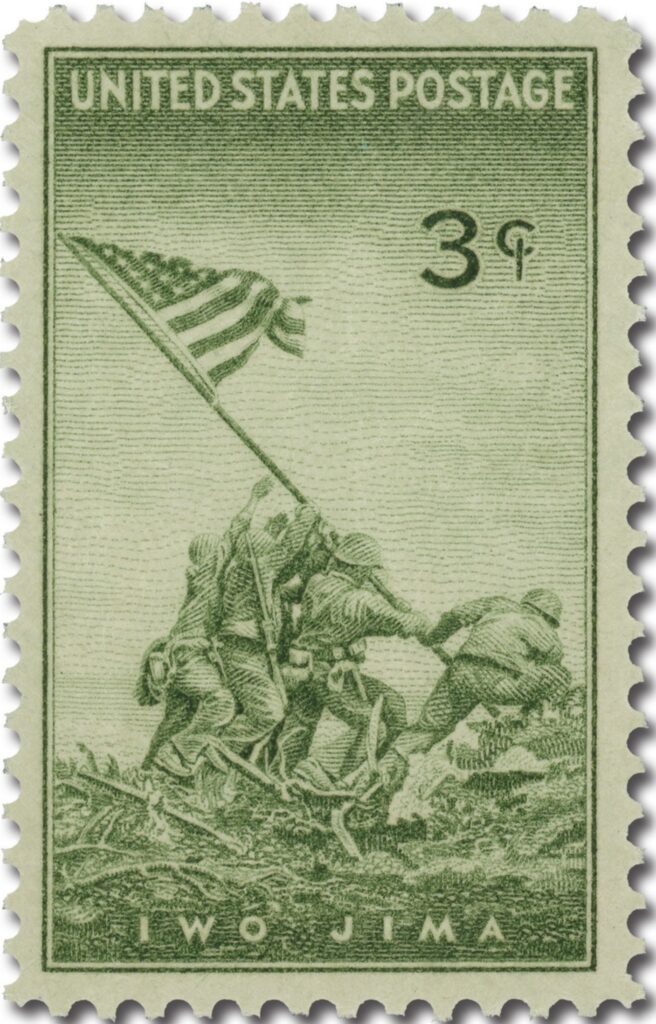
Hayes appears twice on American postage: on the three-cent stamp the Post Office rushed into print on July 11, 1945, less than five months after the flag went up, and again fifty years later, on a thirty-two-cent stamp issued September 2, 1995, for the battle’s golden anniversary.
Both reproduce Rosenthal’s photograph directly, which means both also carry Strank, Block, and Sousley, the three who never came home, and Schultz and Keller, whose place in the picture the country would not properly acknowledge for another seven decades.
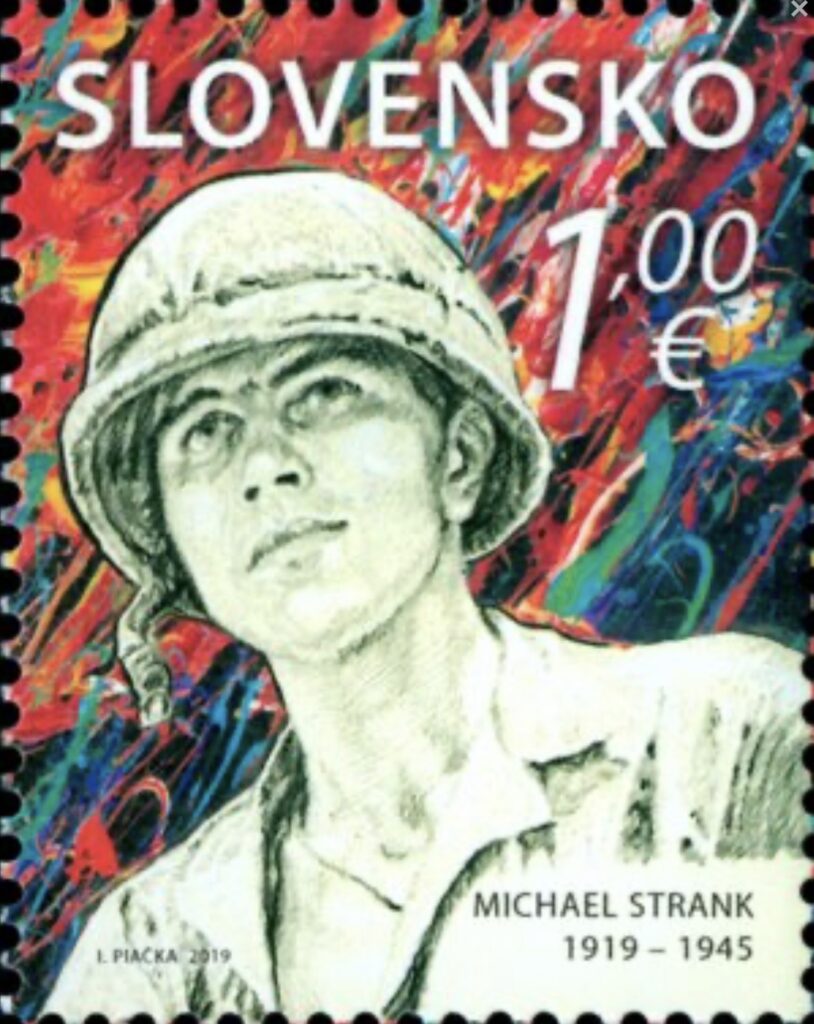
In 2019, Slovakia issued its own stamp honoring Strank alone — a one-euro issue timed to the anniversary of his death, picturing the sergeant from Jarabina against an abstract wash of color, with a first-day cover showing the flag raising itself.
It is a strange and moving thing to consider: a small European nation memorializing the immigrant son of a coal miner on the same mountain, in the same instant, where a Pima Marine from a reservation that the United States had not yet trusted with full citizenship stood shoulder to shoulder with him.
Two boys from two edges of the American story, one raised on land the government had taken from one people and opened to another, ended up holding the same pole.
Hayes never wanted the photograph to define him. It did anyway, and it still does — on a windswept reservation road in Arizona, in a quiet village in Slovakia, and on stamps that neither man lived to see.