Collectors who leaf through the French pages of a stamp album from the Second World War often notice an odd pattern. Stamp after stamp carries two numbers: the postage value and a second figure, sometimes larger than the first, marking a surcharge. Many of these semi-postal stamps raised money for one organization, the Secours National. Behind those small extra charges is one of the more complicated stories of wartime France, one that reached from Paris to Algiers, Dakar and Madagascar.
A Charity Born in Wartime
The Secours National was not a creation of the Second World War. It was founded in August 1914, in the first weeks of the Great War, to coordinate relief for civilians uprooted by the fighting. It brought together charities of every political and religious stripe under a single banner, and it became a model of French national solidarity.
When war returned in 1939, the organization was revived. Then came the catastrophe of 1940. Germany defeated France in six weeks, occupied the north and the Atlantic coast, and left a rump French state governed from the spa town of Vichy under Marshal Philippe Pétain, the elderly hero of Verdun.
The needs were overwhelming. Millions of refugees had fled south during the invasion. Nearly two million French soldiers were prisoners of war in Germany, and their families were left without breadwinners. Food and fuel were rationed, and cities were later bombed.
In October 1940, the Vichy regime reorganized the Secours National as a charity under state supervision, giving it semi-official standing and responsibility for coordinating aid to refugees, bomb victims and the families of prisoners.
Pétain’s Charity
Under Vichy, the Secours National became closely identified with the Marshal himself. Its winter relief campaign was called the Entr’aide d’Hiver du Maréchal, the Marshal’s Winter Mutual Aid, and its appeals carried his name and image.
Historians describe the organization in this period as having been absorbed into the Vichy state and put to work as a showcase for the social program of Pétain’s “National Revolution.”
That is the central tension of the Secours National. Its relief was real. It fed children, sheltered evacuees and sent parcels to prisoners in German camps. At the same time, every bowl of soup was served under the portrait of a regime that collaborated with Nazi Germany.
Critics then and since have noted the resemblance between the Marshal’s winter relief campaign and the German Winterhilfswerk, the Nazi party’s own winter charity drive.
The Stamps of Metropolitan France
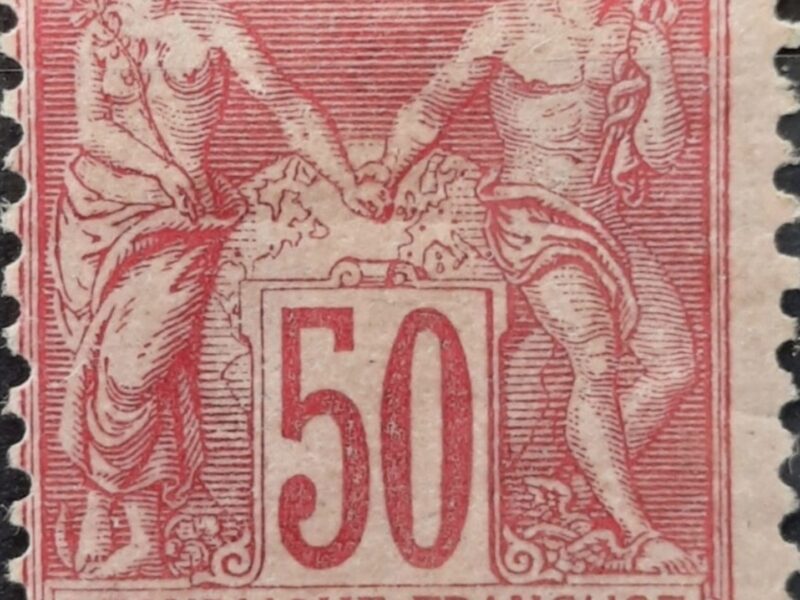
Semi-postal stamps were an obvious fundraising tool. France had issued them since the First World War, and the public was used to paying a few extra centimes for a good cause. Under Vichy, the practice expanded dramatically.
Many of the wartime French semi-postals carried surcharges for the Secours National, and the Marshal’s face appeared on a good number of them. A 1941 pair, catalogued by Scott as B112–B113, is identified with Marshal Pétain’s National Relief Fund, and a further National Relief set followed in 1943.
Other issues raised money for prisoners of war, for towns damaged by bombing, and for children. The designs favored the themes of the National Revolution: work, family and fatherland, peasants at harvest, and the Marshal himself, looking paternal and resolute.
For the ordinary letter writer, buying one of these stamps was a small act of charity and a small act of loyalty at the same time, whether or not the buyer intended the second.
The Empire Joins In
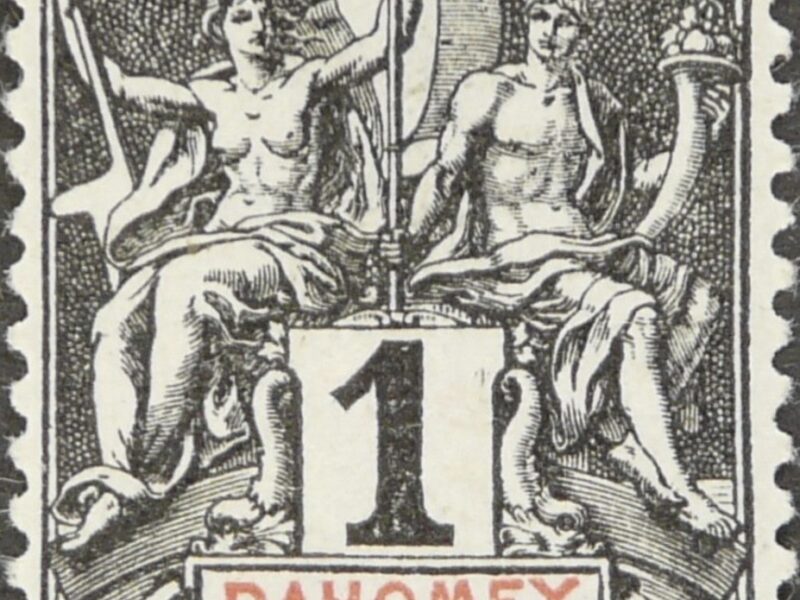
France’s overseas empire was the one great asset Vichy still controlled after 1940, and the regime made a point of enlisting the colonies in its cause. The Paris printing works produced a flood of new colonial stamps, including Pétain portraits and a “Défense de l’Empire” set in 1941. (Yes, oddly enough, Vichy stamps were still printed in Paris, which was controlled by the Germans.)
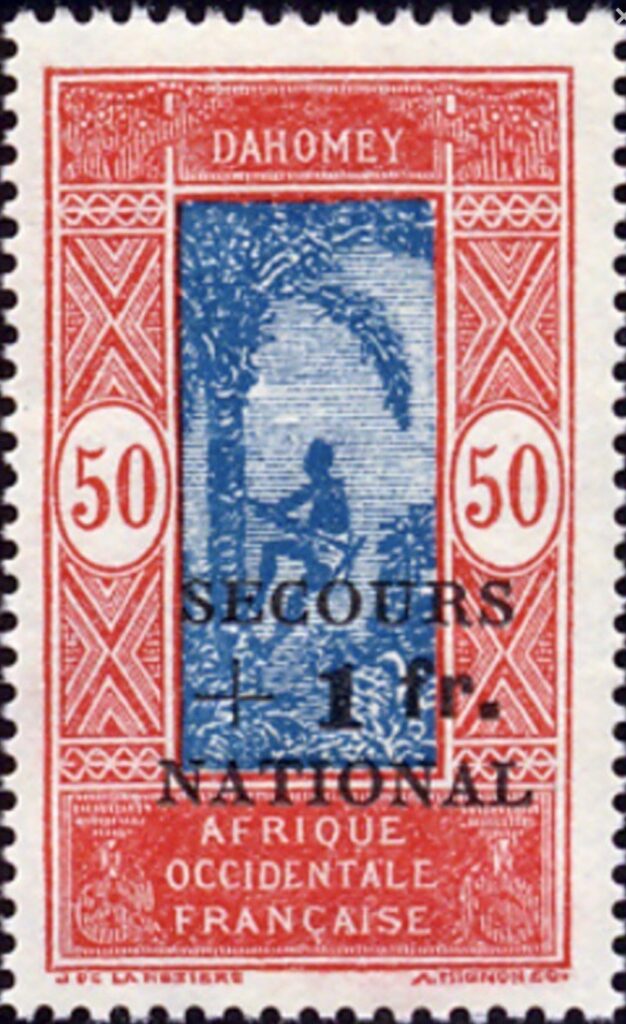
The colonial Secours National stamps followed in 1942, with 15,000 printed for each of the eight colonies of French West Africa, 32 values in all. The issuing colonies included Senegal, Dahomey, Niger, French Guinea and Ivory Coast. That same year, “Secours National” was also overprinted on stamps of Madagascar. In North Africa,
Algeria issued a 1-franc stamp in March 1942 overprinted “SECOURS NATIONAL” with a 4-franc surcharge, a striking example of the surtax far exceeding the postage itself.
Here the story takes a turn that makes these stamps a puzzle for collectors. Many of Vichy’s colonial issues never reached the colonies at all. In November 1942, Allied forces landed in North Africa, and French West Africa soon came over to the Allied side. The stamps printed in Paris for those territories were stranded.
Collectors have long debated which of the Vichy colonial stamps printed between 1941 and 1944 actually reached the colonies and were sold at post office counters, and a list issued by the French overseas ministry in 1946 was needed to sort out the record. Many of these stamps are more common unused than properly used on cover, a sign that they passed mostly through Paris and the collector market rather than the mail.
The Other France
Vichy was not the only France selling charity stamps. In the territories that rallied to General Charles de Gaulle, the Free French ran their own fundraising through the mails. Cameroon, one of the first colonies to join de Gaulle, overprinted stamps in 1941 to raise money for the war effort, including a set reading “SPITFIRE 10fr / General de Gaulle.” The Free French also issued semi-postals in 1943 and 1944 that later became valid throughout liberated France.
Set side by side in an album, the two series tell the story of a nation split in two, with each government asking citizens to pay a little more at the post office for its own vision of France.
After the Liberation
When France was liberated in 1944, the Provisional Government could not simply abolish an organization that was still feeding hungry people. Instead, the Secours National was purged of its Vichy associations and renamed the Entr’aide Française, and it continued relief work in the hard years after the war.
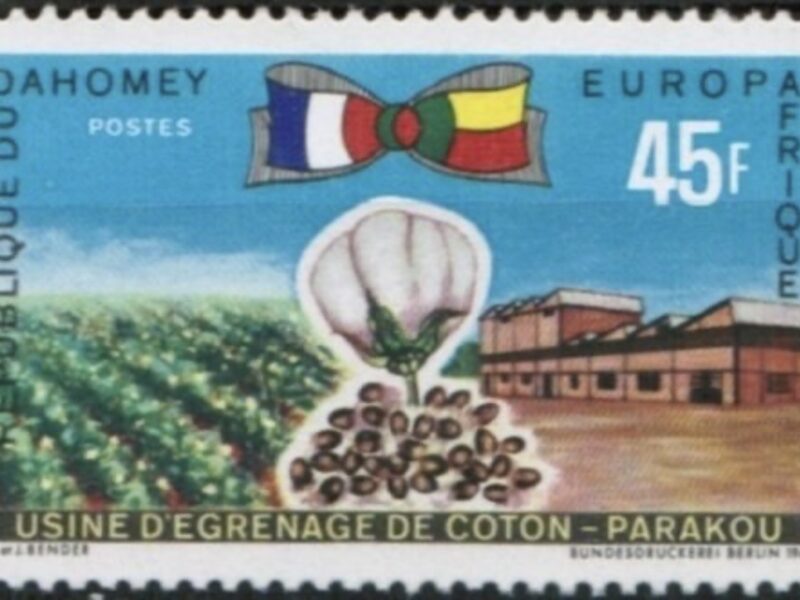
The stamps remain. For historians they are a record of how a collaborationist regime used charity to win public loyalty. For collectors they are a reminder that some of the most interesting stamps are the ones that never did their job. And for readers of our recent post on the Europafrique stamps, there is a quiet connection: Dahomey, Niger and their neighbors, whose names appear on these wartime Vichy issues as colonies, would two decades later issue stamps of their own as independent nations, celebrating a partnership with Europe on very different terms.