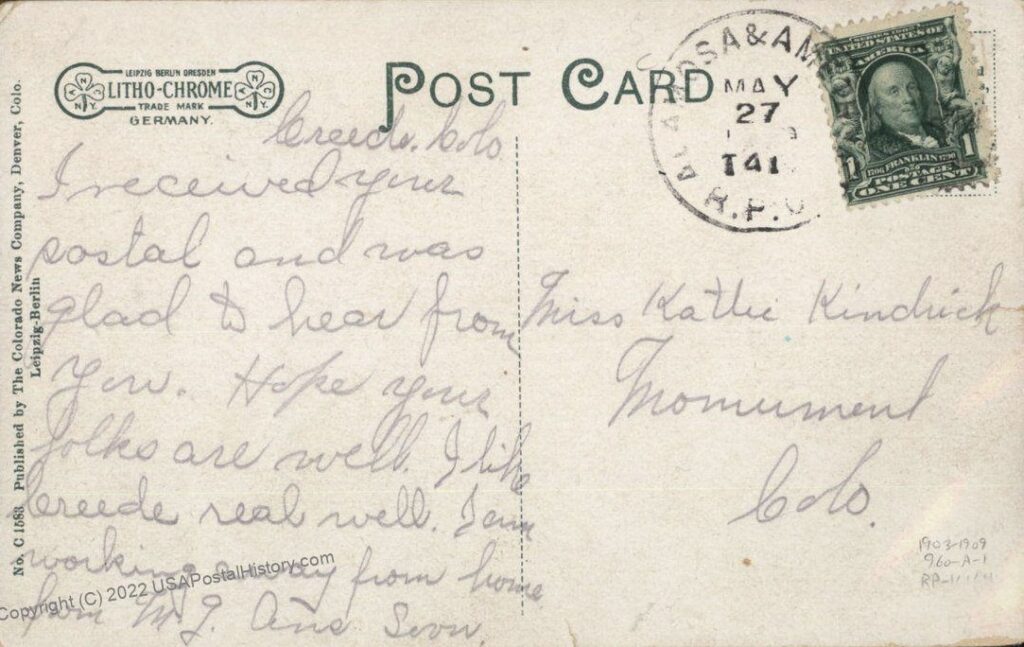
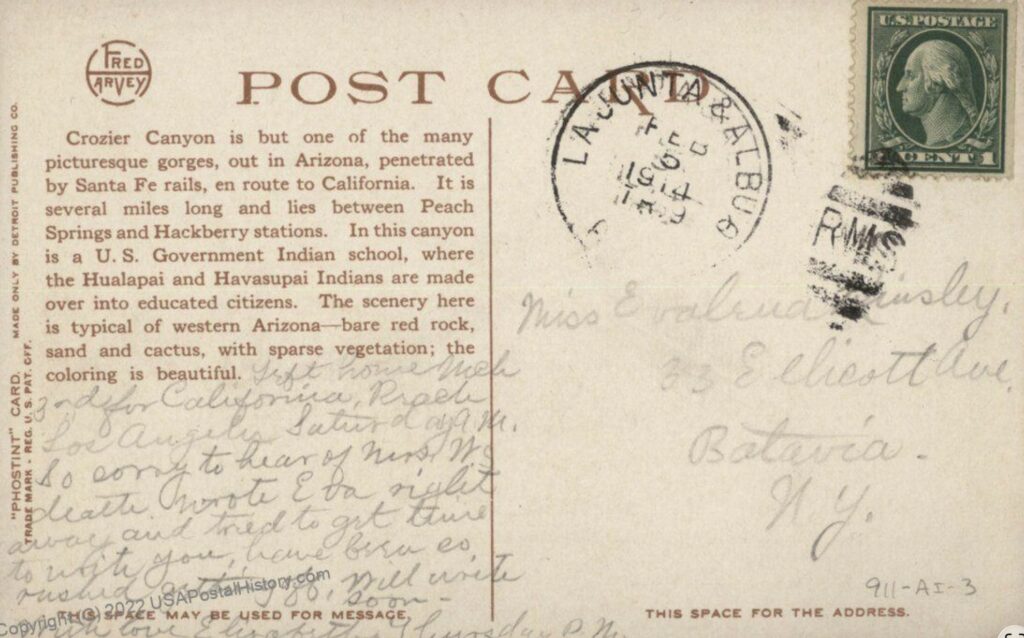
Some weeks back, I was looking at stamps and covers when I came across a postal cancellation made on a train. (See illustration at the bottom of this page.)
I filed the information away, as I do many blog hooks I come across, and pretty much forgot about it. I have a friend who is deep into railroading, so I planned to ask him about it when I saw him again.
Then this morning I received an email from Mystic Stamp Company talking about the Parcel Post issue of 1913. I love getting these emails from Mystic because they’re not just selling stamps (though they are) — they provide wonderful philatelic stories.
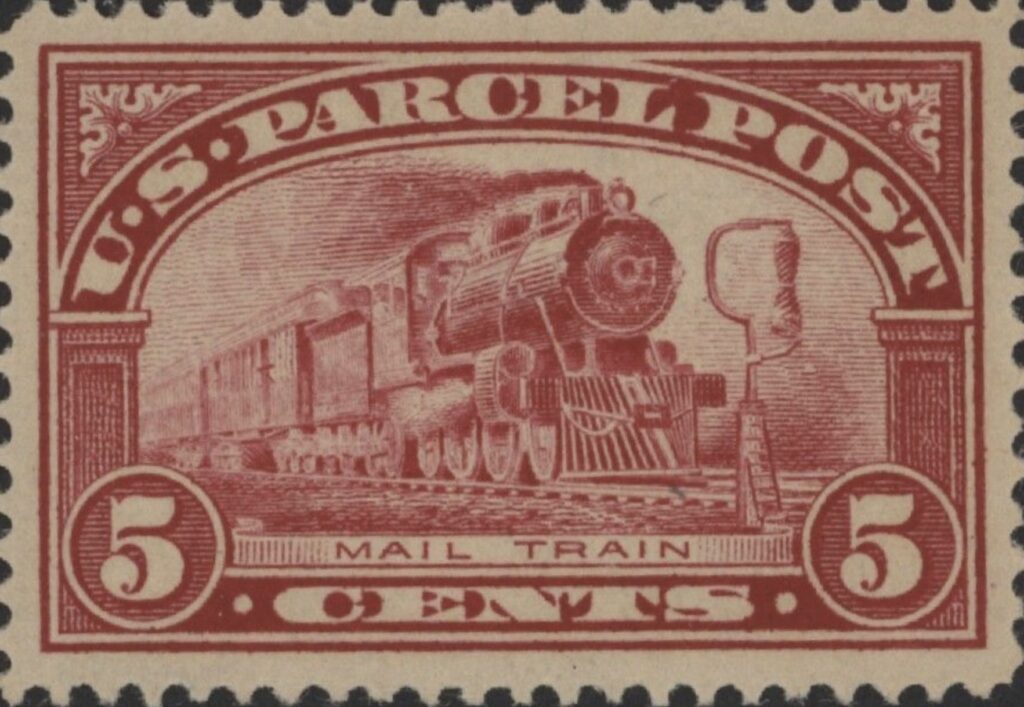
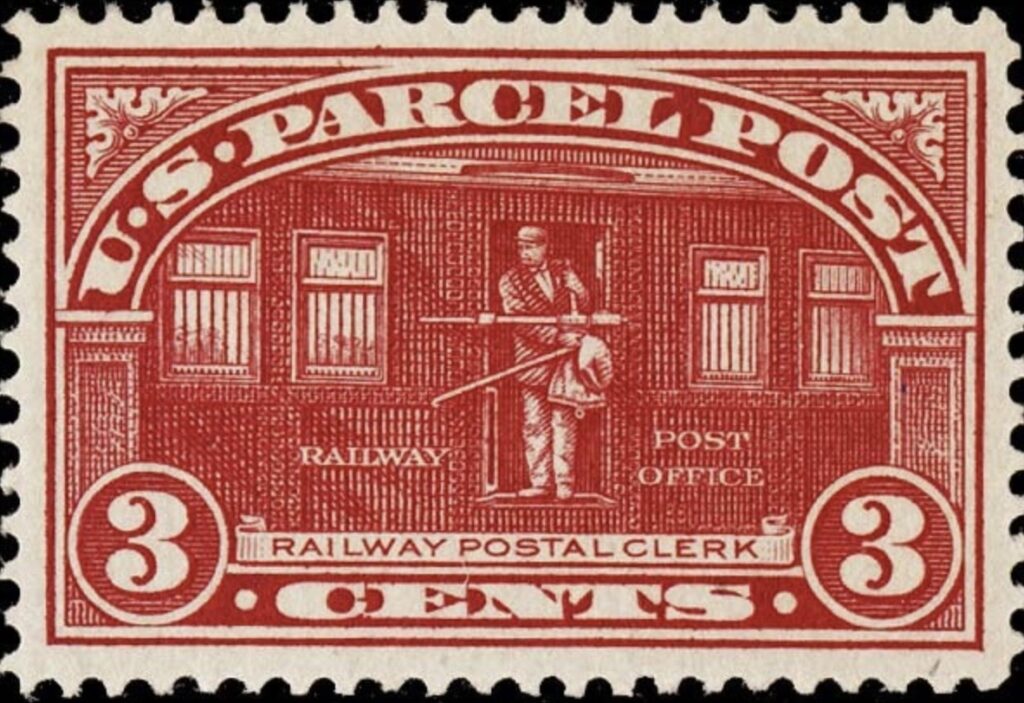
Among the 12 short-lived Parcel Post stamps were two that dealt with the Railway Mail Service, one featuring a mail train and one with a railway postal clerk. Both featured the most colorful aspect of the service: the trackside mailbag that could be grabbed without the train slowing.
That was a sign that it was time for an article, so here it goes:
For more than a century, some of the most skilled workers in the American postal system did their jobs standing up, in a swaying wooden or steel car, while a train roared through the dark at speed. They sorted mail into hundreds of pigeonholes, snatched mailbags off trackside cranes without the train ever stopping, and did it all with an accuracy that modern postal historians still marvel at. This was the Railway Mail Service, and for a hundred years it was a major part of American mail delivery.
An Idea Born of Necessity
The problem the Railway Mail Service solved was simple to state and hard to fix: Mail moved only as fast as it could be sorted, and sorting happened at fixed post offices, which meant letters sat idle while trains carrying them sped past.
The solution, pioneered in Britain in the 1830s with the Traveling Post Office, was to turn the railway car itself into a mobile post office. Clerks would sort mail while under way, so that by the time a train reached its destination, letters were already bundled for their next connection.
The idea crossed the Atlantic and took hold in the United States in the 1860s. A postal clerk named William A. Davis is generally credited with running the first American railway post office car, on the Chicago and North Western Railway in 1864, sorting mail between Chicago and Clinton, Iowa.
The experiment proved so effective that the Post Office Department formally established the Railway Mail Service in 1869, and RPO cars soon multiplied across the growing rail network. By the 1890s, thousands of clerks were working RPO routes, and railway mail sorting had become the standard method for moving first-class mail across the country.
Life Inside the Car
An RPO car was a working post office on wheels, typically occupying part or all of a baggage car, fitted out with sorting racks, pigeonholes for hundreds of destinations, and a small stove for cold nights. (The National Postal Museum has an interesting article on this, showing a cutaway view of a mail car.)
Clerks worked in cramped, jolting conditions, often standing the entire run, memorizing not just states and cities but the specific connecting trains and post offices each piece of mail needed to reach. The job demanded a prodigious memory: A clerk on a busy route might be expected to sort mail correctly for hundreds of towns without hesitation, since the train would not wait for a mistake to be corrected.
One of the more theatrical elements of the service was the mail crane, used on routes where a train would not stop at a small station. A pouch of outgoing mail was hung on a trackside crane, and as the train passed, a clerk leaning from the car door would snag it with an iron catcher arm, while simultaneously kicking off a pouch of incoming mail for that town.
Done at speed, in weather, at night, this maneuver was dangerous work, and RPO clerks were among the more frequent casualties of railroad accidents, since a derailment or collision struck the mail car with particular force given its position near the front of the train.
The Postmark Collectors Prize
For philatelists, the Railway Mail Service left behind one of the most collected categories of postal history: the RPO cancellation.
Each railway post office car carried its own canceling device, stamped with the names of the two terminal points of its route and often a direction indicator and a train or run number, such as “CHICAGO & OMAHA RPO” or “N.Y. & WASH. R.P.O.” These postmarks are prized today not merely as cancellations but as a genealogy of American railroading, since a collector can trace a route’s history through the wording changes, the discontinuation dates, and the eventual disappearance of a marking as a rail line was abandoned or a service consolidated.
Some collectors specialize entirely in a single state’s RPO markings, assembling what amounts to a postal map of a vanished rail network, one cancel at a time.
The Post Office Department itself recognized the significance of the service philatelically far less often than one might expect. Unlike other transportation milestones, the Railway Mail Service was rarely the direct subject of a commemorative stamp issue during its operating lifetime, and it is largely through the working cancellations themselves, along with later retrospective issues and postal history exhibits, that the service is remembered on paper.
Decline and Extinction
The Railway Mail Service reached its peak in the first decades of the 20th century, when passenger rail was still the dominant mode of long-distance travel and RPO cars ran on thousands of routes.
The service’s decline tracked the decline of American passenger rail itself. The rise of the automobile, the expansion of paved highways, and eventually the growth of domestic air mail after World War II all chipped away at the volume of mail that needed sorting on trains.
The Post Office experimented with Highway Post Offices, essentially RPO sorting operations transferred to specially built buses, as an interim measure on routes where rail service was thinning.
The final blow came from a combination of forces: the collapse of many passenger rail lines, the consolidation of the postal system into the U.S. Postal Service in 1971, and a broader shift toward centralized, mechanized mail sorting facilities that did not depend on a moving train at all.
The last railway post office run in the United States operated on June 30, 1977, between New York and Washington, D.C., bringing to a close a service that had, at its height, defined how quickly and reliably mail could move across a continent. (The Postal Museum offers a detailed history of the service.)
A Legacy in Cancellations and Memory
Today, the physical RPO cars themselves survive mostly in railroad museums, restored as static exhibits or occasionally operated on heritage lines.
But it is in the philatelic record that the service’s daily life is most fully preserved: thousands of distinct cancellation types, each representing a route, a run, a clerk’s working day, and ultimately a small piece of the vast, largely invisible infrastructure that once moved the nation’s correspondence at the speed of the rails.
These two envelopes below I found at Hipstamp, both from German Postal History, which is located in Colorado.