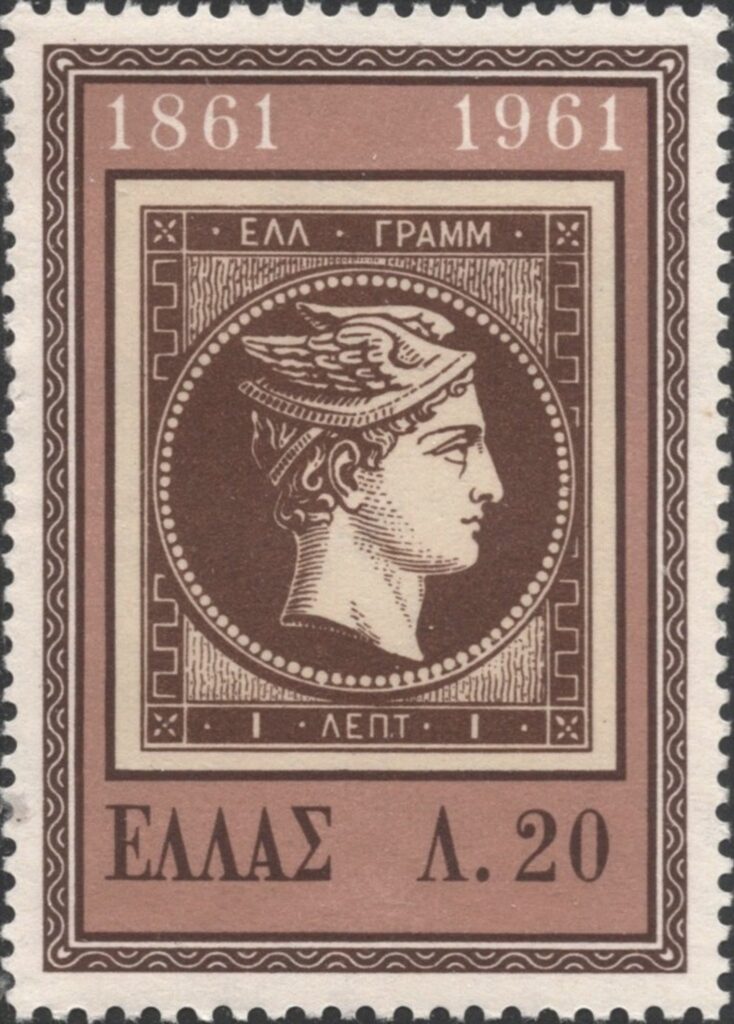
When Greece issued its first postage stamps on October 1, 1861, it chose not a king, not a coat of arms, and not a national emblem, but a god. Specifically, it chose Hermes — messenger of the Olympians, patron of travelers, and, fittingly, a deity long associated with the swift conveyance of news.
The choice was not accidental. It reflected both the aesthetic sensibilities of a young nation eager to align itself with the glories of classical antiquity, and a practical truth: No figure in the Greek pantheon suited the function of a postage stamp better than the god whose entire mythological purpose was to carry messages between realms.
Hermes was, from the earliest strata of Greek myth, the divine courier. Son of Zeus and the nymph Maia, born in a cave on Mount Cyllene in Arcadia, he was precocious to the point of mischief — the Homeric Hymn to Hermes tells of him stealing Apollo’s cattle on the very day of his birth, then charming his way out of punishment by inventing the lyre and offering it as tribute.
That combination of cunning, speed, and diplomacy became his defining character. Zeus made him herald of the gods, the one being trusted to move between Olympus, the mortal world, and even the underworld, a role that earned him the title psychopompos, guide of souls to Hades.
He alone among the gods could cross those boundaries freely, and it is that boundary-crossing swiftness — winged sandals (talaria), winged cap (petasos), and the herald’s staff or caduceus — that made him the natural visual shorthand for a postal service.
The caduceus itself deserves a note, since it so often gets confused with the medical symbol (which is properly the single-serpent staff of Asclepius). Hermes’ caduceus, with its two intertwined serpents topped by wings, was a herald’s wand, a mark of protected passage and safe conduct. (The first stamp was just the bust of Hermes, with winged cap. Later issues would include the caduceus.)
Heralds in the ancient world carried such staffs as tokens of diplomatic immunity, much as a flag of truce functions today. When postal administrations across Europe went looking for imagery to represent the transmission of mail, Hermes and his attributes were an obvious reservoir to draw from — France’s earliest allegorical stamp designs flirted with similar classical figures, and Hermes (as the Roman Mercury) appears on postal iconography from Belgium to South America.
But Greece had a stronger claim than most: This was, quite literally, home turf. The god was not an imported classical allusion but a native son, and placing his head on the nation’s first stamps was as much an act of cultural reclamation as design convenience, only decades after Greek independence had been won from Ottoman rule in 1830.
Features the Large Hermes Heads
Those first stamps, issued in 1861, are known today to collectors as the “Large Hermes Heads,” [the link is slow loading, but offers a wealth of details] a series that would run in various printings for over a decade, into the 1880s. They depicted a profile bust of Hermes wearing the petasos, engraved in a neoclassical style influenced heavily by French stamp engraving of the period — indeed, the dies were prepared in Paris, a common practice for young postal administrations lacking their own security-printing infrastructure.
The image was based on an ancient sculptural type, echoing the Hermes of Praxiteles and similar classical busts, which gave the stamps a slightly severe, marble-like quality rather than a naturalistic portrait. Denominations were issued in lepta, the subdivision of the drachma, and the stamps came in a range of colors that have since become a happy hunting ground for specialists, since many printings, papers, and shades exist, some quite rare.
It is worth situating this moment in the broader arc of postal history. Greece was a comparative latecomer to adhesive postage — Britain’s Penny Black had appeared in 1840, and by the time Athens got around to it in 1861, dozens of countries and states had already adopted the stamp as the mechanism for prepaying mail.
A young, struggling Greece
The delay had practical causes: Greece in the 1830s to 1850s was a young, financially strained kingdom still consolidating its territory and institutions after the War of Independence, and a modern postal apparatus was one of many nation-building projects competing for attention and money.
When the system finally arrived, however, it arrived with clear intent to project a certain image of Greece to the world — not the Greece of Ottoman-era provincial towns, but the Greece of Pericles and Praxiteles, the wellspring of Western civilization. A stamp is a small thing, but it is also a kind of national calling card, seen by foreign postal clerks and collectors far beyond one’s borders, and the Hermes Heads served that function admirably.
The Large Hermes Heads were eventually followed by the “Small Hermes Heads” in the 1880s, a redesign with a smaller, more delicate central vignette, and Hermes continued to appear, in various guises, on Greek philatelic material for decades afterward.
But it is those first Large Hermes Head stamps of 1861 that hold the historical distinction: Greece’s entry into the age of pre-paid postage, wrapped in the image of the one god whose whole mythic identity was, from the start, about getting a message where it needed to go.
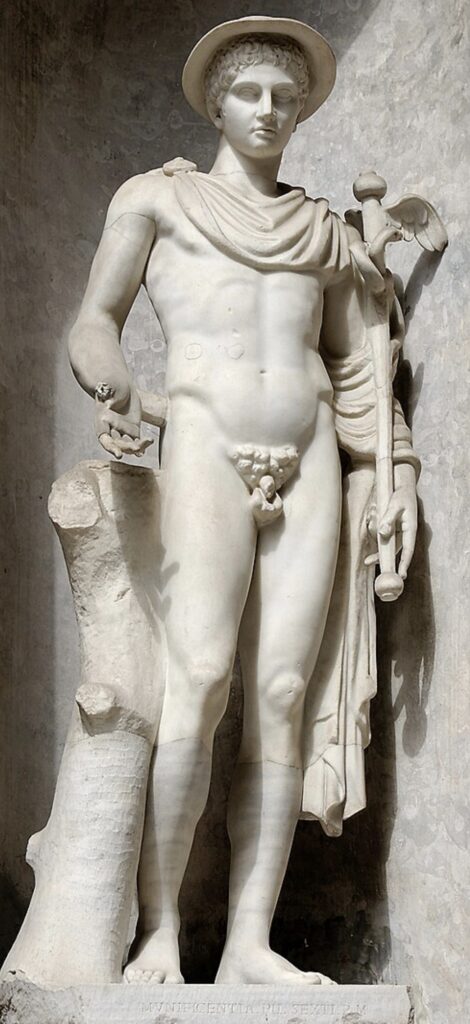
The image at the right is Hermes Ingenui from the Vatican Museums. It’s a Roman copy of the second century BC after a Greek original of the 5th century BC. Here you see the caduceus, the round hat (not winged) and a traveler’s cloak. This image is from Wikipedia.
1 thought on “Hermes and the First Greek Stamps”