A Saint Who Made Charity Practical
Long before “social work” was a profession, there was Vincent de Paul.
Born in 1581 in a small village in southwestern France, Vincent was ordained a priest in 1600 and, after a winding early career that even included a period of captivity at sea, found his life’s purpose serving the rural and urban poor of France. He founded the Congregation of the Mission in 1625 to train priests for work among peasants, and in 1633, together with Louise de Marillac, he established the Daughters of Charity — the first community of women religious to work actively in the world rather than behind convent walls.
Earlier still, in 1617, he had organized the Confraternities of Charity, lay groups (mostly wealthy women) dedicated to caring for the sick and poor near Lyon. Vincent died in Paris in 1660, was canonized in 1737, and was later named the patron saint of all charitable works — a fitting title for a man whose genius was turning compassion into organized, sustainable action.
A Student’s Challenge Becomes a Global Movement
The Society that carries Vincent de Paul’s name, however, was not founded by the saint himself — it arose nearly two centuries after his death. In 1833, a 20-year-old law student at the Sorbonne named Frédéric Ozanam was challenged by a classmate during a debate: Catholics could point to the Church’s glorious past, the critic said, but what were they actually doing for the poor of Paris now?
Stung by the question, Ozanam gathered six friends and, under the guidance of Emmanuel Bailly and a Daughter of Charity named Sister Rosalie Rendu, formed the first “Conference of Charity” on April 23, 1833. The young men visited poor families in their homes, financing their efforts out of their own pockets. They soon adopted Vincent de Paul as their patron and took his name.
The idea spread with remarkable speed. Within a few decades, conferences had appeared across Europe, and by the early 20th century the Society counted thousands of conferences and well over 100,000 members worldwide. Today the Society of St. Vincent de Paul operates in roughly 150 countries with close to a million members and volunteers, making it one of the largest lay Catholic charitable organizations on earth.
Its method has changed little since Ozanam’s day: small groups of volunteers, organized into local “conferences,” visit those in need directly, building personal relationships rather than simply distributing aid from a distance.
The Society Takes Root in Colombia
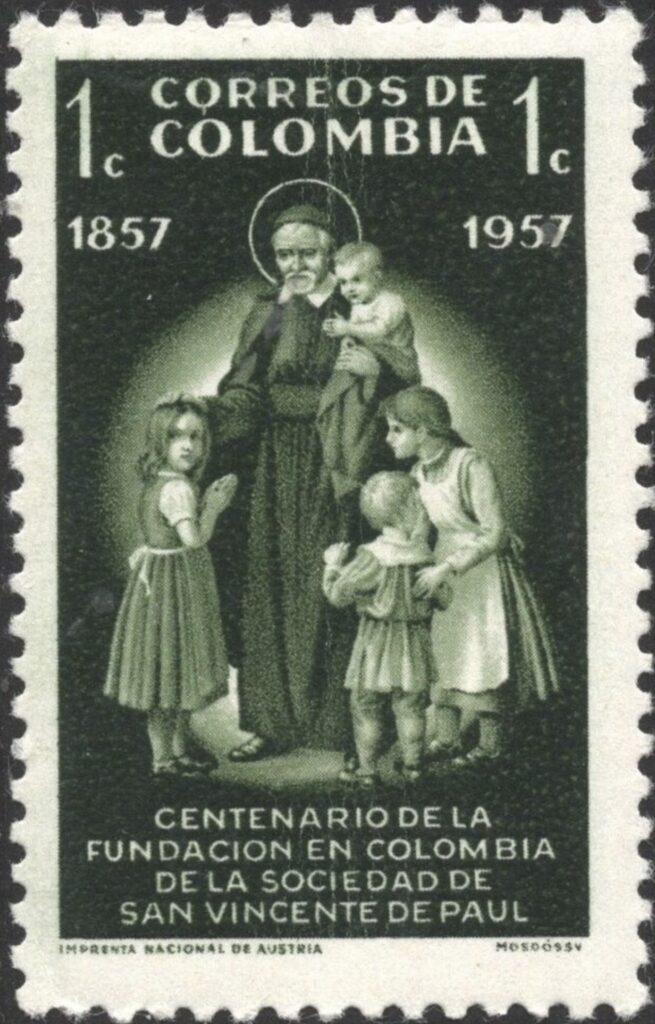
The Society’s arrival in Colombia came just 24 years after its founding in Paris. On October 18, 1857, a young Bogotá lawyer named Mario Valenzuela — inspired by Ozanam’s example — founded the Sociedad San Vicente de Paúl in the Colombian capital together with six companions and Dr. Jorge Víctor Eyzaguirre.
Valenzuela, born in Bogotá in 1836, had studied under the Jesuits and gone on to study philosophy and law at the National University before turning his energy toward organized charity.
From Bogotá, the Society spread quickly to other towns and cities, including Socorro and Cali, and reached Medellín in 1882, where local elites — among them future presidents and prominent businessmen — established a conference that remains the country’s second-largest to this day.
As in France, growth in Colombia accelerated through the late 19th century. In 1893, a National Superior Council was established in Bogotá to coordinate the growing number of conferences springing up across the country, carrying the Vincentian charism from the major cities into smaller, more remote communities.
The Society eventually received formal legal recognition from Colombia’s Ministry of Justice as a national organization through Resolution No. 4111 of August 1, 1974, cementing its institutional standing after more than a century of grassroots work. Today the Society is present in 24 of Colombia’s 33 departments, with active conferences from Bogotá and Medellín to smaller cities such as Sonsón, each operating with a degree of local autonomy while sharing the same international rule and spiritual foundation.
A Century and a Half of Service
The 20th century brought significant programmatic expansion, particularly in Bogotá. In 1954, the Society founded the Hogar Infantil Camitas Blancas, a children’s home that today cares for more than 220 boys and girls. Over the following decades, additional programs emerged to serve different vulnerable populations: the Jornadas Alternas Mario Valenzuela and Mi Casita initiatives, which provide supplementary education to thousands of at-risk children, and the Hogar Tercera Edad, which offers comprehensive care for the elderly.
In Medellín, the Society — now well over 140 years old — describes itself as the city’s oldest charitable institution still in operation, continuing to center its mission on what it calls “human promotion”: not just relieving immediate suffering but addressing its underlying causes.
That philosophy traces directly back to Ozanam’s founding insight in Paris — that charity meant more than almsgiving; it meant building a genuine, personal relationship with those in need. Colombian Vincentians have applied that insight to their own context, responding over the decades to civil conflict, urban poverty, and the needs of children, families, and the elderly across a famously diverse and at times difficult national landscape.