This is the topic I hate most!
I’ve been watching the three movies filmed in the teens to tell the epic story of Ayn Rand’s “Atlas Shrugged.” The key phrase that has the audience intrigued is: “Who is John Galt?” The answer, based on her 1957 novel of libertarianism, or objectivism, is what everyone is waiting for.
My own bio carries far less gravitas.
But as I am frequently told, I must respond in a way that will encourage folks to read why I am writing. So here goes. In the third person.
Here we go
Gary was born in Cochise County in 1953, shortly before the Lavender pit started producing copper. The family home at that time was literally within rock-throwing distance of the Mexican border.
Bisbee was booming because the pit added incremental production for the mines and because Fort Huachuca had been reactivated for the Korean war, or conflict, if you prefer.
The town was mostly blue collar and held great amounts of political power. It’s fascinating to read about Bisbee’s role in the rebirth of Fort Huachuca. That was before the “one-man, one-vote” decision of the U. S. Supreme Court in 1964.
The schools were not just good; they were excellent. They may well have been the best in the state. With a plethora of independent businesses, organizations flourished and got things done. Gary went on to the University of Arizona via a scholarship furnished by George Gregson (née Gregovich), a Bisbee boy and UA graduate who went on to make a fortune in Beverly Hills real estate.
No to nuclear engineering
Gary started his UA classes in nuclear engineering, but lost a battle with physics (optics in particular) and moved on over to journalism. It was something he knew a bit about, having worked as sports editor of the Bisbee Daily Review while a senior in high school.
When he left for college, the mines were running and gunning, but when he returned, they had been closed, leaving Bisbee permanently changed and debilitated. He went to work as sports editor of the tri-weekly Sierra Vista Herald and soon moved on to be editor of the Bisbee Review (a weekly by that time), which was owned by the Wick family. He was involved in the merger of those two papers to create a combined daily, which lasted until only recently.
In 1980, he was hired by Bill Epler to write for PAY DIRT, a news magazine that covered the Arizona mining industry. Epler needed more horsepower as he planned to start more regional editions. Before long, there were four monthly magazines covering the entire West.
Also, the two men created a monumental edition of the magazine that commemorated a century of Phelps Dodge’s presence in the copper industry. This was Gary’s first introduction to local history and the impact it has on understanding the present. He was hooked!
In the mid-1980s, there was a recession in the copper industry and Gary left Bisbee for Phoenix, to edit a construction magazine there. That didn’t last, as you would expect; a small-town boy just couldn’t tolerate the city. After a couple of years, he returned to his roots, as editor of the Douglas daily newspaper and then the weekly paper in Safford. Before long, he was back in Bisbee, where Epler had started Bisbee’s third newspaper at the time.
Back to PAY DIRT
He soon moved back to editing PAY DIRT, which was contracting from its ambitious four editions. Soon it would start to feel the effects of the internet on the printed publication industry.
In 1993, he married Margaret and new avenues of interest opened up. An entrepreneur at heart, she started her own businesses. It gave her the opportunity to work and at the same time take care of children. Their son Thomas literally grew up hearing about marketing from Margaret and listening to history presentations from his father. (Margaret is a nomad at heart and now spends much of her time in a Winnebago traveling, particularly around the Midwest. You can follow her on her blog Aroundthemidwest.com. Gary and Margaret are now divorced.)
Gary did many types of work, including spending a year writing weekly installments of a centennial history of the Bisbee Review. He wrote and published numerous booklets on Bisbee history, all of which are out of print, and lectured frequently on that subject. He also was an instructor for the local Elderhostel (today Road Scholar), covering the borderlands and Mexico.
The couple also did a television show on the local cable channel, “Focus on Bisbee,” which lasted several years until there were too few cable customers as satellite took over. When Tom and Ginger Mosier started Lavender Jeep Tours, Gary guided those tours off and on over the years, and would continue until a few years ago, when health issues forced his (unwilling) retirement. For almost a decade, he edited an economic-development newsletter, and for many years did research on the banking industry.
Over his years in Bisbee, Gary has served on the Bisbee City Council, the board of the Bisbee Mining & Historical Museum, the board of the Copper Queen Community Hospital and other community organizations.
Now in the doldrums of ‘20s, he is able to devote more time to writing Bisbee history, a passion with almost endless potential.
Interest in stamps
(And here I move into first person.)
I got my original interest in stamps from my maternal grandmother. We were visiting one summer when I was about 7 years old and she pulled out a scrapbook she had kept during World War II and the years immediately thereafter. In it, she had newspaper clippings about major events and, where they fit in, she had affixed postage stamps from the era. (Read this for one example.)
I was fascinated. And hooked! They weren’t just old stamps — they were story-tellers. They complemented newspaper articles and went far beyond in the imagination of a little boy!
A few years later, when she thought I was old enough to both appreciate and care for the album, she gave it to me. I just about wore it out looking at it. And I must have talked about it, because a family friend had me look after her dogs while she was on vacation, and as thanks, she brought me several plate blocks of the current postage stamps. I still have them, too!
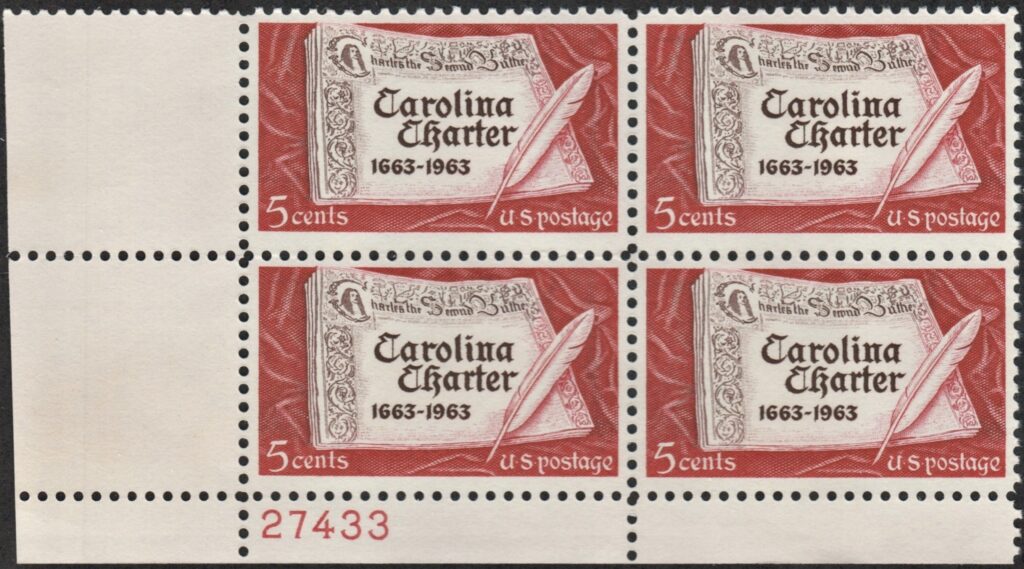
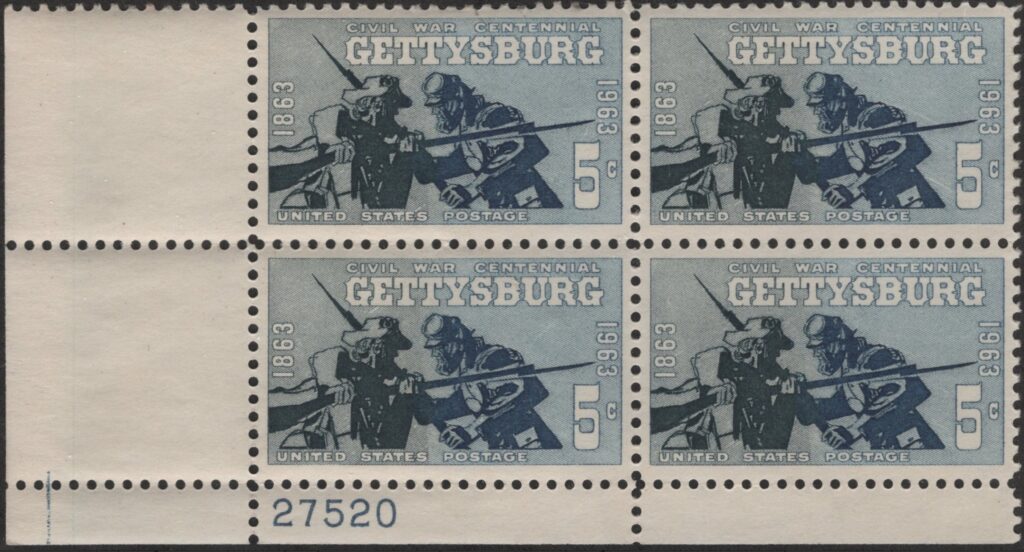
This was in 1963, when I was about 10 years old. Among those stamps were the Carolina Charter, West Virginia Statehood and Blue and Gray at Gettysburg. The subjects covered by these new stamps also were covered in our newly acquired Encyclopedia Americana. Which got great usage.
This was the beginning. Not much more happened for many years — note that I didn’t have to pay for my earliest “acquisitions.” When I got a good job in Phoenix when I was in my 30s, I found a great stamp store and — now with an income — started buying. Still, it wasn’t for investing. It was for the stories.
Later in life I got a job — Jeep tour driver — where I received tips, and some of that income went into stamps. By now the internet was in full swing, and the opportunity for acquiring and learning about stamps was endless. I didn’t just buy stamps willy-nilly, however. When I saw one that was attractive, I’d research the subject. If what I learned was of interest, I’d make the purchase.
That when I got the idea of publishing my writing about postage stamps. I’m a lifelong journalist and enjoy writing, so why not write about something I wanted to write about instead of something I had to write about!
It’s taken quite a few years to get here, but after several false starts, I’m slowly mastering the technology needed to make that happen. And loving it!
I hope you will enjoy these stamps stories as much as I do.
(For a bit more on this subject, please visit the About this Site page.)